Defender Downdraft Tables: Four Configurations for Welding and Grinding Work
Defender tables range from a single-user 4×3 station to a 4×9 flat table rated at 9,000 CFM, with layouts for shared work and weld training.
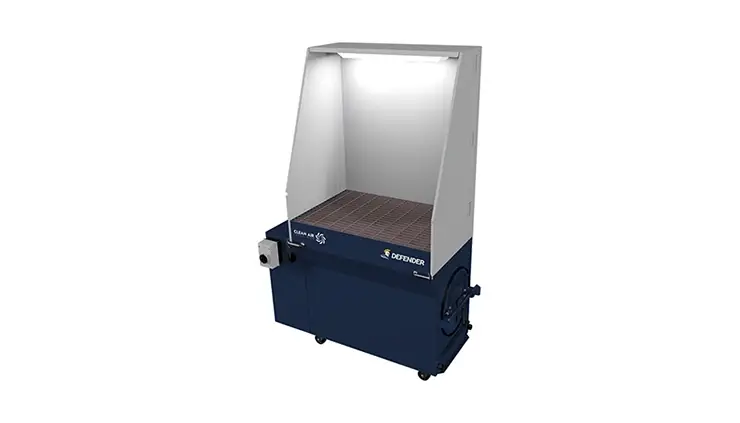
Table layout changes how a welding or grinding station handles workpieces, users and visibility. Clean Air Industries describes four Defender Industrial Downdraft Table arrangements: a compact station for one user, a shared 4×6 workstation, a flat 4×9 table for larger parts, and a 4×6 setup for weld training. The largest configuration is specified at 9,000 cubic feet per minute (CFM); the other configurations in the description have no airflow figures stated.
Match the work surface to the task
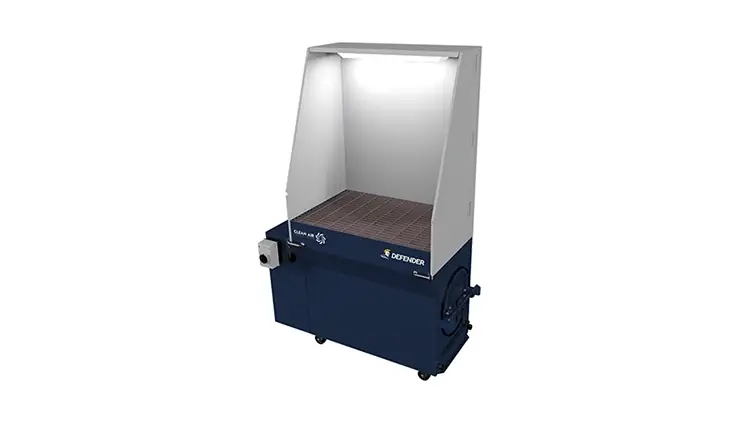
The DDT 4×3 is the compact option. It has side and back walls and is intended for a single user. Those walls define the working area around the table, while the downdraft surface draws weld fume and dust from the work area. For a station dedicated to one person and a smaller footprint, this arrangement is the simplest of the four described.
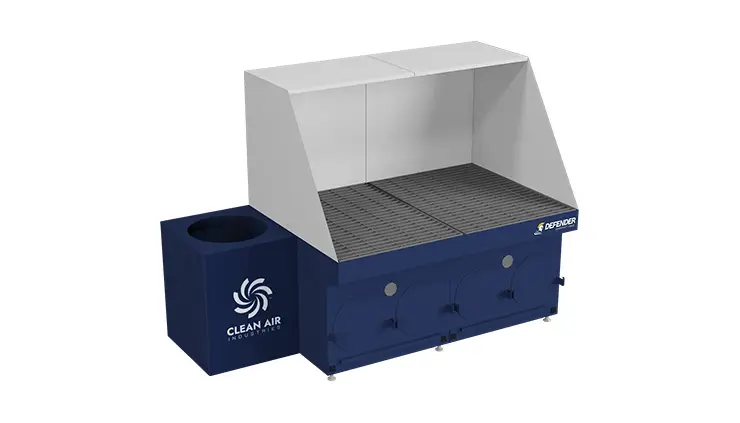
The DDT 4×6 adds sidewalls and a middle partition. Clean Air Industries says this arrangement can accommodate up to four users at a time, or serve as a multi-use workstation with different equipment set up across the table. The partition divides the surface into work zones, which can help organize concurrent tasks. The material provided doesn’t specify the dimensions of each zone, permitted equipment, or how airflow is distributed between users; those details matter when planning a particular process.
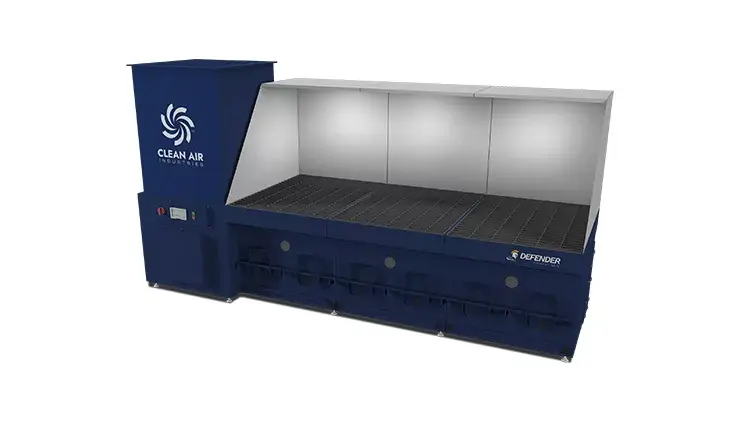
For larger workpieces, the DDT 4×9 uses a flat configuration that allows overhead loading. Its stated airflow capacity is 9,000 CFM. A flat surface gives operators room to place larger parts without the side and back walls of the smaller arrangement defining the working area. Overhead loading can also suit work that is awkward to maneuver into a more enclosed station. The description doesn’t state the part size or mass the table can accommodate, so those limits need to be confirmed for the intended application.
Training layout keeps the work visible
The fourth example is a DDT 4×6 configured with sidewalls and viewing windows for weld training. The windows give an instructor a view of a student’s performance while the work takes place at the table. That visibility is a practical distinction from a standard partitioned workstation: the layout can support observation without requiring the instructor to stand directly over the work surface.
Clean Air Industries doesn’t specify window dimensions, materials, or whether the training arrangement changes the table’s airflow performance. Facilities considering this setup will need to check those details against their welding processes and room layout. The key design point is that visibility is built into the workstation configuration rather than treated as a separate observation position.
Airflow and system choice
The configurations are presented as ways to capture weld fume and dust at the work surface. In practical terms, the table dimensions and partitions affect how the station fits into a work area and how users share its surface; airflow and filtration must also suit the application. The only airflow figure given for these industrial configurations is 9,000 CFM for the DDT 4×9. No capture velocity, filter specification, noise level, or test conditions are provided, so those values shouldn’t be inferred from the CFM rating alone.
Clean Air Industries lists self-contained industrial tables in 4×3, 4×6 and 4×9 sizes, with airflow up to 9,000 CFM. It also offers ducted Defender tables designed to connect to dust collector systems. The company describes ducted tables as a cost-effective option where multiple tables are required. Choosing between self-contained and ducted equipment depends on the facility’s collection arrangement and the number of stations; the supplied description gives no comparative installation or operating costs.
For smaller work, the company also lists a portable 2×3 Defender downdraft table rated at 1,200 CFM, intended for weld fume and grinding dust capture. That compact unit is a separate product size from the industrial 4×3, 4×6 and 4×9 configurations, and its airflow figure shouldn’t be applied to those larger tables.
Configuration is part of workstation planning
These examples frame the choice around three concrete requirements: how many people share the surface, how large the workpieces are, and whether an instructor needs a clear view. A 4×3 with side and back walls is aimed at one user; a partitioned 4×6 supports a shared or multi-use layout; and a flat 4×9 provides overhead access for larger parts. The training version of the 4×6 adds viewing windows.
Those arrangements are starting points rather than complete application specifications. Before selecting a table, a facility should confirm the required airflow and filtration for its process, the actual workpiece envelope, and how the table will connect to the facility’s collection system. Clean Air Industries says custom configurations are also possible, but doesn’t list their dimensions or options in the description.
Defender Industrial Downdraft Tables
Defender Ducted Downdraft Tables
 AMD Venice Uses 2.5D Packaging to Feed More Bandwidth Into EPYC Zen 6
 CNC Controller Board Design: Interfaces, PCB Specs and Assembly Testing
 Stratasys and Nano Dimension End $42.5 Million Markforged Sale Agreement