Stratasys and Nano Dimension End $42.5 Million Markforged Sale Agreement
The planned sale ends after approval costs and timing exceeded expectations, leaving Nano Dimension without a key restructuring step.

The planned $42.5 million sale of Markforged from Nano Dimension to Stratasys has ended, leaving both additive manufacturing companies with different strategic questions. Nano Dimension loses a transaction it had tied to lower cash use, while Stratasys gives up a route to add Markforged’s continuous carbon fiber printers and Digital Forge software to its product portfolio.

The companies mutually terminated the agreement after concluding that required approvals would take “materially longer” and cost more “than initially anticipated,” according to Nano Dimension’s filing. It did not identify the approval process, the jurisdictions involved or the expected additional expense. Those omissions make it difficult to assess whether the obstacle was specific to one market or reflected a broader delay in completing the transaction.
The timing matters. Just days before the termination, Nano Dimension’s third-quarter 2026 results described the sale as ongoing and expected to close in the fourth quarter. The company did not hold an earnings call, citing “ongoing strategic initiatives.” The change leaves shareholders, customers and suppliers without a stated timetable for what Nano Dimension intends to do with Markforged next.
Markforged’s weight in Nano Dimension’s business
Markforged is more than an asset Nano Dimension had planned to sell. It generated $18.6 million of Nano Dimension’s $31.9 million in third-quarter 2026 revenue, making it the largest product line by sales in that period. Retaining the business therefore preserves a substantial source of revenue, while also keeping its costs and cash requirements within Nano Dimension’s operations.

The sale was projected to reduce annual cash burn by roughly $15 million. That figure points to the central trade-off: disposing of Markforged could have lowered recurring cash use, but would also have removed a major contributor to quarterly revenue. With the transaction terminated, the expected reduction cannot be counted on as part of the company’s plan. Nano Dimension has not identified a replacement transaction or explained how it will pursue the same cash reduction without the sale.
Markforged makes metal and carbon fiber 3D printing systems. Its Continuous Carbon Fiber platform and Digital Forge software were among the assets Stratasys expected to bring into its wider network. For industrial users, the proposed combination was relevant because it joined printing hardware and software with a larger set of customer and partner relationships. The agreement’s termination means that portfolio combination will not proceed under this deal; it does not, by itself, indicate any change to Markforged’s products or customer support.
Leadership changes add uncertainty
Nano Dimension’s direction has shifted during the period surrounding the sale. Its previous board had announced a non-binding term sheet for a $890 million combination with Infinite Epigenetics, a company focused on AI health and diagnostics. That proposal would have taken Nano Dimension away from 3D printing. The sale of Markforged to Stratasys formed a separate part of the company’s plans, but the two transactions show how sharply its strategic options have changed.

Then-CEO David Stehlin and several board members resigned in July after a settlement with activist investor Murchinson Ltd. Board member Moshe Rozenbaum became interim CEO and was appointed permanently to the role on November 3. The leadership changes matter because decisions about Markforged’s future now sit with a different management team than the one that began the sale process. Nano Dimension has not said whether the new leadership will seek another buyer, retain the business as a core operation or revise its broader plans.
Stratasys loses an expansion path
For Stratasys, the agreement had offered a way to add Markforged’s continuous carbon fiber technology and Digital Forge software to its existing network. CEO Yoav Zeif had said the acquisition would “immediately reinvigorate revenue growth,” with particular emphasis on aerospace customers. That growth opportunity is now off the table through this transaction.
Stratasys ended the third quarter of 2026 with $210.7 million in cash and no debt. Its aerospace revenue grew 35% year over year in the same quarter, indicating that the segment was expanding without the Markforged portfolio. That performance does not show what the acquisition might have added, but it gives context for the company’s position as it steps away from the purchase.
The immediate operational picture is therefore clearer for Stratasys than for Nano Dimension: the acquisition will not close, and Stratasys keeps its cash available for other needs. Nano Dimension, meanwhile, retains a business that produced more than half of its third-quarter revenue while losing a planned means of reducing annual cash use. Its next stated decision will determine whether Markforged remains central to the company’s additive manufacturing strategy or returns to the market as a possible sale candidate.
For engineers and industrial customers, the termination changes the ownership outlook around Markforged’s technology, but the available details do not establish a product, service or availability change. The practical point to watch is whether Nano Dimension sets out a new operating plan for the business—and whether that plan supports continued investment in its printing systems and software.
 AMD Venice Uses 2.5D Packaging to Feed More Bandwidth Into EPYC Zen 6
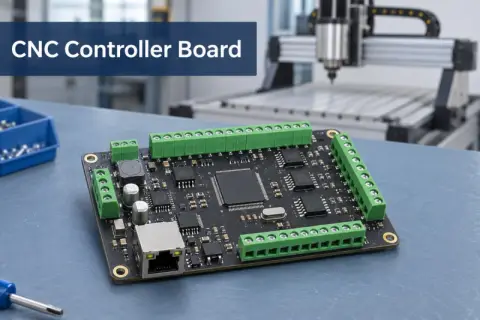 CNC Controller Board Design: Interfaces, PCB Specs and Assembly Testing
 Xometry Q3 2026 Revenue Reaches $252.4 Million as Marketplace Margins Rise