Xometry Q3 2026 Revenue Reaches $252.4 Million as Marketplace Margins Rise
Xometry reports 40% year-over-year revenue growth, its first quarterly GAAP profit and higher 2026 revenue guidance.

Xometry’s third-quarter results point to a digital manufacturing marketplace gaining both volume and operating leverage. Revenue reached $252.4 million, up 40% year over year, while the company reported its first quarterly GAAP net profit: $1.9 million. The quarter’s revenue, extrapolated across 12 months, represents a run rate above $1 billion; it is not revenue already earned during 2026.

Profitability improved alongside growth. Adjusted EBITDA increased to $21.4 million from $6.1 million a year earlier, and its margin rose to 8.5% from 3.4%. The company had recorded a $5.3 million net loss in Q2 2026 and an $11.6 million loss in Q3 2025. CFO James Miln attributed the improvement to revenue growth, higher marketplace gross margins and operating efficiencies. Non-GAAP operating expenses rose 17% year over year, slower than revenue.
Marketplace volume and margins lead growth
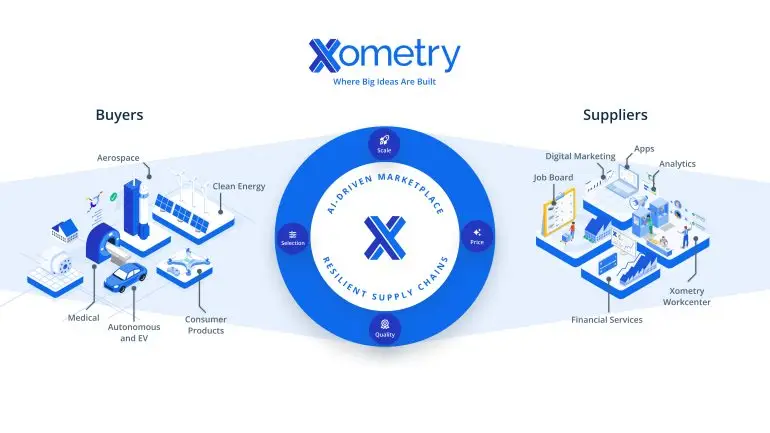
The marketplace connects buyers with suppliers offering processes that include additive manufacturing, CNC machining and injection moulding. Xometry does not report additive manufacturing revenue separately, so its results show the scale of the broader custom manufacturing business rather than the performance of any one process.
Marketplace revenue was $238 million, up 42.9% year over year and 10.5% from Q2. Marketplace gross profit reached $85.7 million, an increase of 44% year over year and 14.6% quarter over quarter. Gross margin set a quarterly record of 36%, compared with 35.7% in Q3 2025 and 34.7% in Q2 2026.
| Revenue segment | Q3 2026 | Q3 2025 | Q2 2026 | Year-over-year change | Quarter-over-quarter change |
|---|---|---|---|---|---|
| Marketplace | $238 million | $166.6 million | $215.4 million | +42.9% | +10.5% |
| Supplier services | $14.4 million | $14.1 million | $13.9 million | +2.1% | +3.6% |
| Total | $252.4 million | $180.7 million | $229.3 million | +39.7% | +10.1% |
Buyer activity grew across the customer base. Active marketplace buyers rose 20% year over year to 93,812, with 4,255 net additions during the quarter. The number of accounts spending at least $50,000 over the previous 12 months climbed 26% to 2,172, including 6.5% growth from Q2. Miln said revenue per active buyer increased 19% year over year, mainly because existing customers spent more; revenue from the largest customers grew by more than 40%.
Xometry linked marketplace performance to increased enterprise demand and changes to its pricing and sourcing models. CEO Sanjeev Singh Sahni said most buyer traffic had moved to a redesigned e-commerce platform. The company also introduced one-click reordering and added more than 100 materials to its Instant Quoting Engine. For buyers, those changes are aimed at shortening the path from specifying a part to receiving a quote or repeating an order.
Supplier services, which include advertising, marketing, financial products and software services tied in part to Thomasnet, generated $14.4 million. That was 2.1% above the year-earlier quarter and 3.6% above Q2. The segment’s slower growth compared with the marketplace means the latest expansion was concentrated in transactions between buyers and manufacturing suppliers.
Supplier tools and purchasing integrations
Xometry updated its Workcenter platform for manufacturing suppliers, following the introduction of AI sourcing models in July. Workcenter brings job opportunities, supplier performance scores and payment information together. Its updated Job Board adds filters, an on-screen 3D viewer and a drawing review tool so a supplier can examine a job’s requirements before accepting it.
Sahni said suppliers have accepted work faster since the update and that more jobs are reaching a suitable manufacturing partner on the first offer. The company’s global network includes more than 5,000 active suppliers. Matching accuracy matters to a marketplace model because an unsuitable initial offer can add time before a buyer’s part reaches a capable shop.
The company also expanded its TradeCentric integration to automate purchase orders and invoices, building on an existing PunchOut connection. Xometry says the system connects its marketplace to more than 220 eProcurement solutions, including SAP Ariba, Coupa and Microsoft Dynamics. The practical aim is to reduce manual purchasing and billing steps for organizations using those systems.
A separate collaboration with Siemens is intended to bring Xometry manufacturing prices and manufacturability data into Siemens Designcenter. Sahni said a beta launch is expected in Q1 2027, with customer rollout planned gradually during the year. Xometry’s enterprise strategy also builds on its 2021 acquisition of Thomas, an industrial sourcing and digital marketing platform purchased for approximately $300 million.
Higher revenue and EBITDA outlook
Xometry raised its full-year 2026 revenue growth outlook from 33%–34% to at least 37%, with marketplace growth expected to be approximately 41%. For Q4, it forecast revenue of $254 million–$256 million, equivalent to 32%–33% year-over-year growth and approximately 0.6%–1.4% sequential growth. Marketplace revenue is expected to rise about 35%–36% year over year; supplier services revenue is forecast to be flat to slightly higher.
Full-year adjusted EBITDA guidance increased to $68 million–$68.5 million, approximately $7 million above the prior outlook. The Q4 forecast is $22 million–$22.5 million, compared with $8.4 million in Q4 2025. Management said it continues to target an incremental adjusted EBITDA margin of at least 20% above the $1 billion revenue run rate, and expects to provide detailed 2027 guidance with its Q4 results.
US revenue rose 41% year over year to $213.4 million, while international revenue increased 32% to $39 million. The international segment narrowed its adjusted EBITDA loss from $4.2 million to approximately $597,000. Miln cautioned that the improvement partly reflected one-time expense factors that are expected to balance out in Q4. The next results will show whether marketplace growth and higher margins can continue as the company absorbs those costs.
 AMD Venice Uses 2.5D Packaging to Feed More Bandwidth Into EPYC Zen 6
 CNC Controller Board Design: Interfaces, PCB Specs and Assembly Testing
 Stratasys and Nano Dimension End $42.5 Million Markforged Sale Agreement