Arkema and Carbon Expand UV-Curable Elastomer Work for 3D-Printed Footwear
Arkema supplies scalable UV-curable chemistry for Carbon’s DLS elastomers, supporting lattice products such as Vivobarefoot’s 91-gram custom sandal.

The practical test for 3D-printed footwear is whether a material can move from a tuned lattice on screen to consistent parts at production volume. Arkema and Carbon are extending work that has lasted more than 13 years, dividing the materials task between Arkema’s specialty UV-curable chemistry and scale-up capability and Carbon’s elastomer development for its Digital Light Synthesis (DLS) platform.

That division matters because a lattice’s behavior depends on both its geometry and the resin that forms it. Carbon’s customers can adjust lattice structures to target cushioning, support and energy return. Those properties suit midsoles and protective padding, as well as other consumer products where deformation under load is part of the design. The companies say brands in footwear, fashion and lifestyle are using the technology to develop products for retail.
Separating chemistry from elastomer formulation
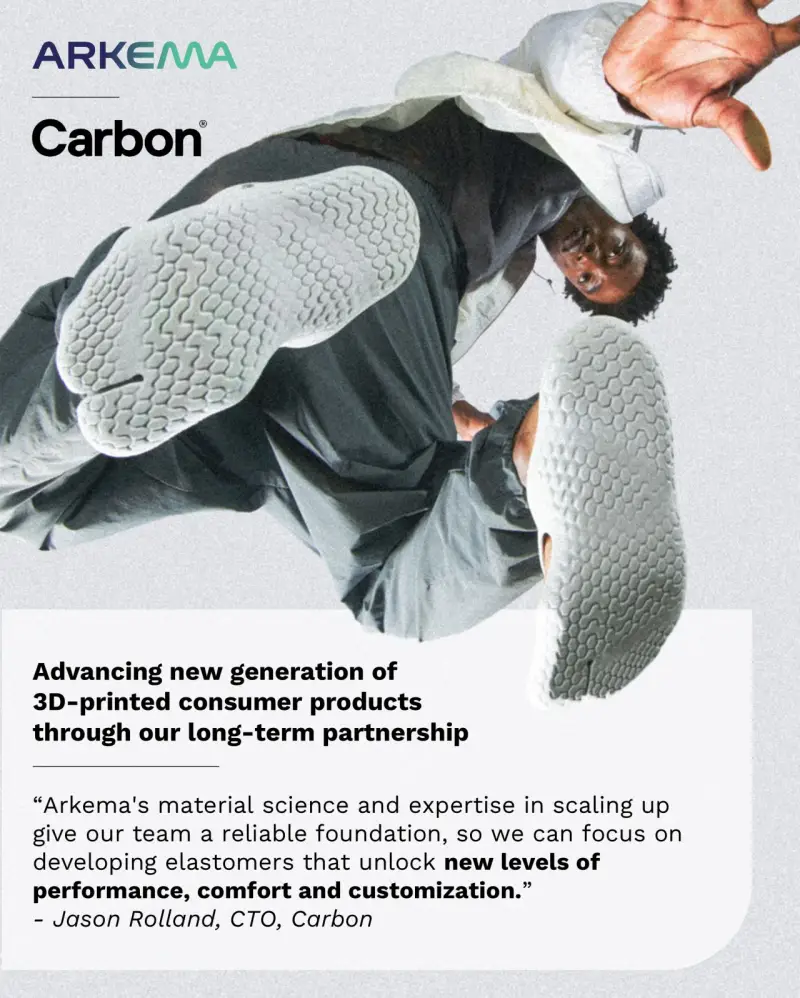
Arkema provides material science and the industrial capacity to produce the underlying materials at scale. Carbon uses that base to formulate elastomers for its DLS printers. Carbon chief technology officer Jason Rolland said the arrangement lets his team focus on performance instead of developing the raw chemistry as well.
Rolland’s stated case is that additive manufacturing gives brands more freedom to rethink product design and production as it becomes more competitive with traditional methods. He said Arkema’s materials expertise and scale-up work give Carbon a foundation for developing elastomers aimed at performance, comfort and customization. Those are company views; the supplied details don’t specify resin formulations, mechanical properties or production volumes for the materials in this work.
For product teams, the distinction between material development and printer compatibility is significant. A resin must work within the printer process and meet the intended part behavior, while production at volume introduces a separate need for consistent material supply. Arkema’s role addresses the chemistry and capacity side; Carbon’s role links the material to its DLS process and the performance requirements of printed parts.
A scan-to-order sandal puts personalization to work
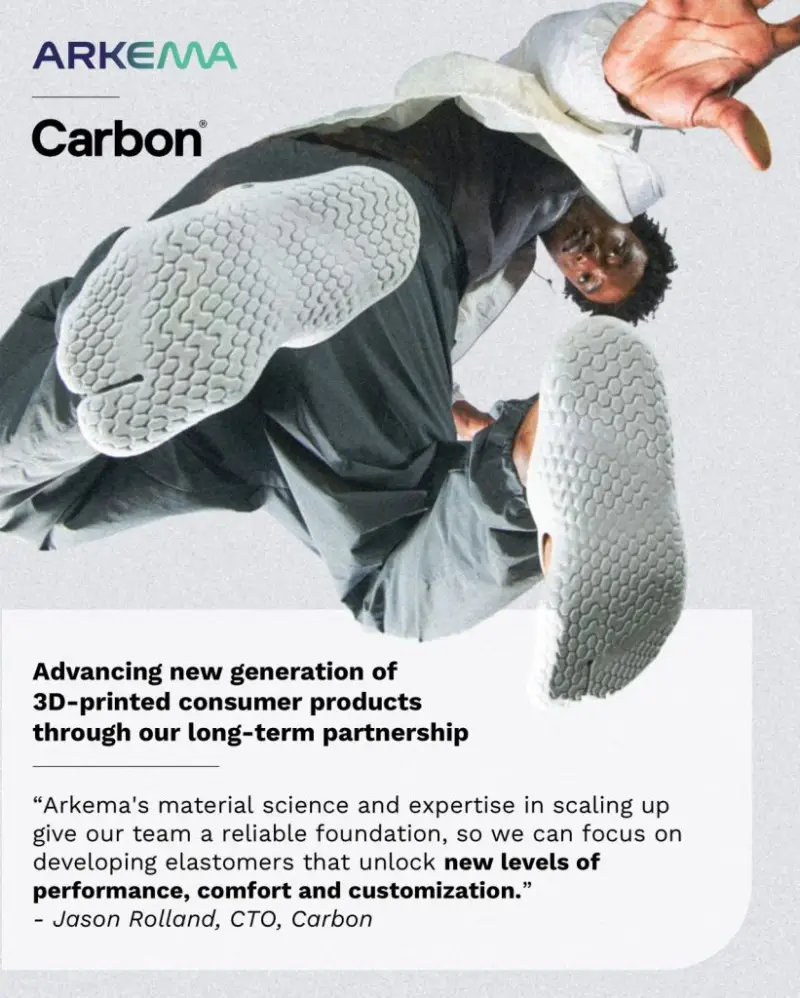
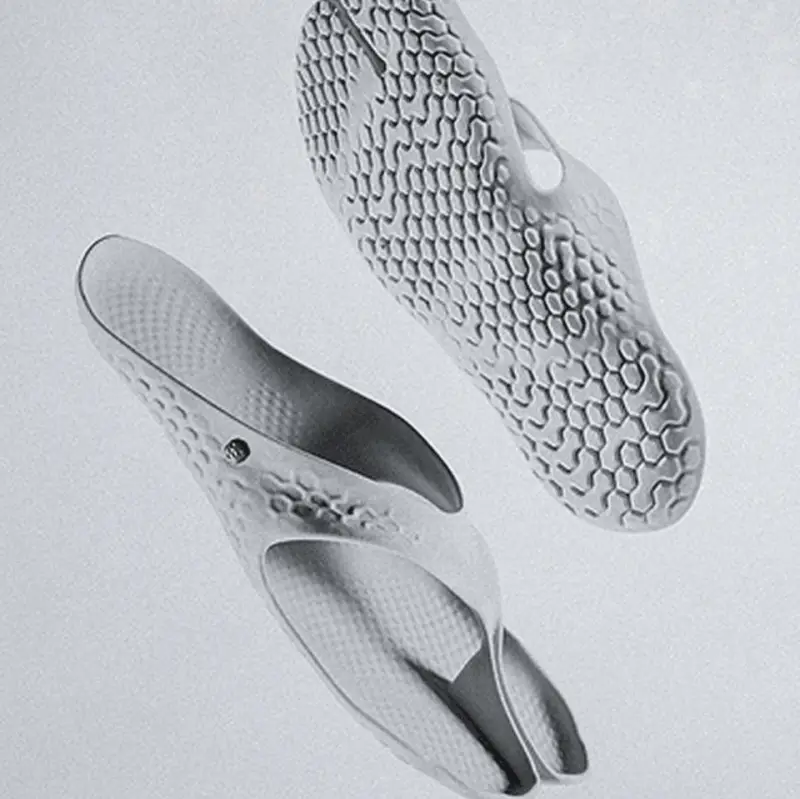
Vivobarefoot’s Tabi Gen 02 shows how the companies’ work can reach a consumer product. The second version of the brand’s barefoot sandal uses individual foot scans to make footwear to order. It was developed with Carbon and is manufactured by Oechsler. The design weighs roughly 91 grams per sandal and has a 2mm-thick sole; the move to DLS is credited with making it lighter.
Vivobarefoot presents the scan-to-print approach as a way to tailor each sandal to its customer. Made-to-order production can also reduce the need to hold finished sizes in inventory and can limit material waste associated with conventional stock-based production. The source provides no quantified comparison of waste, cost or lead time, so those effects should be read as the model’s stated rationale rather than measured results.
The thin sole and low mass make the part a useful example of a product designed around a particular form and fit. Still, the published details don’t give durability data, fit tolerances or process yield for the sandal. Those figures would help manufacturing teams assess how a personalized design performs across customers and how readily the model can scale.
Material control is becoming a production advantage
Arkema vice president of marketing at Arkema Coating Solutions Julie Haevermans said brands are looking for more performance and personalization alongside lower waste. She described the work with Carbon as an opportunity to rethink consumer product design and manufacturing, and said future material development will focus on performance and sustainability. No specific targets or test protocols were provided.
The commercial logic extends beyond footwear. Carbon recently reported passing one million 3D-printed cycling saddles across 11 brands. That figure illustrates the reach of lattice-based consumer products, though it doesn’t establish how many parts were made with the same resin systems involved in the Arkema work.
Other footwear efforts also connect printer or process developers with materials suppliers. New Balance and Formlabs worked on materials, hardware and manufacturing for athletic footwear, producing Rebound Resin for springy lattice structures with the durability of injection-molded thermoplastic. LuxCreo and Asics developed the ACTIBREEZE HYBRID sandal; its elastomer was tested for up to one million cycles at 2,000 newtons, about four times average body weight.
Powder-based processes show a related pattern. Farsoon refined laser-sintering parameters for a TPU midsole developed with PEAK Sports using Wanhua Chemical’s 3D Printed Shoe-Material Solution. Lubrizol has also worked with Lore Cycle on personalized 3D-printed cycling shoes.
Across these examples, material control is part of the product design proposition, not simply a printer input. Arkema’s chemistry and scale-up role could help Carbon develop elastomers for repeatable production, while Carbon applies them to DLS parts with designed lattice behavior. The next useful evidence will be application-level data on consistency, durability and manufacturing throughput as these products move beyond demonstration and into larger production runs.
 AMD Venice Uses 2.5D Packaging to Feed More Bandwidth Into EPYC Zen 6
 CNC Controller Board Design: Interfaces, PCB Specs and Assembly Testing
 Stratasys and Nano Dimension End $42.5 Million Markforged Sale Agreement