SEESII LiteVNA Review: 50 kHz to 6.3 GHz RF Testing in a Handheld Unit
The SEESII LiteVNA covers antenna, cable and filter checks from 50 kHz to 6.3 GHz, with onboard readouts, battery power and Touchstone export.
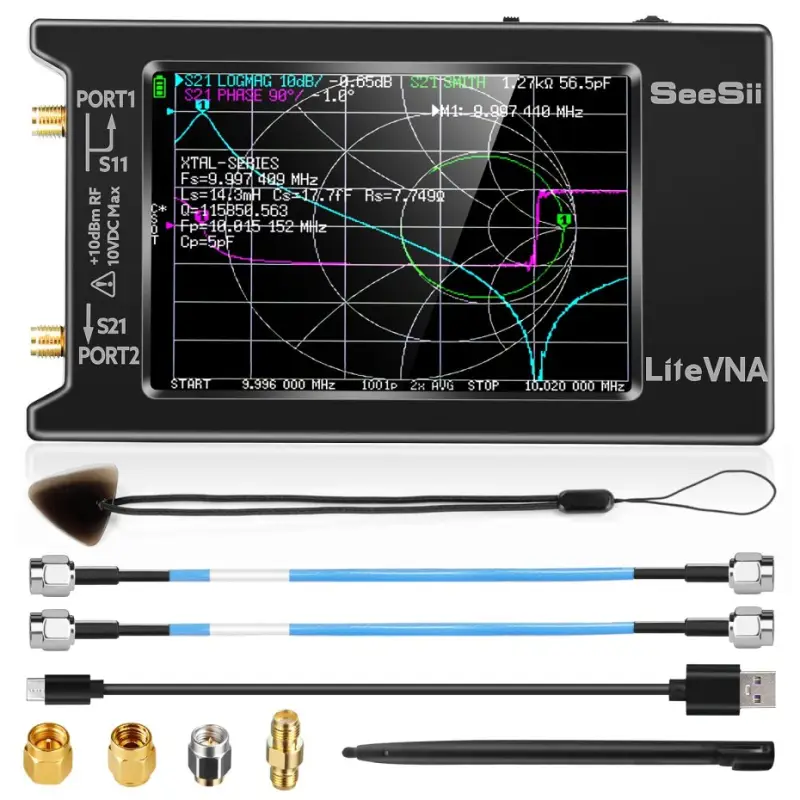
The SEESII LiteVNA brings antenna, cable and filter measurements into a handheld instrument covering 50 kHz to 6.3 GHz. In testing across HF, VHF and UHF work, that span reduced the need to switch analyzers between jobs. Its S11 and S21 functions, plus TDR and DTF tools, make it useful for field checks; a computer remains the better place to inspect and archive detailed results.
One analyzer across a broad frequency span
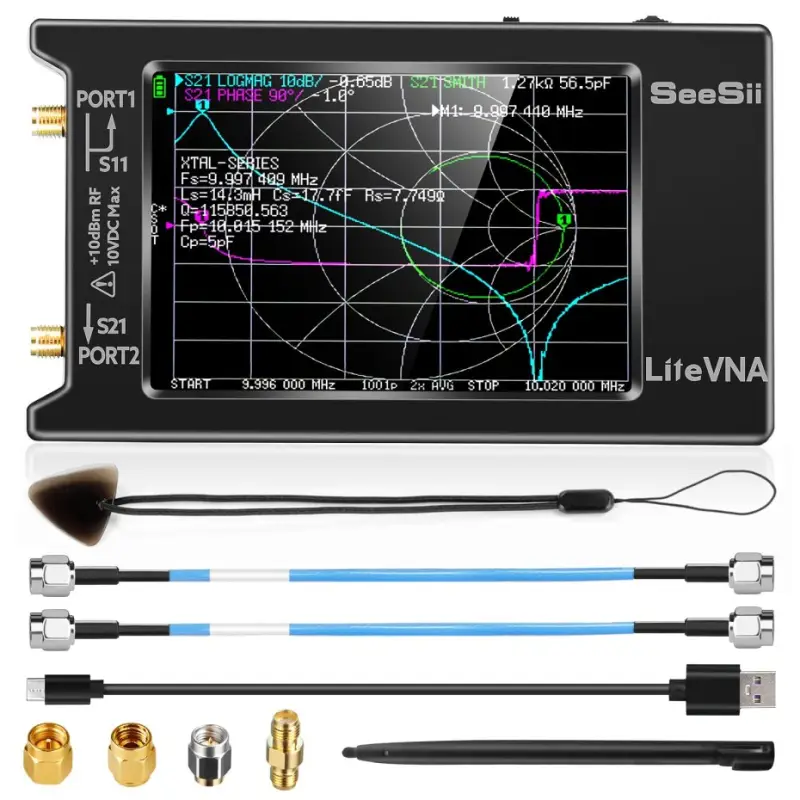
The LiteVNA’s main practical advantage is its frequency coverage: 50 kHz to 6.3 GHz. That range supported the reviewer’s antenna checks across HF, VHF and UHF, as well as measurements on 5 GHz wireless components. They also used it to inspect cable loss, filters and a duplexer over a weekend of testing.
For an engineer or radio operator moving between those tasks, consolidating measurements in one portable instrument can simplify field work. The reviewer found the internal RF switching convenient when changing measurement types, with less need to swap connections or repeatedly adjust settings. The source doesn’t provide accuracy, dynamic range, sweep-point count or calibration specifications, so those performance details can’t be assessed from the reported tests.
S11, S21 and cable fault checks
The LiteVNA provides S11 measurements for examining reflection and antenna matching, and S21 measurements for transmission through devices such as cables and filters. The reviewer used S11 to check antennas and S21 to assess cable loss and filter insertion loss. Duplexer isolation checks were also reported as straightforward on the instrument’s display.
These measurement modes are most useful when the results answer a specific bench or field question: whether an antenna is matched over the band of interest, how much a cable or filter attenuates a signal, or how a component behaves across a sweep. The reviewer found the traces and numeric readouts clear enough for basic tuning and component checks, but didn’t report reference equipment or comparison data. Treat the experience as an account of practical use rather than a quantified accuracy evaluation.
The TDR and DTF functions add a way to investigate cable problems from the unit itself. Both use inverse fast Fourier transform (IFFT) calculations to estimate distance to a discontinuity. TDR was used to identify impedance mismatches along a cable, while DTF gave an approximate location for a fault such as a break or poor connector. These are diagnostic indications: the reported results help narrow the search along a cable run, but the source gives no distance resolution or accuracy figures.
On-device views and controls
A 4-inch color touchscreen presents SWR, Smith charts, phase and delay, and resistance and reactance values. The reviewer could switch among these views on the instrument without opening computer software. That makes the screen handy for quick checks where the immediate question is whether a measurement is in range or where to look next.
The display was described as sharp and readable, including during outdoor antenna work. Its size still constrains how much trace detail is visible at once; close inspection of fine chart features is easier on a larger computer display. The reviewer also found touch response less precise for some fine adjustments and sometimes used a stylus. New VNA users should allow time to learn the menus and settings, since the available account describes a learning curve rather than a fully automatic workflow.
Battery, charging and portability
The unit has a built-in rechargeable 3.7 V, 2000 mAh battery and charges over USB-C. The reviewer reported enough runtime for several short sessions and a full afternoon of field measurements, while cautioning that it shouldn’t be treated as an all-day power source for extended continuous work. Runtime will depend on conditions that weren’t specified in the account.
USB-C charging makes it easier to top up with a commonly used cable, and battery operation frees the instrument from an outlet during antenna and cable checks. The reviewer described the device as weighing just over 2 pounds and compact enough to carry in a field bag. Those characteristics suit portable work, though the supplied package reportedly didn’t include every cable needed for advanced setups; users should check what their measurement arrangement requires.
Saving results and taking them to a computer
For local storage, the LiteVNA supports a MicroSD card up to 32 GB. The card is sold separately. The reviewer saved screenshots and raw measurement data to a card, and found the file handling simple. Setting the date and time enabled automatic timestamps, which helped distinguish files from different sessions. One caveat: the date and time may reset if the battery drains completely, so they may need checking after long storage.
Computer connectivity extends the workflow beyond the onboard screen. The reviewer connected the analyzer to a Windows PC without driver problems and exported Touchstone SNP files for use in RF simulation software. Mac and Linux compatibility was listed, though the reviewer’s direct connection experience was with Windows. Touchstone export is particularly useful when measurements need further inspection, comparison or documentation in compatible tools.
Where it fits in an RF workflow
The reported use cases center on amateur radio and electronics work: tuning antennas, locating cable discontinuities, checking cable attenuation, and measuring filters and duplexers. The broad frequency span also enabled checks on components from a 5 GHz wireless setup. For smaller RF projects, the instrument can serve as a portable option for quick measurements without transporting bench equipment.
Its strongest fit is repeatable, practical field work where a technician needs to see matching or transmission behavior and save the results for later. The reviewer’s experience suggests the LiteVNA can cover several common tasks in one device, while the limited screen area and learning curve matter most when measurements become detailed or the user is new to VNAs. No test conditions or measured uncertainty were supplied, so teams with tighter measurement requirements will need to assess those against their own procedures.
Practical trade-offs
The reviewer’s positives were the 50 kHz to 6.3 GHz span, readable touchscreen, battery operation, MicroSD logging and computer export. They also valued the compact form for field use. The main drawbacks were the separately purchased memory card, the time needed to learn the controls, occasional difficulty making precise touchscreen adjustments, and limited included accessories for more involved test setups.
The listing was reported to have a 4.4-star average from 34 ratings, a modest sample for a specialized instrument. No written buyer comments were available to explain the score, so it can’t establish what users thought about build quality, measurement performance or long-term reliability. The hands-on account provides more detail about operation, but likewise doesn’t include calibration comparisons or numerical performance tests.
Assessment
The SEESII LiteVNA looks suited to users who value broad coverage and portable S-parameter and cable diagnostics in one instrument. Its touchscreen handles quick field readouts, while MicroSD storage and Touchstone export support later review. Plan for a separate card and any cables your setup needs; for close trace analysis, use a computer display. The key decision is whether its reported functions and unspecified measurement performance meet the requirements of the work at hand.
 AMD Venice Uses 2.5D Packaging to Feed More Bandwidth Into EPYC Zen 6
 CNC Controller Board Design: Interfaces, PCB Specs and Assembly Testing
 Stratasys and Nano Dimension End $42.5 Million Markforged Sale Agreement