Five Two Way Radios Compared for Range, Battery Life and Durability
Five radio options span dual band handhelds to six unit FRS packs, with tradeoffs in range, battery life, durability and group size.
Choosing an emergency radio starts with a practical question: how many people need to stay in contact, and across what kind of terrain? The five options here range from a dual band handheld with broad frequency coverage to a six radio FRS pack for household coordination. Their tradeoffs are just as important as their headline features: range depends on obstacles, batteries need a charging plan, and ruggedness varies from light rain protection to an IP67 rating.
Two way radios send signals directly between units or through repeater systems, so they can work without internet access or a cellular network. That makes them useful when those services are unavailable or overloaded. But a radio’s real reach depends on buildings, hills, trees and the system being used. Advertised distances are best treated as open terrain figures, not a promise of neighborhood coverage.
Five options for different communication needs
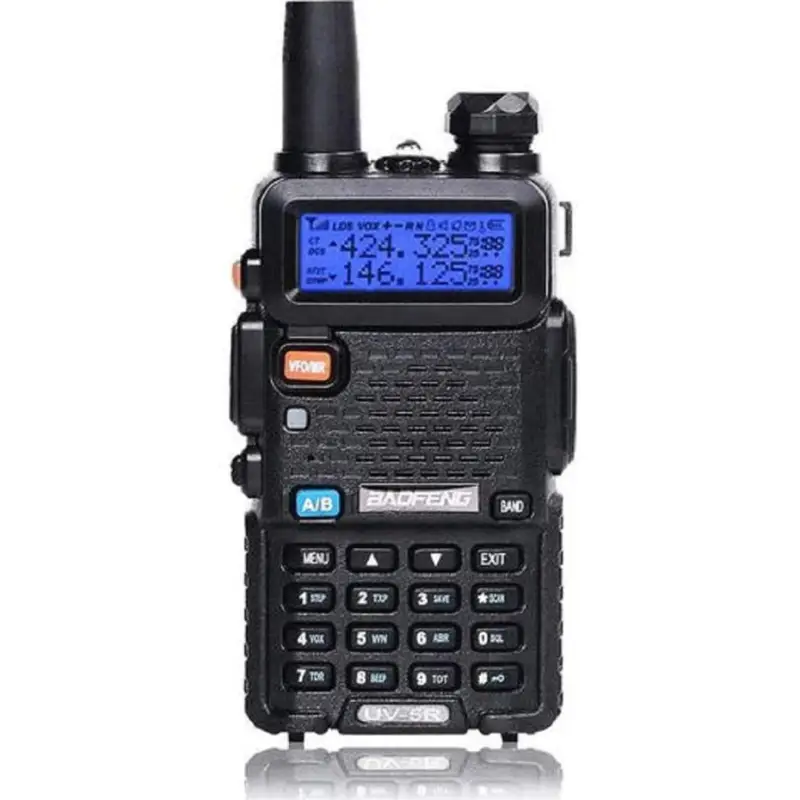
Baofeng UV-5R Dual Band Radio
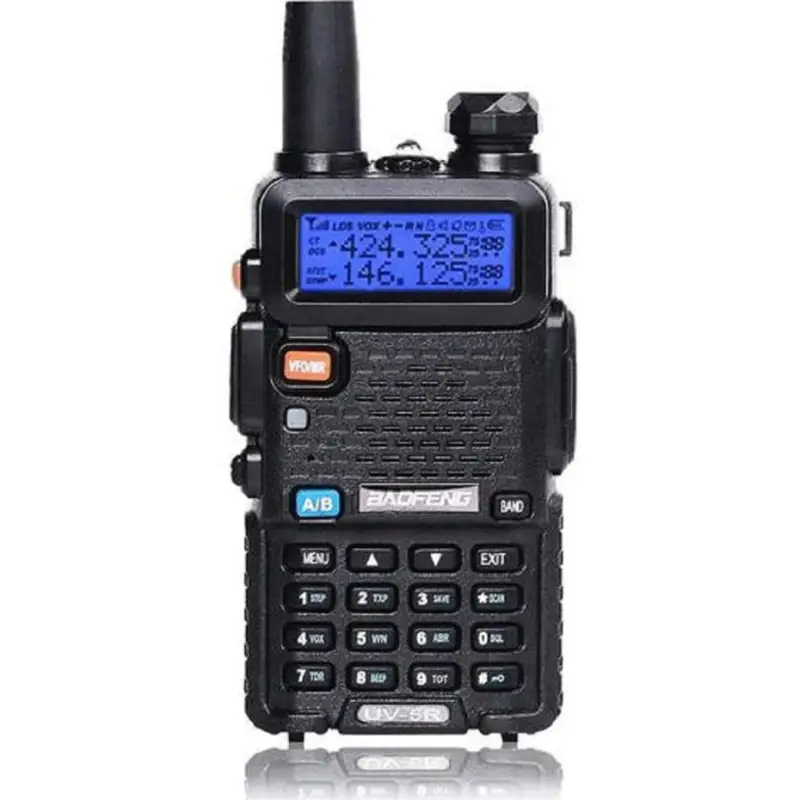
The UV-5R’s appeal is its VHF and UHF coverage, which lets users work across both bands with one handheld. It also ships with accessories including a charger, headset and spare antenna. In testing, the battery lasted several days between charges, and the belt clip stayed secure during hikes and yard work.
Setup takes patience. The small buttons and densely packed menu make channel programming less intuitive at first, though the reviewer found it quicker after learning the layout. CHIRP software can load frequencies from a computer, reducing the amount of button entry needed.
In open areas, the radio produced clear signals over a few miles. Buildings and hills reduced that distance, as expected for a handheld VHF/UHF unit. Its plastic construction feels less suited to rough handling than the tougher options here, and the listing says it is not water resistant. A protective case is advisable for wet conditions. This is the flexible, lower cost choice for someone prepared to learn its controls and protect it from rain.
Retevis RT85 Two Way Radio (2 Pack)
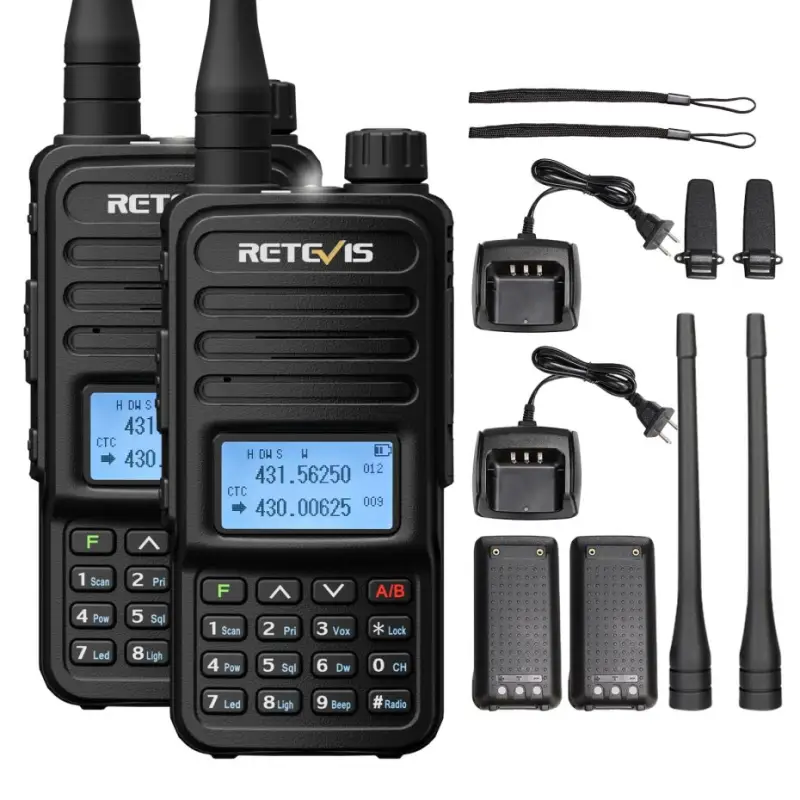
The RT85 pair emphasizes a solid casing and group coordination. The reviewer reported that a unit kept working after an accidental drop onto a rock. Its 5W output delivered clear audio several hundred yards from base camp, without the static or garbled speech experienced with some cheaper radios. The two band design also allowed two hiking teams to use separate channels for distinct conversations.
An SOS alarm and built in flashlight add useful functions when equipment is close at hand and visibility is low. The controls and screen may take beginners time to learn, however, and the battery was described as decent rather than exceptional for continuous field use. The radios have no water resistance; after light drizzle, they had to be tucked under a jacket. Anyone using them around water or in wet weather should plan for protection.
This set makes sense for a small group that values a sturdy feel, clear audio and separate channels. The absence of water protection is the main limitation to account for in an outdoor kit.
Retevis RB48 Rugged Walkie Talkies
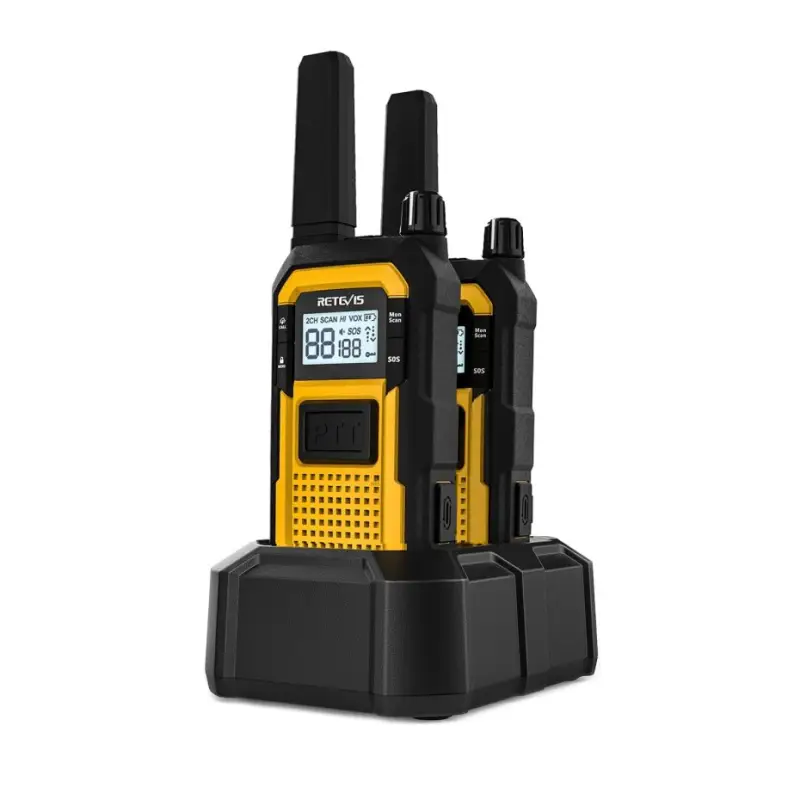
For users who expect drops, dust or water exposure, the RB48 stands out among these choices. It carries an IP67 rating. In the reviewer’s tests, it kept working after repeated drops onto concrete, a faucet rinse and a night in a dusty garage. Its bright yellow body was easy to spot after being dropped in tall grass, and the buttons were usable with gloves. Silicone button covers also worked with wet hands without sticking or misfiring.
The rechargeable battery lasted through a weekend camping trip with intermittent use over two days, and USB C charging meant no separate charger or unusual cable was needed. The tradeoffs are size and accessories: the radio is bulkier than basic consumer models, and no earpiece is included. Its FRS range claims also depend heavily on unobstructed terrain. In a neighborhood of houses and trees, the reviewer got clear reception for a few blocks; that suits nearby coordination, but not long distance communication.
The two pack is a straightforward fit for a household or small group looking for a radio that can take rough handling. Its visibility, charging connection and water and dust protection are practical advantages; its bulk and terrain limited range deserve consideration.
Pxton PX-888S Two Way Radios
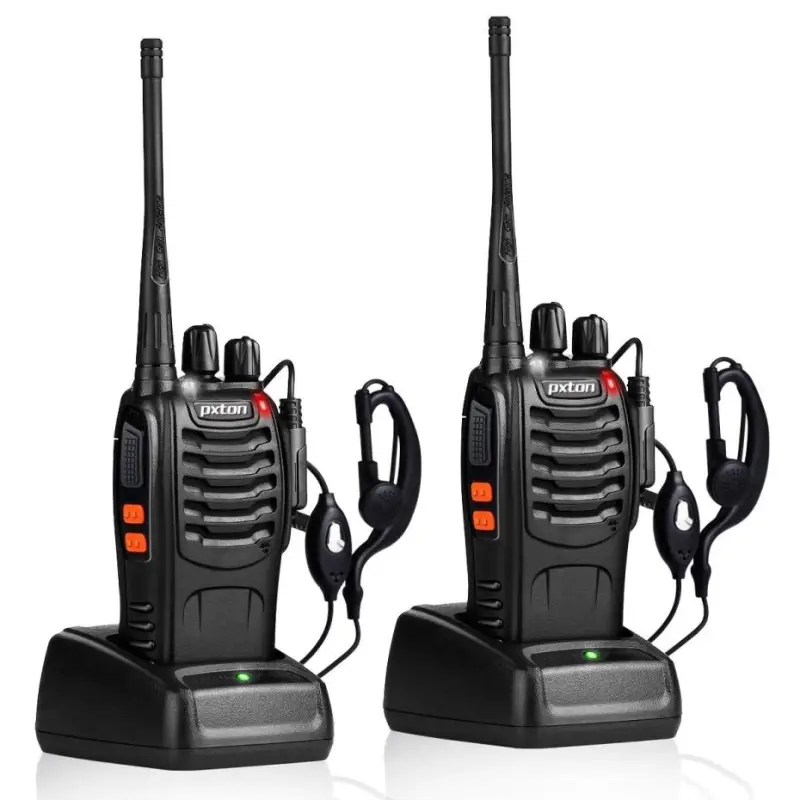
The PX-888S pair is aimed at buyers who want a simple set with useful extras. A top mounted knob makes channel selection quick, and the reviewer found the controls easy to understand without consulting the manual. Battery life was a strong point: one unit remained charged after a couple of days on standby, while frequent calling used the charge more quickly. A full recharge from empty took a few hours.
In open space, the reviewer reported clear communication well past a mile. Houses and trees cut the distance in a neighborhood. The radios have 16 channels, which may constrain more involved channel plans. Their plastic bodies felt light, though they survived several accidental drops. The IP54 rating offers protection against light rain and dust, but does not make the units suitable for submersion.
The package includes earpieces, belt clips, a flashlight, charger and batteries. Those accessories make the set ready to use with little additional setup, while the built in light can be reached quickly at night. The PX-888S is a practical fit for hiking, job sites or a backup kit where uncomplicated controls and included accessories matter more than extensive channel capacity.
Pxton 6 Pack Walkie Talkies
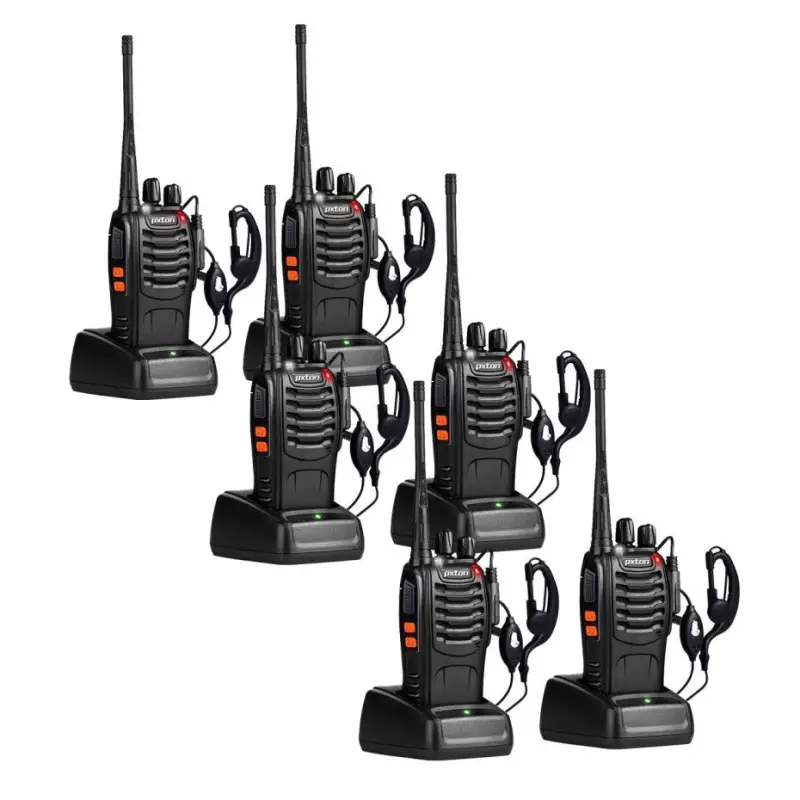
When a household or group needs several units at once, this six pack provides one radio for each person and leaves room for spares. Large buttons and a rotating channel knob make operation straightforward, including with gloves. During a day of intermittent hiking use, one radio still had power at the end. Recharging from empty took a few hours.
The reviewer found the radios worked around a neighborhood and on a camping trip, but signal strength fell as buildings blocked the path. In open areas such as fields or along the coast, reception came close to the advertised distance. That makes the set better suited to close range coordination than communication across a city. The hard shell casing handled being carried in a bag or dropped, but the plastic clips and straps felt less durable. The included earpieces also showed wear with regular use and may need replacement.
For a group that needs several ready to use radios at a manageable per unit cost, the quantity is the central advantage. The short range limits still apply: plan around local terrain and treat these as tools for nearby coordination during an outage or outdoor activity.
What to weigh before choosing
Range and terrain
Range figures describe how far a signal may travel under particular conditions. Open terrain gives a radio a clearer path; buildings, trees and hills reduce effective distance. The buying guide groups short range as up to 5 miles for home or small property use, medium range as 5–20 miles for neighborhood groups or rural areas, and long range as 20+ miles for teams spread farther apart. These are categories, not guarantees of what a handheld will achieve in a specific location. The reported tests show why: the same kind of radio can cover miles in open space and only a few blocks among houses.
Power and battery planning
Check whether a unit uses a rechargeable pack, replaceable batteries or both. Multiple power options give users more flexibility during an extended outage; the buying guide recommends keeping standard batteries available as a backup. Battery life also depends on how the radio is used. Standby can preserve charge longer than frequent calls, so consider likely use when comparing models. The UV-5R lasted several days between charges in testing, the RB48 ran through a weekend of intermittent use, and the Pxton sets also showed strong standby or day use. Those observations describe the tests, not a guaranteed runtime for every user.
Durability and protection
Look for a stated water or dust rating if the radio will be carried outdoors. Protection levels differ substantially: the UV-5R has no water resistance listed, the RT85 lacks water protection, the PX-888S carries an IP54 rating for light rain and dust, and the RB48 is rated IP67. A rating does not make every unit suitable for every exposure, so match the specification to the conditions you expect. Drop resistance and ease of handling matter too. The RB48’s bright color makes it easier to find, while the PX-888S and six pack offer simpler controls for quick channel changes.
Frequency type and added functions
The buying guide identifies FRS and GMRS as common radio types and says GMRS operation requires a license. The UV-5R is described as a dual band ham radio covering VHF and UHF, while the RB48 is identified as an FRS set. Frequency coverage and channel access affect compatibility between radios, so confirm that the units in a group can communicate on the same frequencies and channels before relying on them together.
Some models include features such as weather alerts, NOAA channels, flashlights or alarm functions. In this group, the RT85 has an SOS alarm and flashlight, while the Pxton sets include a flashlight and accessories such as earpieces. These extras can be useful, but they don't replace the main checks: compatible radios, a realistic range for local terrain, a workable charging plan and protection suited to the weather.
The right choice depends on the communication job. The UV-5R offers broader band coverage and a computer programming option; the RT85 provides a sturdy two radio setup with clear audio; the RB48 prioritizes water and dust protection; the PX-888S keeps operation simple and includes accessories; and the six pack equips a larger group. A useful kit starts with the route, group size and power plan, then chooses radios whose limits match those conditions.
 AMD Venice Uses 2.5D Packaging to Feed More Bandwidth Into EPYC Zen 6
 CNC Controller Board Design: Interfaces, PCB Specs and Assembly Testing
 Stratasys and Nano Dimension End $42.5 Million Markforged Sale Agreement