Six Temperature and Humidity Meters Compared for Home and HVAC Checks
Six meters cover quick room checks, trend tracking and probe measurements, with trade-offs in display, memory, mounting and power.
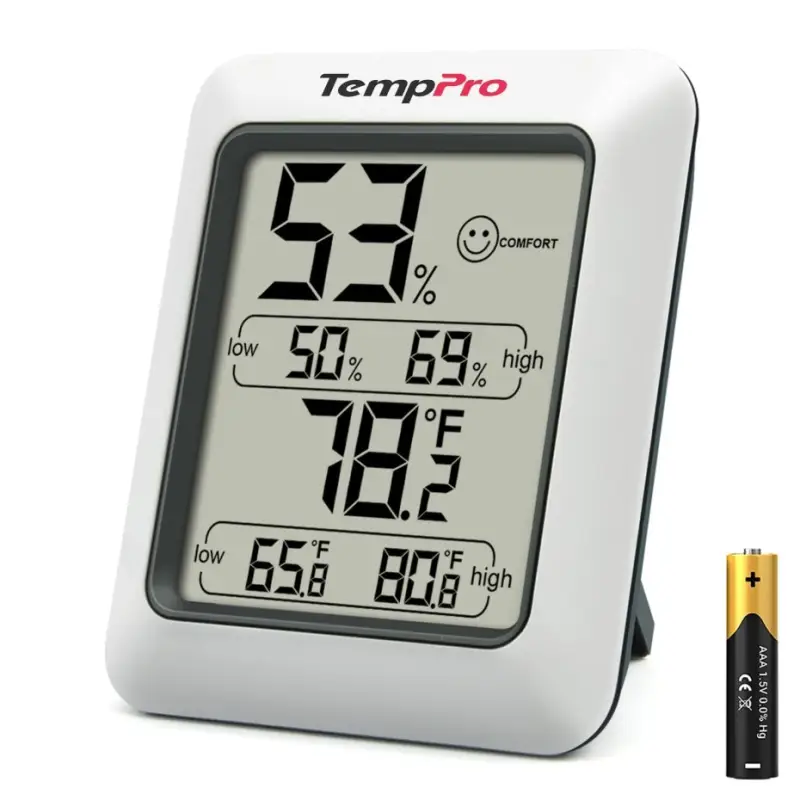
Choosing a temperature and humidity meter comes down to the kind of reading you need and where you need to take it. A compact room monitor can show whether conditions are drifting over time; a probe meter can reach into ductwork or a crawl space; and instruments that report dew point or wet bulb temperature add context for moisture checks. The six models below span those uses, from simple household monitoring to more involved HVAC work.
Temperature and relative humidity describe different parts of indoor air. Temperature indicates how warm or cool the air is, while relative humidity expresses how much water vapor it holds relative to the amount it could hold at that temperature. Dew point and wet bulb readings provide additional ways to interpret moisture conditions. They can be useful when checking for condensation risk or comparing conditions across spaces.
These meters have different strengths, and the source provides no standardized accuracy figures for each model. The comparisons that follow reflect reported use and stated features, so they’re best read as practical distinctions rather than a controlled, side-by-side instrument evaluation. For decisions that depend on tight tolerances, check the manufacturer’s specifications and intended use before relying on any consumer monitor.
Room monitors for quick checks
TempPro TP50 Digital Hygrometer
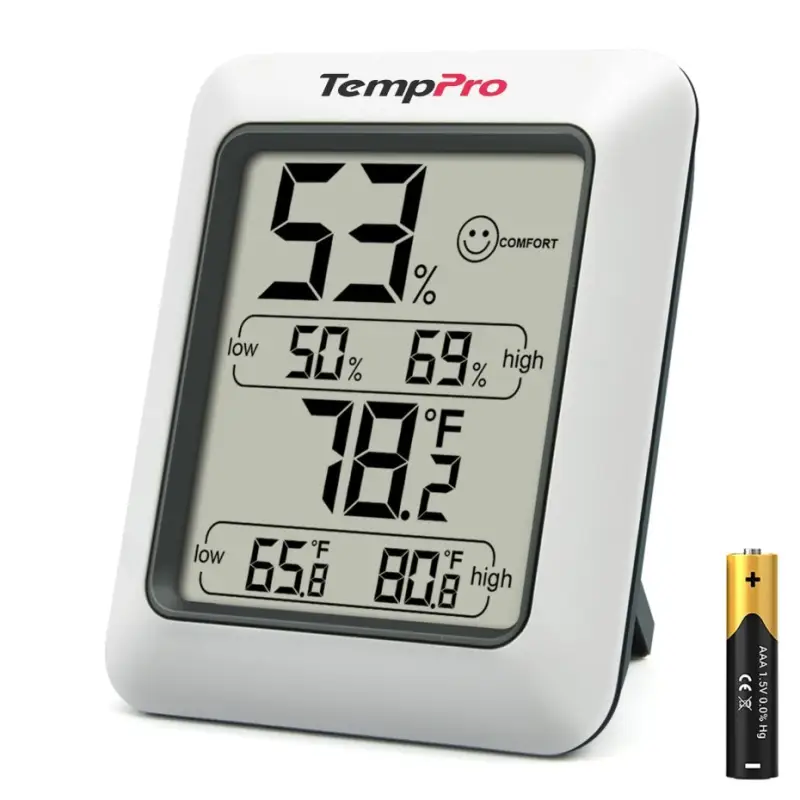
The TP50 keeps its job simple: it measures temperature and humidity, displays the readings, and records high and low values. Its face icon gives a quick dry, comfortable or wet indication, while the numeric readings offer more detail. The reported response time is under 10 seconds, making it useful for observing changes after, for example, opening a window.
Placement is flexible for a basic monitor. It has a small stand for a counter and a magnetic back for attaching it to a metal surface such as a refrigerator. The trade-offs are a small display, no backlight and power from one AAA battery. In a dark room or across a large space, reading the numbers may take a closer look.
The high and low memory is more useful than a single glance when conditions vary overnight or through the day. It can help reveal a humidity spike that a quick check would miss. There’s no app connection or other smart monitoring feature described, so this suits someone who wants local readings without extra setup.
TempPro TempAir Digital Hygrometer
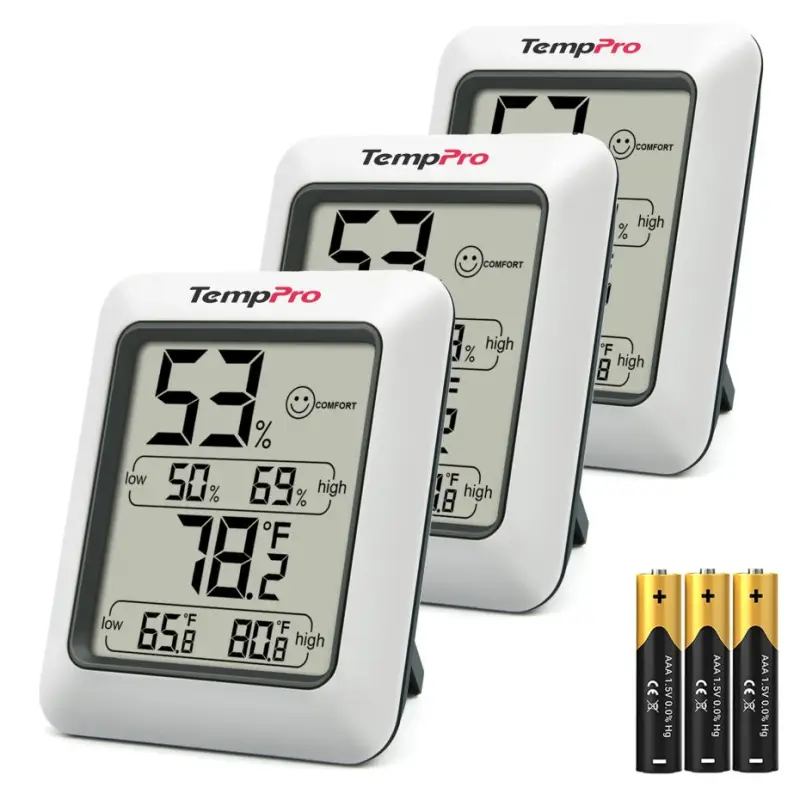
The TempAir takes a similar household approach, pairing current temperature and humidity with high and low records. DRY, COMFORT and WET icons make the display easier to interpret at a glance, while the reported quick updates help when checking a changing room. The source describes a comparison against another thermometer, with readings close enough for everyday use, but gives no formal accuracy tolerance.
A stand and magnetic back support countertop or metal-surface placement. The unit is described as an indoor monitor only, so it isn’t the pick for outdoor measurement. Its small screen can be difficult to read from across a room, and the plastic case feels light rather than heavy duty. For a compact home gauge, those limits may matter less than the ability to move it between rooms and review daily highs and lows.
The recorded trends may be helpful for keeping a more stable environment around plants, instruments or other belongings. The device doesn’t provide the specialist readings or remote access available on some other kinds of meters. Its role is to make ordinary room conditions visible with little fuss.
SMARTRO SC42 Digital Hygrometer
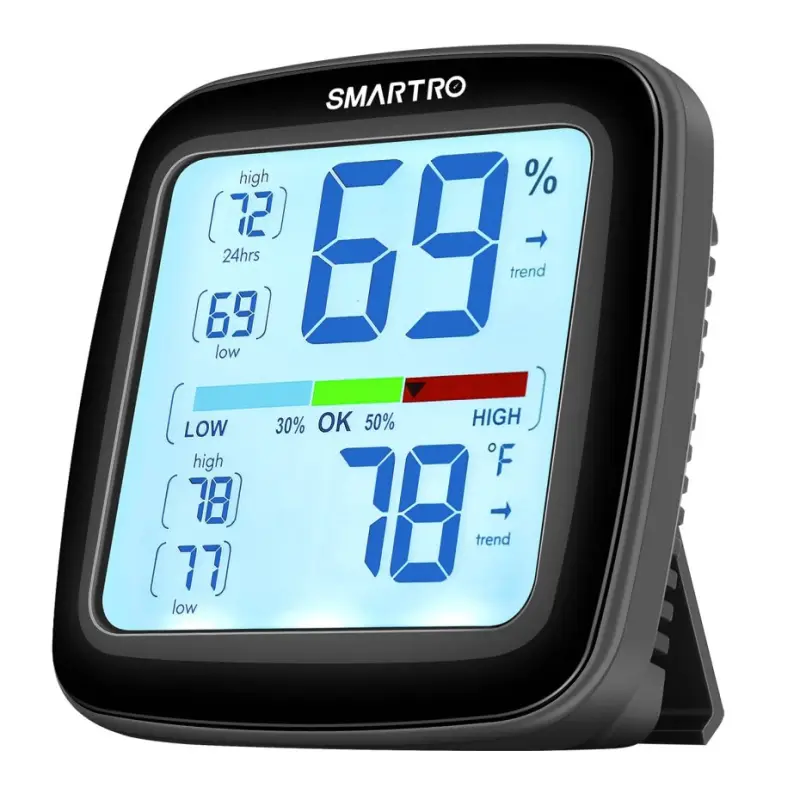
The SC42 gives more priority to legibility. Its large screen is reported to be readable from across a room, and readings update every 10 seconds. A max/min memory records temperature and humidity changes over a day, which lets a user check the range without watching the display continuously.
Mounting options include a stand, a wall-mount hole and magnets. That gives it more placement choices than a tabletop-only unit, including on a refrigerator or another metal surface. The backlight turns off after 10 seconds, so it supports brief checks in low light rather than continuous illumination. Batteries aren’t included, and there’s no smartphone app or remote monitoring.
That makes the SC42 a practical fit when large digits and flexible placement matter more than connecting readings to a phone. It can serve a bedroom, nursery, basement or greenhouse as a local monitor, although the source doesn’t provide formal measurement tolerances for those applications.
Probe and expanded moisture readings
Amprobe THWD-3 Humidity Meter
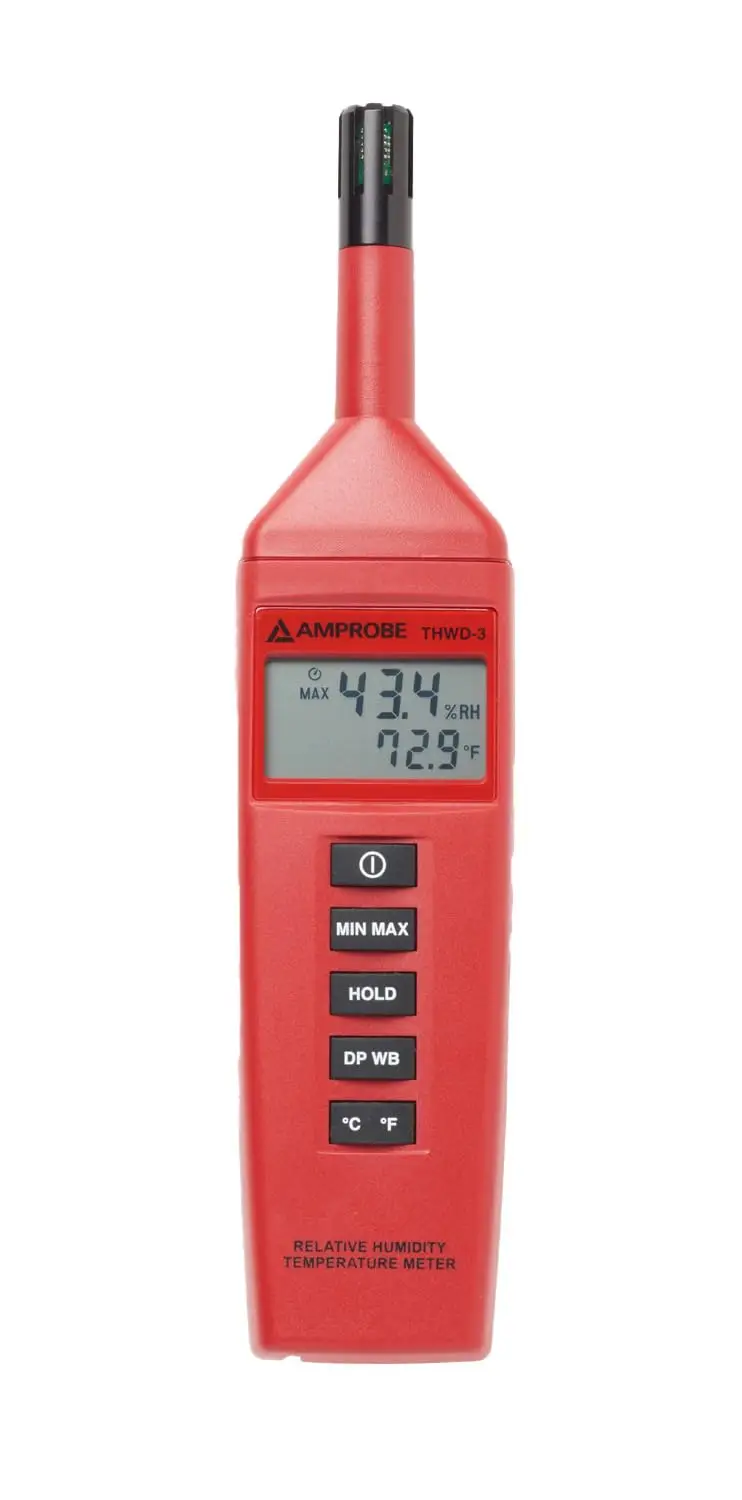
The THWD-3 stands out for access. Its extended probe can reach into narrow gaps, air ducts and vents, reducing the need to maneuver the meter itself into a cramped location. The dual display shows temperature and humidity together, avoiding a screen toggle when recording readings across several spots.
It also reports dew point and wet bulb temperature. Those readings can help when assessing moisture conditions or considering condensation in a storage area, though interpreting them still depends on the measurement context. The source describes the meter as suitable for household and HVAC checks, with a stated temperature limit of 140°F. That ceiling excludes hotter work near some industrial equipment.
The listed drawbacks are the 9-volt battery, no warranty included with purchase and a narrower temperature range than more expensive models. For a user who needs to sample air in hard-to-reach locations and wants more than relative humidity alone, probe access and the extra readings are the central reasons to consider it.
Fluke 971 Temperature Humidity Meter
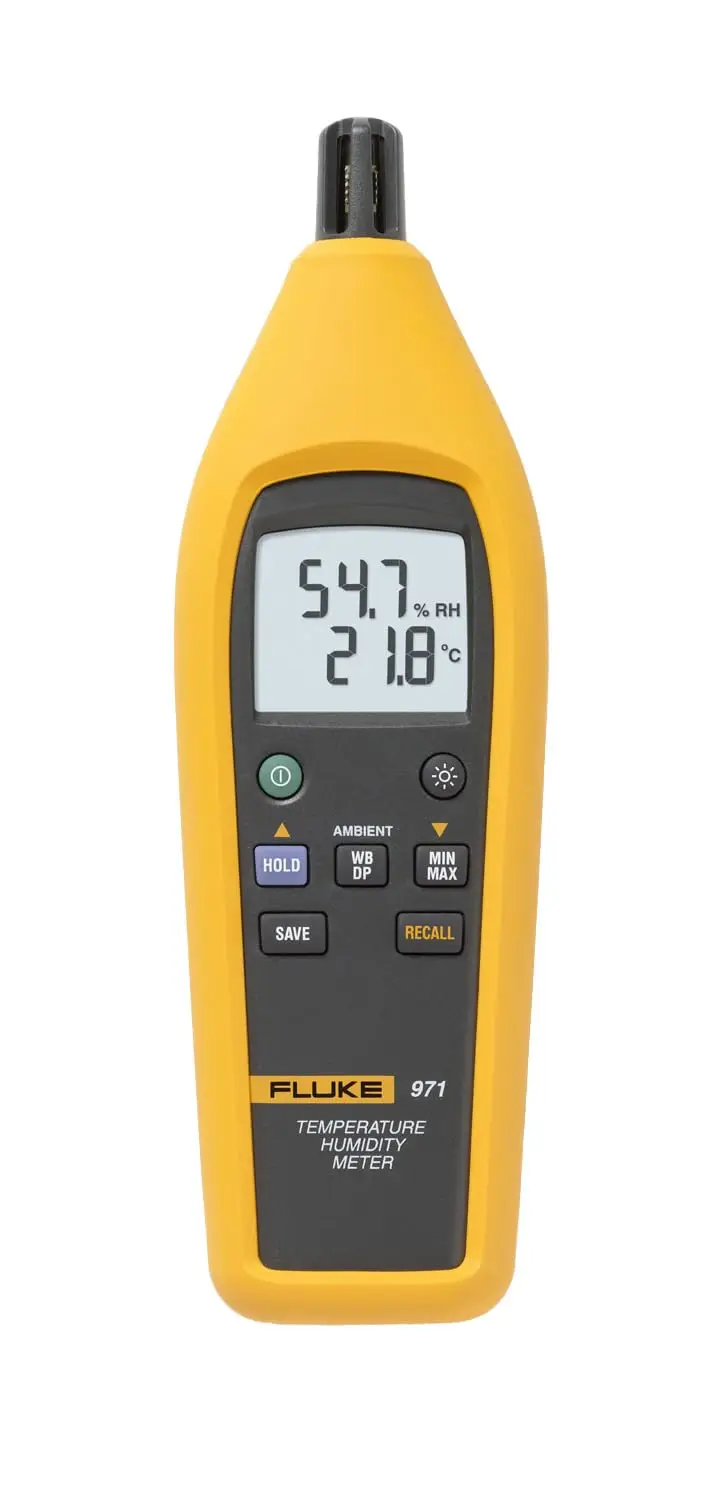
The Fluke 971 is oriented toward frequent movement between measurement points. Its backlit screen supports checks in dim rooms, while a protective holster and belt clip make it easier to carry during work across rooms or sites. It displays temperature and humidity together and provides dew point and wet bulb readings, giving users additional information for investigating indoor moisture conditions.
The unit stores up to 99 records. That’s a useful way to retain measurements, but it may be limiting when tracking many locations over time. It runs on four AAA batteries and has a low-battery indicator. The source describes battery life as solid during use but doesn’t state a runtime.
One stated limitation concerns temperature accuracy outside the 0 to 45 degree range. That range should be considered alongside the measurement conditions and the manufacturer’s specifications for the task. The reported testing found that humidity changes appeared quickly, and the meter felt light but sturdy, with the holster and clip supporting mobile use.
Protmex PT6508 Digital Hygrometer
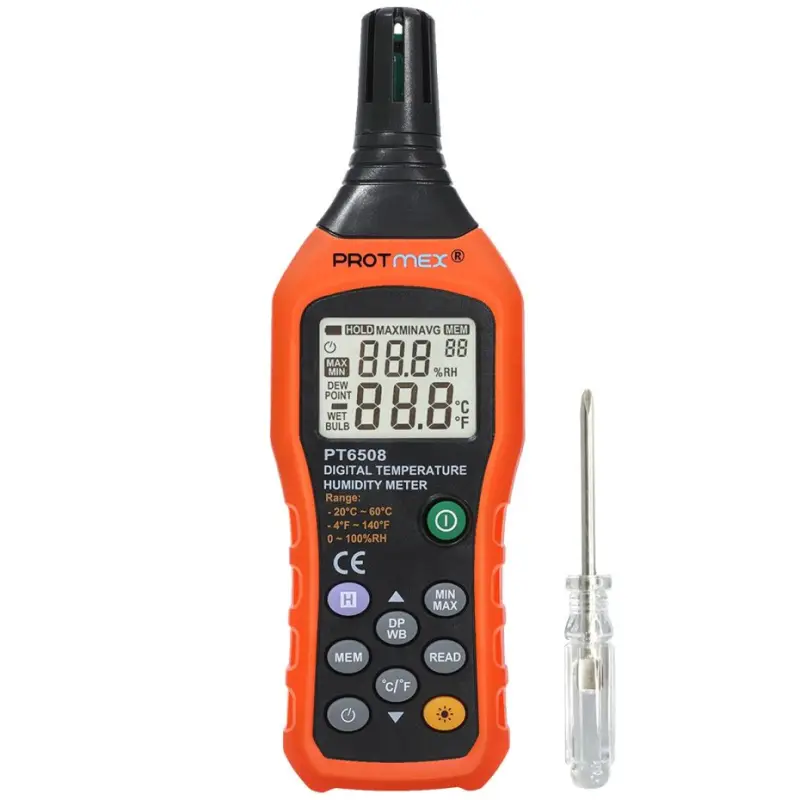
The PT6508 brings several temperature readings together, including ambient temperature, dew point and wet bulb temperature. The source reports a comparison with a separate thermometer, with readings differing by about a tenth of a degree; it doesn’t identify the test conditions or establish a formal accuracy specification. The meter is described as suitable for spaces such as wine cellars or server rooms, but users should check the manufacturer’s stated limits for their own requirements.
A backlight helps with checks in low light, and the display records high and low readings. An automatic shutoff after 30 minutes of inactivity is intended to conserve its four AAA batteries. The unit uses a tabletop stand, with no wall-mount option described.
The screen packs in a lot of information, which can take a moment to parse. Small, stiff buttons also make switching between readings less immediate until the layout becomes familiar. In return, the meter offers dew point and wet bulb information in a single handheld instrument, a useful feature set for someone who wants more context than a basic room monitor supplies.
What to check before buying
Accuracy and intended use
Accuracy is central because even a clear display can’t make an unreliable measurement useful. The buying guidance gives general targets of ±1°F for temperature and ±3% to ±5% for humidity. Treat those as selection guidance from the source, not as specifications for the six models above: their individual accuracy tolerances aren’t supplied here. Compare a meter’s published specifications with the precision your application requires, especially when readings will inform a consequential decision.
Display and measurement format
A large digit size helps with quick readings from a distance; a backlight helps when the room is dim. Check whether the instrument shows both temperature and humidity at once, or makes you switch between screens. Some monitors display indoor and outdoor readings together, but that feature isn’t listed for these six models. A dual reading on one screen can save time when moving between measurement points.
| Display feature | Practical effect |
|---|---|
| Backlight | Makes a short check easier in a dark room |
| Large digits | Improves readability from farther away |
| Simultaneous readings | Shows temperature and humidity without switching screens |
Sensor location and access
Think about where the measurement needs to happen. A self-contained monitor is convenient on a shelf or metal surface, while a wired or extended probe can reach a duct or a narrow space. Wireless sensors can also make placement easier in locations that are awkward to access, though they aren’t a feature described for the models here. Confirm what the meter measures at the probe or sensor and how it connects before assuming it will suit a particular installation.
Power, records and extra functions
Most of the listed meters use batteries, with types ranging from AAA to 9-volt. The buying guidance also suggests considering plug-in power and battery backup for devices intended to remain in place. For trend checks, look at whether the meter stores high and low values or a larger set of records. If you need remote access, verify that the model actually connects to an app: the SC42, for example, is described as having no phone connection.
Alerts for high or low humidity can draw attention to conditions without requiring constant checks, but no alert feature is specified for these six products. Dew point and wet bulb readings may also be useful for interpreting moisture. They add information, though they don’t replace choosing the right instrument or understanding the conditions under which it measures.
Housing and placement
Consider whether the meter will stay on a counter, move between rooms or travel with a technician. Stands, magnets, wall-mount holes, holsters and belt clips all affect how practical a device is in its intended location. A sturdier case can matter in frequent handling or humid settings. Outdoor suitability should be confirmed explicitly: the TempAir is described as indoor-only, and a magnetic back or tabletop stand alone doesn’t establish that a meter is designed for outdoor exposure.
For a straightforward view of household conditions, the TP50, TempAir and SC42 emphasize simple displays, placement flexibility or stored highs and lows. The THWD-3 is the clearest fit when a probe is needed to reach into ductwork, while the Fluke 971 and PT6508 add expanded moisture readings and support more involved checks. The deciding details are the measurement location, required accuracy, visibility and record keeping; match those needs to the instrument’s published specifications before putting its readings to work.
 CNC Controller Board Design: Interfaces, PCB Specs and Assembly Testing
 Stratasys and Nano Dimension End $42.5 Million Markforged Sale Agreement
 Xometry Q3 2026 Revenue Reaches $252.4 Million as Marketplace Margins Rise