AI Infrastructure Growth Expands Demand for Precision Machined Parts
Data centers, chipmaking equipment and AI-enabled robots are expanding the hardware supply chain for precision machining suppliers.
AI’s physical footprint reaches the machine shop
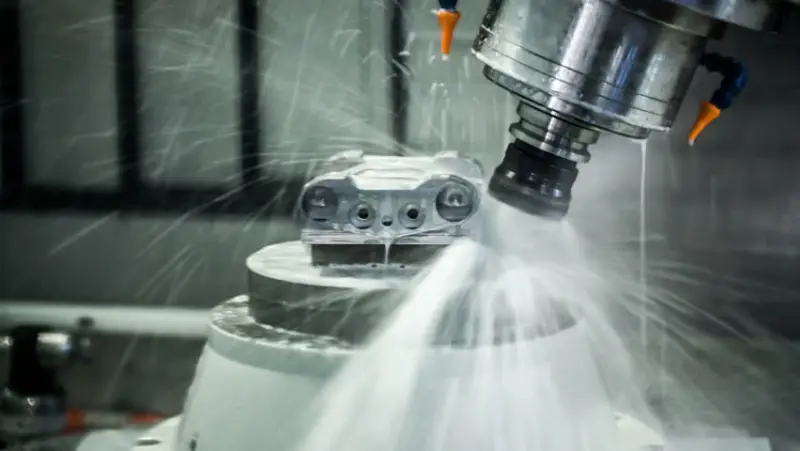
AI’s expansion creates work for manufacturers well beyond processors and servers. Data centers need power and cooling systems; chipmakers need advanced production equipment; and AI-enabled robots need mechanical assemblies. Each layer can call for metal or plastic parts made to controlled dimensions, giving precision machining suppliers routes into AI-related supply chains without making AI products themselves.
The demand runs through several linked markets. More AI computing can drive investment in data-center capacity and semiconductors. That investment, in turn, can call for servers, cooling equipment, semiconductor production tools and automated machinery. CNC machining is one of several ways to make the brackets, housings, mounts, shafts and other components used in those systems.
The scale of the infrastructure build-out is substantial. The International Energy Agency (IEA) projected global data-center electricity consumption to rise from 485 TWh in 2025 to around 950 TWh by 2030. It expected consumption by AI-focused data centers to grow approximately threefold over the same period. Electricity use does not translate directly into a machining order, but it points to the expanding physical systems required to run more computing.
More computing means more supporting hardware
Servers, networking and storage systems sit inside a broader installation that also needs racks, mechanical supports, power-management hardware, cable-management components and cooling equipment. Some parts are fabricated, stamped, molded or assembled. CNC machining becomes relevant when a part’s geometry, tolerance, material or finish makes that process a suitable choice.
Potential machined parts include brackets, housings, mounting components, structural elements, connectors and heat-management components. The specific process depends on the design and production volume; not every data-center component needs machining. The practical point for suppliers is that infrastructure spending can create demand across many types of hardware, and some of that hardware relies on accurately made mechanical parts.
Investment figures offer another measure of the build-out. The IEA reported that capital expenditure by five major technology companies exceeded $400 billion in 2025 and was expected to increase further in 2026. That spending supports a broad infrastructure ecosystem, rather than a single class of component.
Chipmaking equipment adds a second demand path
AI computing depends on processors, accelerators, high-bandwidth memory (HBM), networking chips and advanced packaging. As demand for these devices grows, semiconductor manufacturers invest in production capacity and the equipment needed to make and test them. For machining suppliers, the equipment chain can matter as much as the finished chip market.
SEMI forecast global semiconductor manufacturing equipment sales of $125.5 billion in 2025 and $138.1 billion in 2026, identifying AI-driven chip innovation and capacity expansion as growth factors. A later projection from SEMI, dated July 2026, put 2026 sales at $165.9 billion. It linked that outlook to AI-related investment in leading-edge logic, advanced memory, testing and packaging. These are forecasts cited for their respective dates, not machining-market sales figures.
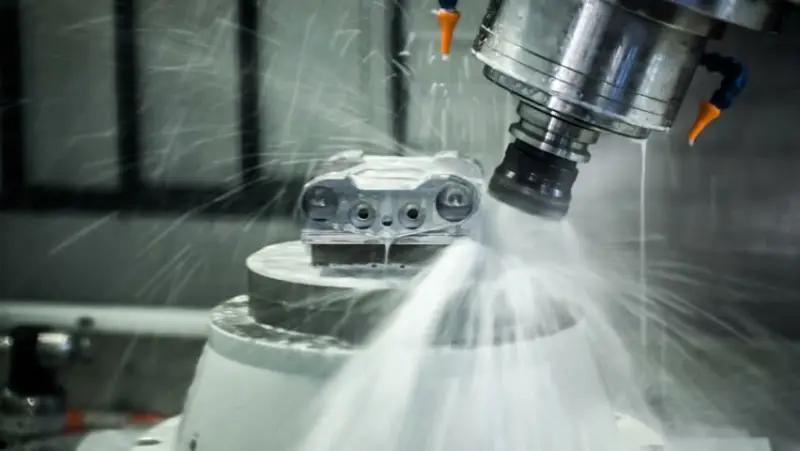
Semiconductor production tools often combine precision mechanical assemblies with demanding requirements for geometry, dimensional control, surface finish, material and cleanliness. Equipment makers may need parts with complex shapes or closely controlled interfaces. Those demands can create opportunities for suppliers able to meet the relevant specifications and quality requirements.
The connection is indirect: demand for AI chips can encourage capacity expansion, which calls for more production equipment, some of which contains precision-machined components. A supplier’s opportunity depends on the equipment design and its chosen manufacturing processes.
Robotics brings another set of mechanical requirements
AI is also changing the capabilities expected of robots. The International Federation of Robotics (IFR) has identified analytical AI, physical AI and generative AI applications as trends shaping robotics. Better perception, planning and adaptability may make robots suitable for more tasks in manufacturing, logistics, warehousing, inspection, healthcare and other fields.
The installed base is already sizeable. IFR reported 542,000 industrial robot installations worldwide in 2024, more than twice the number installed ten years earlier. The global operational stock reached approximately 4.66 million industrial robots that year.
Every robot still needs a physical structure: joints, housings, shafts, brackets, mounting plates, sensor mounts and end-effectors. Depending on design and production volume, manufacturers may make some of these parts through CNC turning, milling, grinding or other precision processes. If AI expands the tasks robots can perform, demand may grow for the systems and components that support those applications.
Component requirements can become more demanding
AI-related growth may affect the technical requirements for parts as well as their quantity. More compact equipment, greater computing density and demanding thermal conditions can put pressure on component design and assembly. The source industries cited here include advanced logic, HBM and advanced packaging, areas where SEMI has associated investment with AI-related demand.
For machined parts, the requirements vary by application. Dimensional accuracy and geometric controls such as flatness, perpendicularity and concentricity can matter when components must align in an assembly. Surface finish may affect sealing, sliding, heat transfer or fit. Material choice can depend on strength, weight, electrical or thermal conductivity, corrosion resistance and wear. Cooling hardware may call for particular geometries and controlled interfaces, while semiconductor equipment can impose cleanliness requirements tied to contamination control.
These are not universal specifications for every AI-related part. They are examples of the factors that customers may define for a particular component. Machining suppliers need to understand those requirements before quoting or selecting a process.
Development work can suit flexible machining
AI hardware and related equipment continue to develop, which can bring design changes and new product generations. That creates possible demand for prototypes, engineering samples, pilot production and low- to medium-volume runs. CNC machining can suit this work because it can produce complex metal and plastic components without dedicated molds or large tooling investments.
A product’s manufacturing route can change as volumes rise. Some parts may move to another process once production scales; others may remain machined because of their geometry, material, quantity or customization needs. Suppliers that support design iterations and repeat production can therefore contribute at more than one stage of development.
The opportunity is not automatic. Customers may look for more than material removal: they may need consistent dimensional control, difficult-to-machine material experience, inspection records, finishing coordination and engineering input. Design-for-manufacturing feedback can identify issues such as poor tool access, overly tight tolerances or challenging wall thicknesses before production begins.
Inspection and documentation also matter when a component enters expensive or technically demanding equipment. Depending on customer requirements, checks may include dimensional measurement, coordinate measuring machine (CMM) inspection, surface roughness measurement, material certification or coating verification.
Capabilities matter more than the label
AI-related manufacturing is not one uniform market. A supplier making parts for semiconductor equipment may face different material and cleanliness requirements from one serving robotics or data-center cooling. Each application brings its own design, volume and performance needs.
Still, several capabilities can apply across these markets: dependable CNC milling and turning, stable process control, suitable inspection methods, material knowledge, surface-treatment coordination, DFM support and flexible low-volume production. A supplier’s fit depends on its ability to meet a customer’s actual specifications, not on describing its work as AI-related.
TSMC reported strong AI-related demand throughout 2025 and described semiconductor demand as a fundamental part of the AI growth trend. That points to the breadth of activity across the hardware chain, though it does not establish demand for any particular machined component.
AI may begin as software, but its growth increasingly depends on physical infrastructure: data centers, semiconductor tools, cooling systems and robots. For precision machining companies, the clearest takeaway is to track where that hardware build-out creates a need for controlled geometry, material performance and repeatable quality. Those are the conditions under which machining can become a useful part of the supply chain.
 AMD Venice Uses 2.5D Packaging to Feed More Bandwidth Into EPYC Zen 6
 CNC Controller Board Design: Interfaces, PCB Specs and Assembly Testing
 Stratasys and Nano Dimension End $42.5 Million Markforged Sale Agreement