Stratasys Sets 2030 Targets for Emissions, Water, Waste and Workplace Safety
Stratasys targets a 40% cut in Scope 1 and 2 emissions by 2030; its 2025 results set the starting point for four company-wide goals.

Stratasys has put deadlines on four company-wide environmental and workplace targets, including a 40% reduction in Scope 1 and 2 greenhouse gas emissions by 2030. Its 2025 results provide a starting point, but show that several goals will require sustained progress: non-hazardous waste diversion stood at 40% against a 55% target, while the company’s Total Recordable Incident Rate (TRIR) was 0.5 against a target below 0.40.

The 3D printer manufacturer set out the targets in its fifth annual ESG and Sustainability Report, released on November 4, 2026. The other goals are to reduce water consumption by 15%, direct at least 55% of non-hazardous waste to reuse, recycling or energy recovery, and bring TRIR below 0.40. Each applies across the company and forms part of its Mindful Manufacturing strategy.
What the 2025 figures show
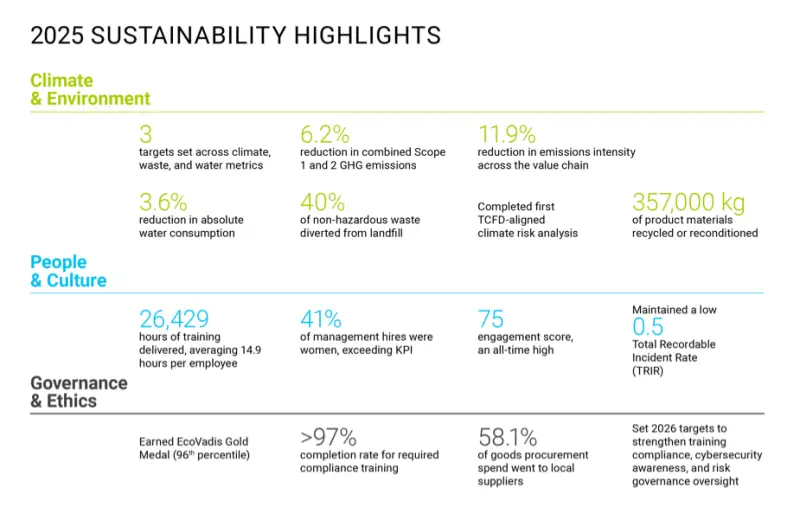
Scope 1 and 2 emissions fell by 6.2% during 2025. The company also reported an 11.9% drop in emissions intensity across its value chain and a 3.6% reduction in absolute water consumption. Those measures track different things: absolute emissions and water use describe total quantities, while intensity reflects emissions relative to an activity or output measure. The report does not give a target for value-chain emissions intensity among the four 2030 goals.
Waste and safety remain further from their stated benchmarks. Stratasys diverted 40% of its non-hazardous waste from landfill, 15 percentage points below the 2030 target. It also reported recycling or reconditioning 357,000 kg of product materials. These material recovery figures describe activity, while the waste diversion percentage shows how much of the non-hazardous waste stream was routed away from landfill.
TRIR was 0.5 for 2025, compared with the company’s goal of less than 0.40. The report presents the rate as a safety measure, but the supplied figures do not specify its calculation basis or the number of incidents behind it. That makes the target clear while leaving readers without enough detail here to compare the rate directly with another organization’s performance.
Stratasys says an independent third party provided limited assurance for its 2025 greenhouse gas data. That qualification gives readers information about the level of external checking: it is an assurance statement, not a claim that every reported measure has been independently verified. The company also published its first climate risk analysis aligned with the Task Force on Climate-Related Financial Disclosures (TCFD). Together, the emissions data, targets and climate analysis are intended to help explain how it manages resources and climate-related risks across its operations.
“Setting clear 2030 targets assures our sustainability commitments turn into accountability we can measure,” said Rosa Coblens, Stratasys’ Vice President of Sustainability and Communications. Coblens added that customers expanding additive manufacturing into production expect suppliers to manage climate risks and resources with comparable discipline.
Broader reporting beyond environmental measures
The report also covers company performance on governance, training and workforce measures. Stratasys received an EcoVadis Gold Medal, placing it in the 96th percentile of more than 150,000 companies assessed worldwide. The company reported that employees completed more than 97% of required compliance training, and that local suppliers received 58.1% of goods procurement spend.
Employees logged 26,429 training hours, an average of 14.9 hours each. The employee engagement score was 75, the highest Stratasys has recorded, and women accounted for 41% of management hires, above the company’s own key performance indicator. The report follows Global Reporting Initiative standards and references the Sustainability Accounting Standards Board framework.
Why value-chain measurement matters to additive manufacturing
The company’s earlier reporting acknowledged a challenge for additive manufacturing: environmental benefits are often claimed without consistent measurement. Stratasys’ 2025 report expanded its accounting to the full value chain, reporting 188,843 metric tons of CO₂ equivalent, with Scope 3 responsible for 92% of the total. The new 2030 goals cover Scope 1 and 2 emissions, so they do not set a direct reduction target for the much larger Scope 3 share described in that baseline.
That distinction matters when production teams assess additive manufacturing against other processes. A printer’s operational energy use is only one part of a product’s footprint; materials, suppliers, transport and use across the value chain can also contribute. Comparisons are most useful when the system boundary and assumptions are clear. Industry debate has reflected that need: consultancy Roland Berger has questioned whether some additive manufacturing sustainability claims are adequately supported and called for more life-cycle assessments.
Measurement tools are developing alongside corporate targets. EOS has developed a cost and carbon calculator for comparing the CO₂ output of 3D printing with alternative manufacturing methods for metal parts. A separate ASTM International project through America Makes focuses on analyzing additive manufacturing sustainability and environmental benefits, with participants including Boeing, ADDMAN, Amaero Advanced Materials and Manufacturing, and the Additive Manufacturer Green Trade Association.
Stratasys’ 2030 commitments give its teams measurable goals, and the 2025 results establish progress against several of them. The key question over the next reporting cycles is whether improvements in operational emissions and water use can continue while waste diversion and the safety rate move toward their stated thresholds—and how the company will report its much larger Scope 3 footprint alongside those targets.
 AMD Venice Uses 2.5D Packaging to Feed More Bandwidth Into EPYC Zen 6
 CNC Controller Board Design: Interfaces, PCB Specs and Assembly Testing
 Stratasys and Nano Dimension End $42.5 Million Markforged Sale Agreement