Neil Hopkinson to Receive AMUG’s 2027 Innovators Award for High Speed Sintering
The HSS inventor will be recognized at AMUG’s 2027 conference for advancing inkjet and infrared polymer powder bed fusion.

High Speed Sintering helped take polymer powder bed fusion beyond laser-based part building. AMUG has selected Professor Neil Hopkinson, Stratasys Vice President of SAF Technology, for its 2027 Innovators Award, recognizing the process he developed to fuse polymer powder without a laser tracing each part.


The award will be presented during the Additive Manufacturing Users Group (AMUG) Conference, scheduled for March 14 to 18, 2027, at Harrah’s Resort in Atlantic City, New Jersey. Hopkinson is also due to appear on the main stage on March 17 for the Innovators Showcase, where he will discuss his career and the thinking behind his inventions in a conversation with AMUG team member Todd Grimm. He is the 12th recipient of the award, which recognizes people whose work has significantly advanced additive manufacturing.
Inkjet deposition replaces laser scanning
HSS uses printheads to deposit an infrared-absorbing fluid onto selected regions of a polymer powder bed. Infrared energy then fuses the treated powder. Because the printheads define the areas to be fused, the method avoids using a laser to scan each part’s cross-section. That change was central to Hopkinson’s aim of making polymer powder bed fusion more suited to production volumes.
The technology originated at Loughborough University, where Hopkinson developed it and the university patented the process. Loughborough says several companies have licensed HSS, with licensees and supply-chain partners generating more than £1 billion in revenue. The university also reports that more than 2,500 machines are installed across Asia, Europe and North America.
Hopkinson described the longer arc of the work in July 2026, saying he began three decades earlier with the aim of moving 3D printing from prototyping into manufacturing. He said his vision was to remove lasers from polymer powder bed fusion to make production scalable, and that the technology had since developed into a manufacturing process.
From doctoral work to industrial systems
Hopkinson’s route to HSS began with doctoral research in the late 1990s. He studied stereolithography for making injection molds, but the work exposed limitations that could constrain broader manufacturing use. That prompted him to explore other ways to make parts additively.
He joined Loughborough University in Leicestershire, England, in 2001 and developed HSS there. The university filed a patent on the process in 2003, then made the intellectual property available for open licensing in 2013. After two decades in academia, Hopkinson moved to Xaar plc, whose printhead technology was important to the process.
As Xaar’s Director of 3D Printing, he worked to commercialize HSS and build a 3D printing business around it. He later became Director of Technology. That work led to an HSS-based printer and Xaar 3D Ltd., a joint venture with Stratasys. The venture introduced the SAF-powered H350 in 2021. Stratasys acquired Xaar 3D Ltd. six months later, and Hopkinson joined the company as Vice President of Technology.
He now leads research and development for SAF as Stratasys Vice President of SAF Technology. SAF draws on HSS principles but uses its own process architecture for production. AMUG previously recognized Hopkinson with its Distinguished Innovator Operator (DINO) Award in 2009.
Commercial examples of inkjet and infrared fusion
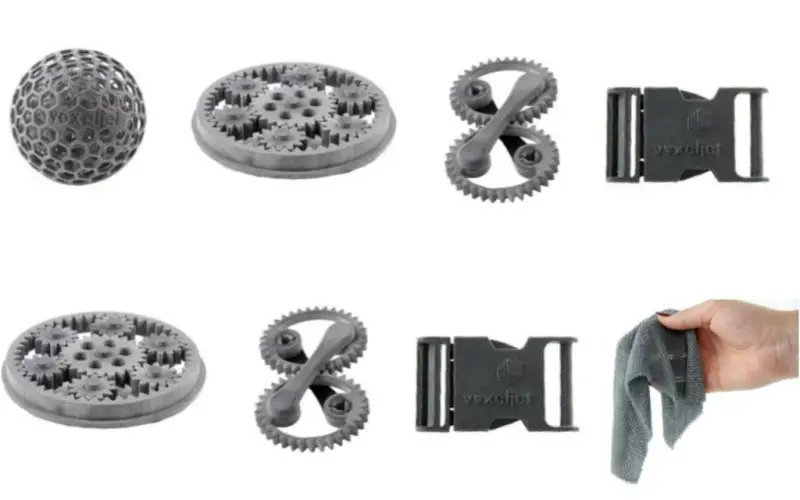
HSS’s licensing history includes voxeljet, a German 3D printer manufacturer that licensed the technology from Loughborough in 2016. Its VX1000 HSS system has a build volume of 1000 x 540 x 180 mm and reported printing rates of up to 7,300 cm³/h. The machine went through a beta program, during which service provider FKM Sintertechnik became the first production partner in voxeljet’s HSS Polymer Network.
HP’s Multi Jet Fusion (MJF) also combines inkjet deposition with infrared energy, though it was developed separately. MJF deposits a radiation-absorbing fusing agent onto selected powder regions and then uses an infrared lamp to fuse them. It also applies a detailing agent to cool boundaries around areas that are not being printed. In a side-by-side comparison of voxeljet HSS, HP MJF and selective laser sintering, HSS and MJF were classified as inkjet-based processes, while SLS was classified as laser powder bed fusion.
AMUG President Dallas Martin said Hopkinson’s work enabled manufacturing with additive technology offering the speed, cost and quality sought in fields including automotive, medical devices and aerospace. Martin also placed him among previous Innovators Award recipients Chuck Hull, Hans Langer, Carl Deckard and Scott Crump, the inventor of fused deposition modeling and a Stratasys co-founder.
The award recognizes a career that links process research, printhead engineering and commercial machine development. HSS and MJF show how inkjet and infrared fusion can be implemented in production polymer systems; Hopkinson’s next chapter is leading SAF development at Stratasys.
 AMD Venice Uses 2.5D Packaging to Feed More Bandwidth Into EPYC Zen 6
 CNC Controller Board Design: Interfaces, PCB Specs and Assembly Testing
 Stratasys and Nano Dimension End $42.5 Million Markforged Sale Agreement