Revopoint’s 3D Scanner Lineup: MIRACO 2, RANGE 3 and Trackit SR Specs
MIRACO 2 adds multi-mode laser scanning, RANGE 3 targets large objects, and Trackit SR tracks scans wirelessly across workpieces up to 4 m.
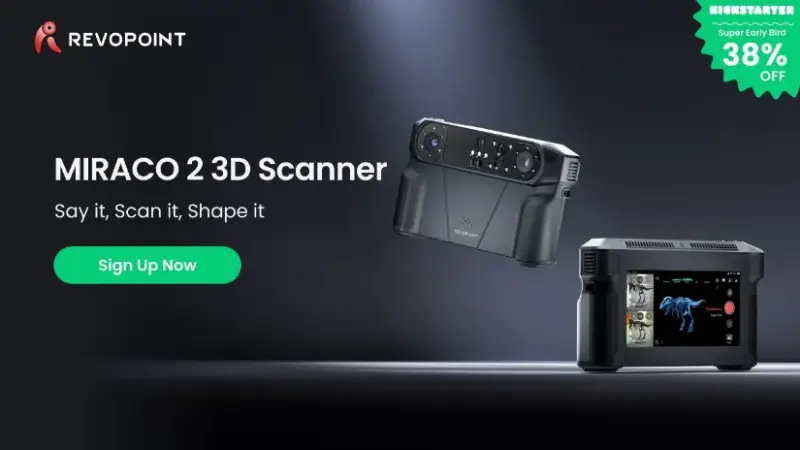
Revopoint’s latest scanners span three distinct workflows: a self-contained unit for switching between scanning modes, wide-field capture for larger objects, and optical tracking that can follow a scanner around a workpiece without placing markers on it. The MIRACO 2, RANGE 3 Series and Trackit SR sit alongside the company’s portable, high-detail and metrology-focused models, making the lineup relevant to tasks from 3D printing and digital modeling to reverse engineering and inspection.
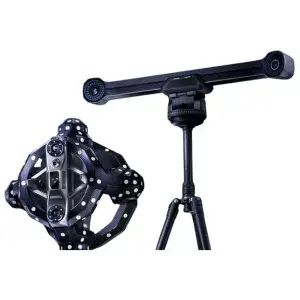
The practical choice depends on the object and the measurement workflow. MIRACO 2 combines several laser and infrared methods in one standalone device. RANGE 3 and RANGE 3 Pro prioritize coverage and portability for medium-to-large subjects. Trackit SR uses a separate optical tracker to determine scanner position, a setup intended for larger parts and spaces where applying markers directly to the object is inconvenient.
MIRACO 2 combines four scanning modes in one device
MIRACO 2 builds on Revopoint’s MIRACO series with blue laser and near-infrared structured-light capture in a standalone scanner. It can scan independently or connect to a PC wirelessly or by cable. That combination is intended to cover a broad range of geometry, from small detailed features to larger objects, without requiring users to change to a separate scanner for each mode.
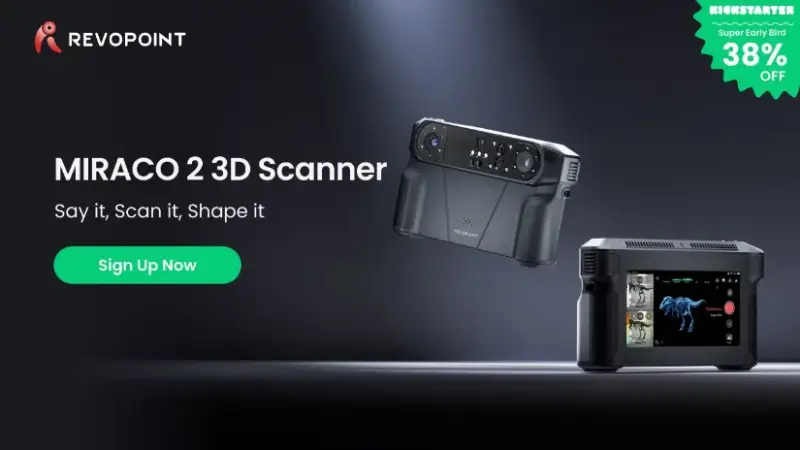
The scanner offers 34 cross-blue laser lines, 15 parallel blue laser lines, a single blue laser line for deep holes, and near-infrared structured light. Each mode addresses a different capture problem: cross lines gather detail across surfaces, parallel lines support coverage, and the single line can reach narrow recesses that are difficult to capture with broader patterns. Infrared structured light adds another method for scanning subjects across a range of sizes.
Revopoint specifies scanning speeds of up to 10 million points per second in hybrid HD mode. In multi-line laser mode, the company lists volumetric accuracy of up to 0.02 mm + 0.05 mm × L (m). These figures describe different aspects of the workflow: point rate indicates how quickly data can be collected, while volumetric accuracy expresses measurement error in relation to scan length.
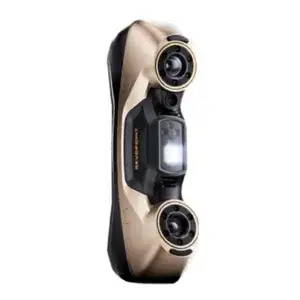
For larger projects, an optional Photogrammetric Metrology Kit works with the scanner’s dual RGB cameras to support 8K photogrammetry. Revopoint says this can improve global positioning accuracy and reduce accumulated error, helping maintain more consistent measurements across a large object. That matters when a scan covers a span too large to treat as one local capture area.
MIRACO 2 is being introduced through a Kickstarter campaign. Revopoint advertised Super Early Bird discounts of up to 38%, and a limited VIP offer in which a $30 deposit provides $70 in additional net savings, an extra year of warranty and 500 marker points for eligible backers. Further workflow details were expected through campaign updates. See the MIRACO 2 launch offer details.
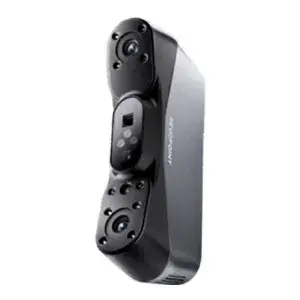
RANGE 3 is built around coverage and portability
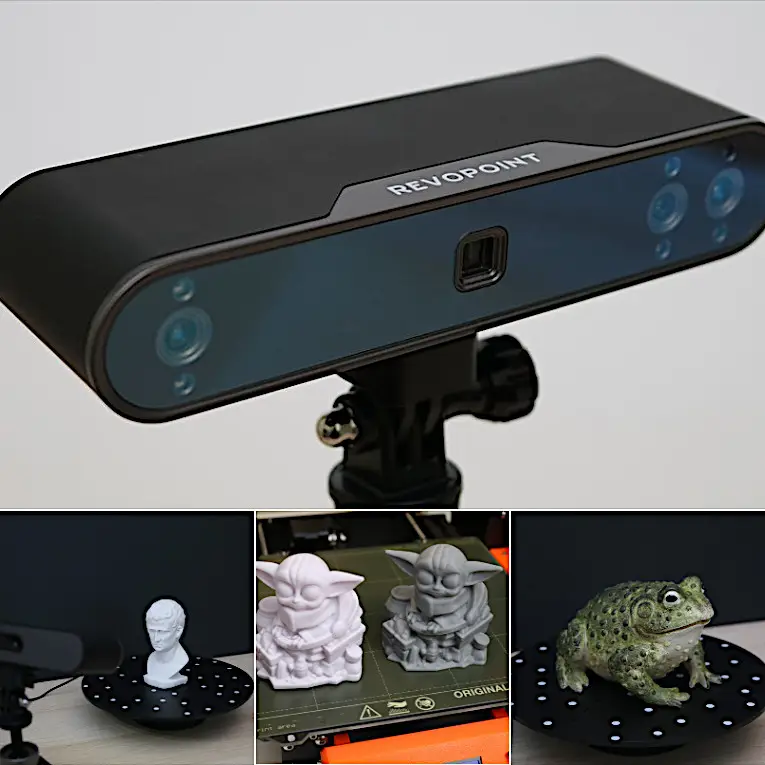
The RANGE 3 Series includes RANGE 3 and RANGE 3 Pro, designed for medium-to-large objects, full-body capture, automotive customization and reverse engineering. Both use infrared structured light and include RGB cameras and fill lights to capture geometry, color and texture. Revopoint lists a scanning area of up to 687 × 672 mm and a maximum scan volume of 4 × 4 × 4 m. The scanners weigh approximately 200–220 g, making them easy to carry between work areas.
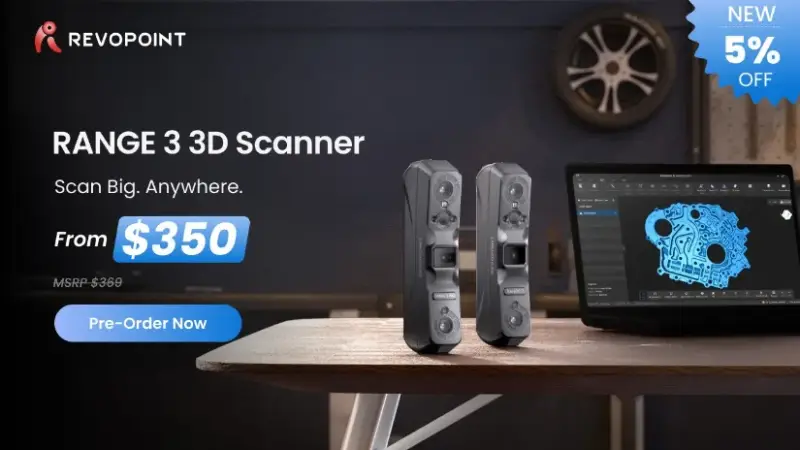
Color-assisted alignment uses surface patterns and texture to help register scan data. This can help when a part has few distinctive geometric features for tracking. Both models support ambient light levels up to 100,000 lux and wireless operation through Wi-Fi 6. RANGE 3 Pro includes a charging handle and magnetic phone holder; these are optional accessories for the standard RANGE 3.
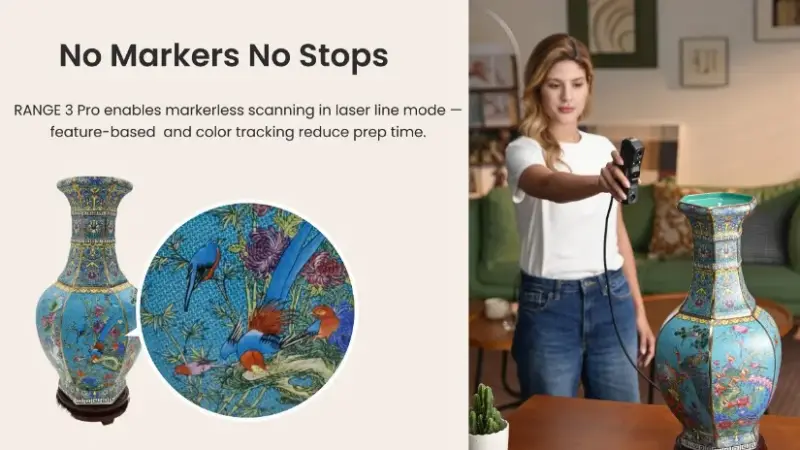
RANGE 3 Pro adds an 11-line infrared laser mode for capturing finer geometry. Its listed volumetric accuracy is 0.03 mm + 0.2 mm × L (m), and Revopoint specifies scanning speeds of up to 105 FPS with NVIDIA GPU acceleration. The Pro also supports markerless tracking when the object has enough shape, color or texture for the software to follow.
Pre-order pricing was listed at $369 for RANGE 3 and $459 for RANGE 3 Pro, with a 5% pre-order discount and an additional offer using code REVORG33DW. Availability and current offers are listed on the Revopoint website.
Trackit SR follows scanner position without object markers
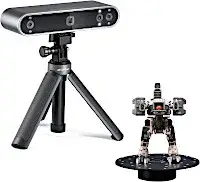
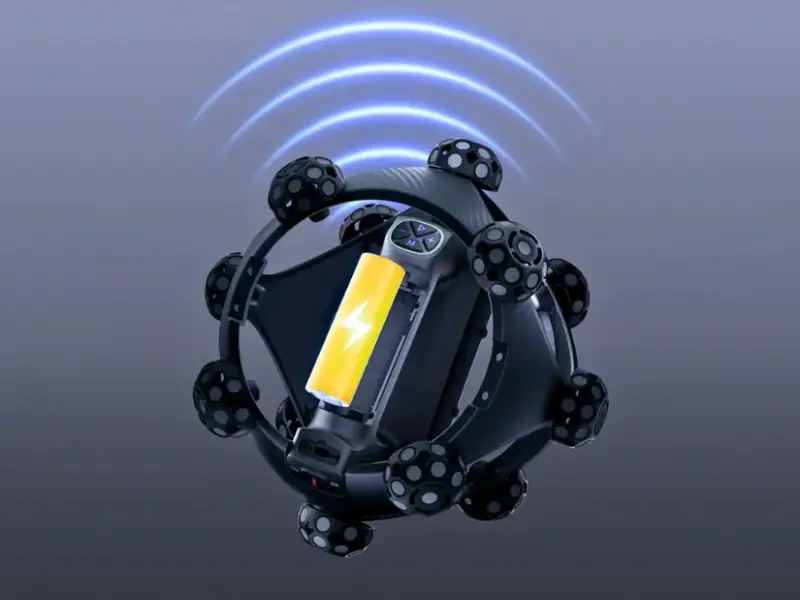
Trackit SR takes a different approach to tracking. A separate optical Tracker monitors the handheld Scanner’s position in real time, allowing marker-free capture without sticking tracking targets directly onto the workpiece. Revopoint positions the system for professional scanning, reverse engineering, inspection and larger-object workflows. The listed starting price is $3,329.
The Tracker and Scanner can both operate wirelessly, so the operator can move around a part without remaining tethered to a computer. For a large object, the Tracker can be moved between scanning stations while shared reference points preserve alignment between captures. Revopoint recommends the system for objects approximately 10 mm to 4 m in size.
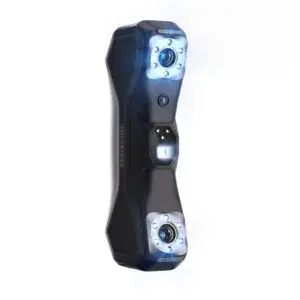
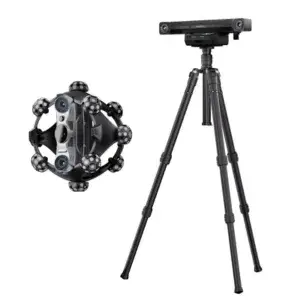
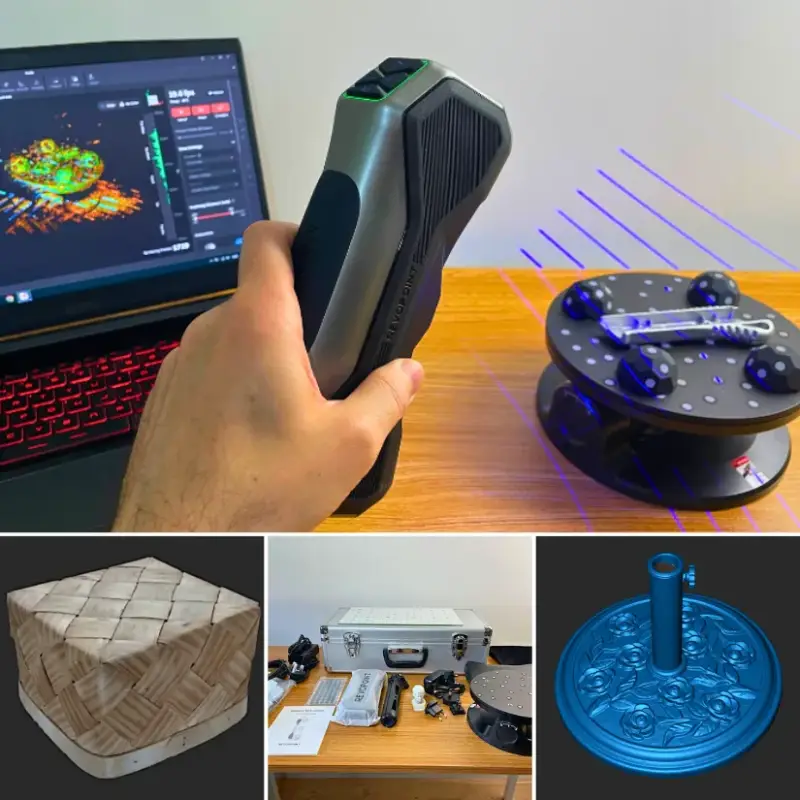
The Scanner combines 30 blue cross laser lines for detailed capture, 17 parallel laser lines for faster coverage over larger surfaces, and a single laser line for hard-to-reach areas such as holes, grooves and crevices. Revopoint specifies a maximum rate of 2 million points per second and tracking-system volumetric accuracy of 0.025 mm + 0.04 mm × L (m).
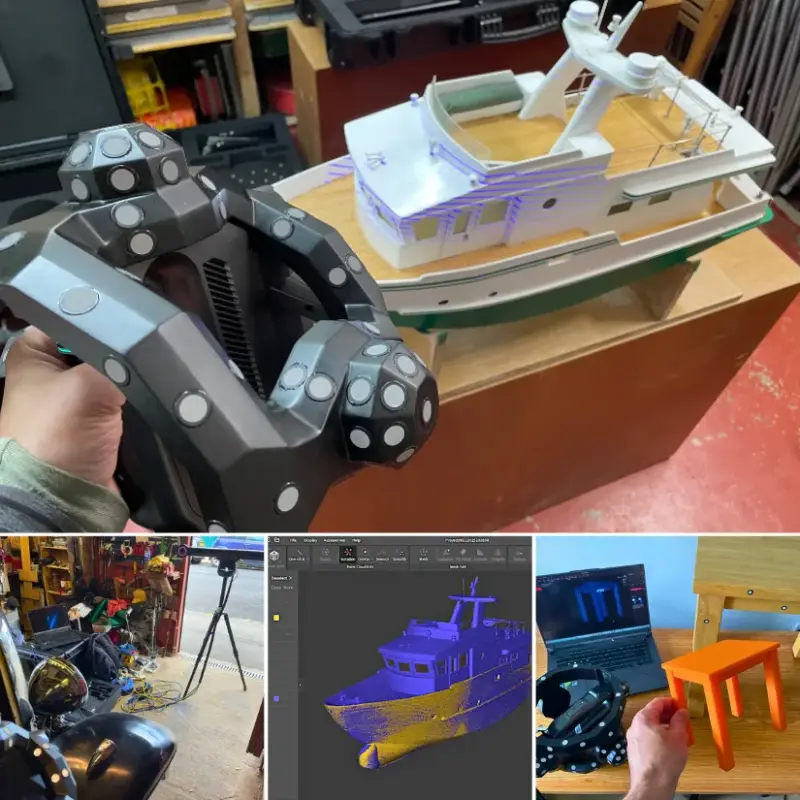
A hands-on evaluation by Max Funkner tested Trackit SR across furniture and a full-size Sea-Doo jet ski, among other projects. The review describes the system as capable on large objects, furniture and workshop parts, particularly where optical tracking without object markers suits the job. Read the Trackit SR review and see scan examples.
Trackit SR is not simply a smaller version of the original Trackit. The original system offers a substantially larger tracking volume, supports objects up to 6 m and has slightly higher volumetric accuracy, while SR adds wireless operation, a lighter design and further scanning flexibility. The original Trackit is listed at $4,482–$4,980.
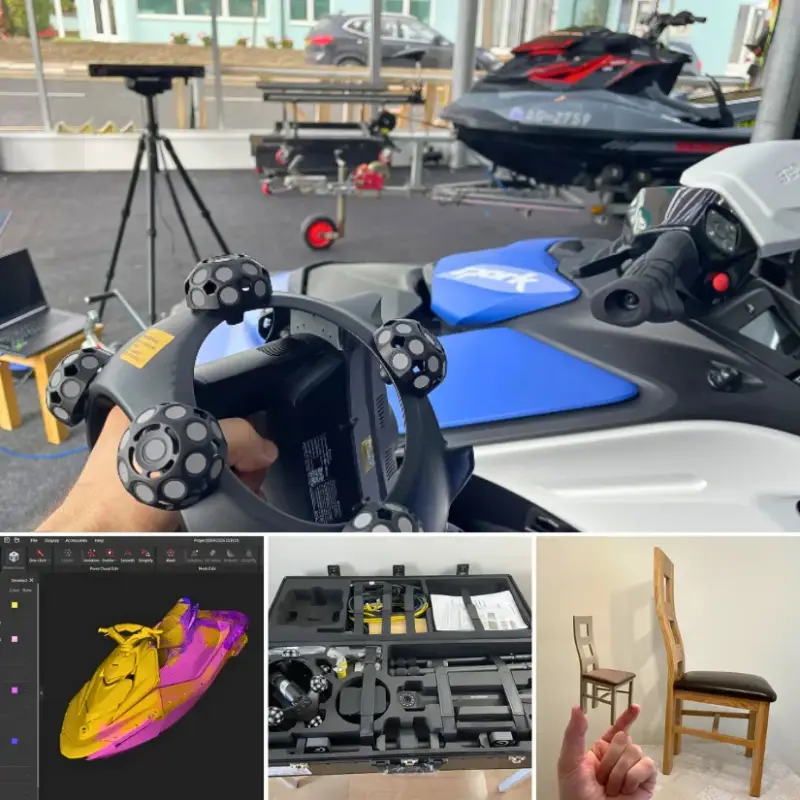
Testing of the original Trackit covered car parts, model boats and furniture, as well as scan-to-print workflows. The hands-on account reports usable meshes and clean geometry across those varied subjects. The system uses infrared cameras and software to track movement, extending capture beyond the limits of a conventional turntable workflow. Read the original Trackit review.
The wider lineup spans creator and inspection workflows
Revopoint’s other scanners help place the new models in context. The MetroY family and MetroY Ultra target higher-precision capture and measurement; POP 4 combines blue laser and infrared methods for everyday use; INSPIRE 2 emphasizes low weight and portability; and MetroX Pro raises scan speed and measurement reliability over MetroX. These models address different compromises in coverage, detail, portability and downstream measurement.
MetroY Ultra adds verification for measurement work
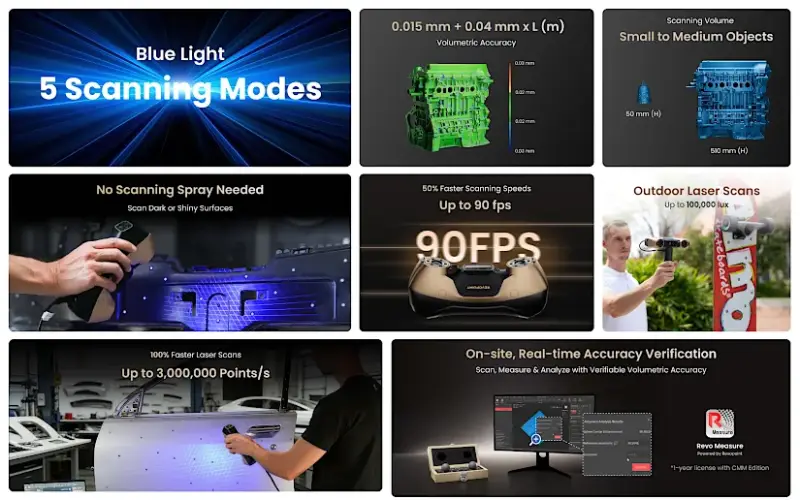
MetroY Ultra is aimed at quality control, reverse engineering and industrial inspection, with a listed volumetric accuracy of 0.015 mm + 0.04 mm × L (m) and multi-line laser scanning up to 90 fps. It offers five modes: cross-line, parallel-line for fine details, single-line for deep holes, full-field structured light and automated turntable scanning.
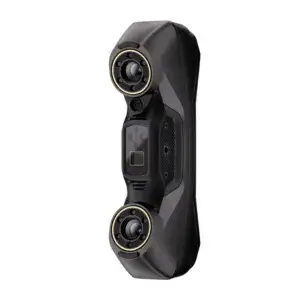
The scanner is specified for outdoor operation up to 100,000 lux. A 5500 mAh battery grip supports wireless use from a mobile device, with around 2.5 hours of untethered scanning. The CMM Edition adds real-time, on-site accuracy verification using a certified carbon-fiber ball plate, and includes Revo Measure for GD&T analysis and reporting. Revopoint lists the Standard Edition from $1,899 and the CMM Edition from $2,499.
MetroY and MetroY Pro pair blue lasers with wireless streaming
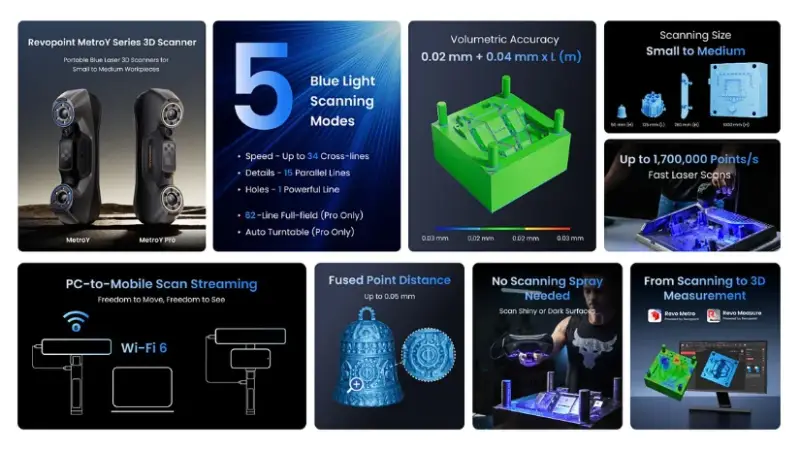
The MetroY and MetroY Pro are handheld blue-laser scanners specified for up to 0.01 mm precision and volumetric accuracy of 0.02 + 0.04 mm × L (m). Both support wireless scanner-to-PC and mobile streaming. MetroY has three handheld laser modes; MetroY Pro expands to five, adding full-field structured blue light for marker-free capture. The Pro reaches up to 7 million points per second and can work with a Dual-Axis Turntable for automated high-detail scanning.
POP 4 combines laser and infrared capture
POP 4 is positioned as an everyday hybrid scanner for small indoor objects and larger outdoor subjects. It combines blue laser with infrared structured light and, according to Revopoint, offers 0.03 mm single-frame accuracy and multi-line laser scanning up to 105 fps. It is specified for outdoor use up to 100,000 lux.
The feature set also includes support for 3D Gaussian Splatting for more photorealistic model exports and a 5500 mAh battery grip rated for up to four hours of wireless scanning. The listed starting price is $579.
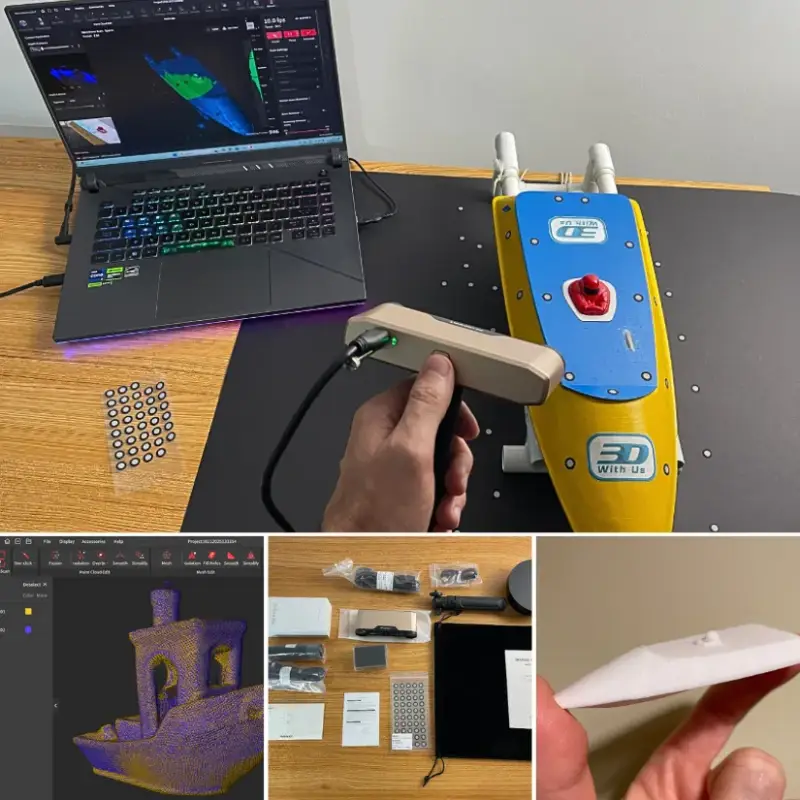
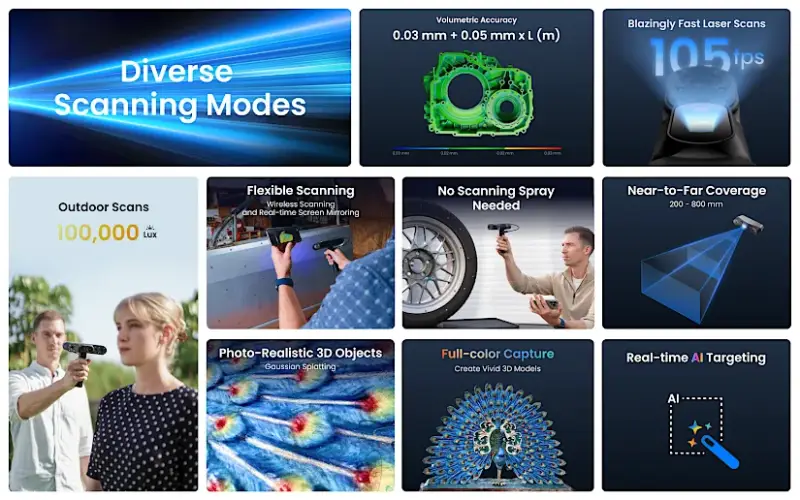
The earlier POP 3 offers a useful point of comparison for hobbyist workflows. It captures full-color texture, has 0.05 mm single-frame precision and a minimum scan volume of 20 x 20 x 20 mm. Capture runs at 12–18 frames per second, and Revo Scan 5 can process point-cloud data into models ready for 3D printing. In a hands-on review, the scanner was described as straightforward to set up and use, with color texture that lacked the detail needed for faithful reproduction of vivid colors or fine surface texture. Read the POP 3 review.
MetroX Pro increases speed and supports mobile viewing
MetroX Pro improves on MetroX with a stated 20% increase in measurement reliability and volumetric accuracy of 0.02 mm + 0.04 mm × L (m). Using 30 cross-blue laser lines, it scans at up to 2 million points per second, compared with 800,000 points for the original MetroX. Revo Mirror enables PC-to-mobile scan streaming, letting an operator view the workflow on a mobile device while moving around a larger object. The listed price range is $1,088.00–$1,209.00.
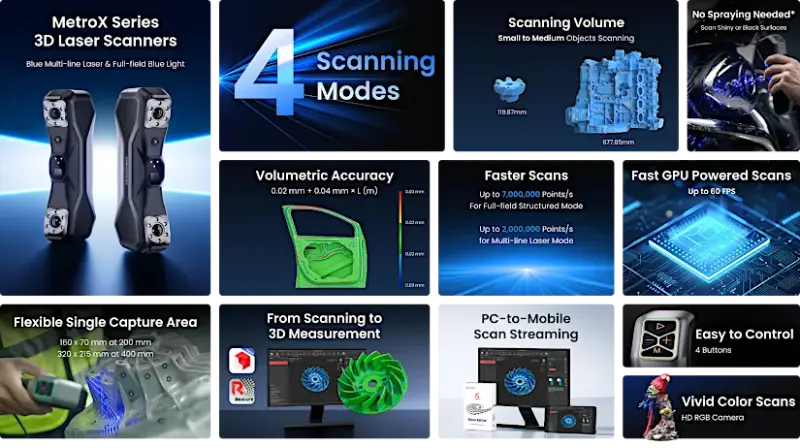
Testing of MetroX included black and shiny metallic objects, with the reviewer reporting good results and describing the Revo Scan 5 MetroX software as clear about scanner movement during capture. Read the MetroX hands-on review.
INSPIRE 2 prioritizes low weight
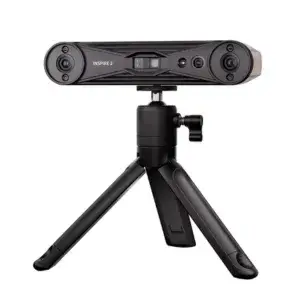
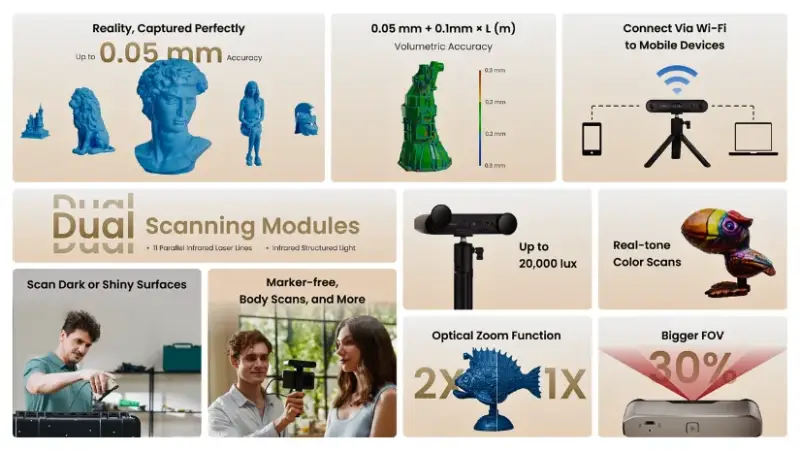
INSPIRE 2 weighs 190 g and is intended for creators, designers and educators who want a compact scanner. Revopoint lists up to 0.03 mm precision and volumetric accuracy of 0.05mm + 0.1mm × L (m). Structured infrared light and multi-line IR lasers support scanning dark and shiny surfaces, with outdoor operation specified up to 20,000 lux.
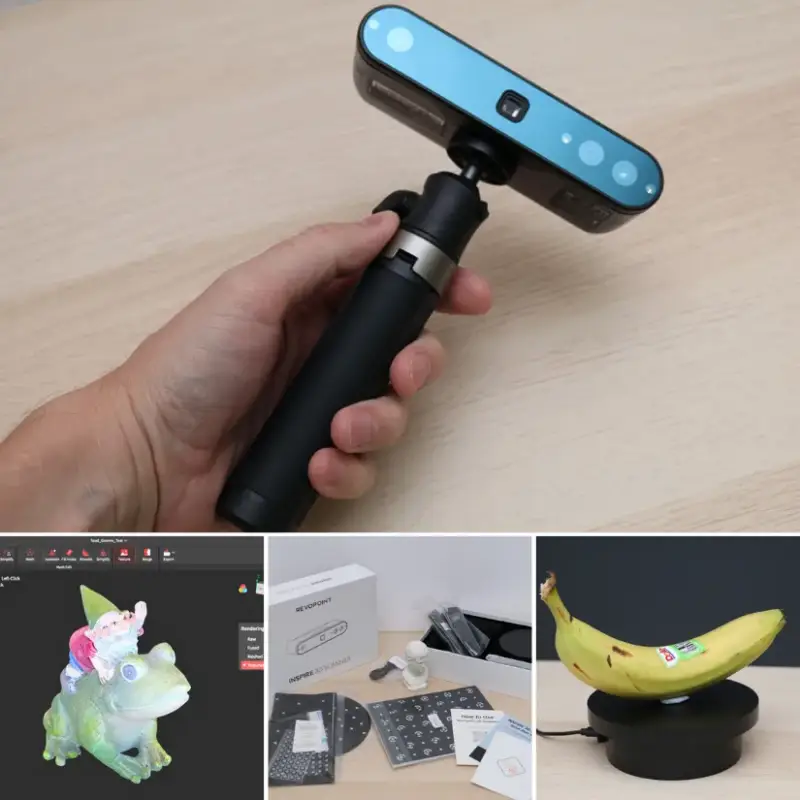
Compared with the earlier design, INSPIRE 2 has a 30% larger scanning area, optical zoom at 1.5x and 2x, and real-time screen sharing over Wi-Fi 6. An optional Power Bank Handle supports mobile operation. In a hands-on test involving an RC boat project, the reviewer scanned, merged and repaired the model, then 3D printed a miniature version. The evaluation found it approachable for beginners and hobbyists, while pointing advanced users toward MetroX or MetroY if they can accommodate a heavier scanner. Read the INSPIRE 2 review.
Software carries scan data into CAD and inspection
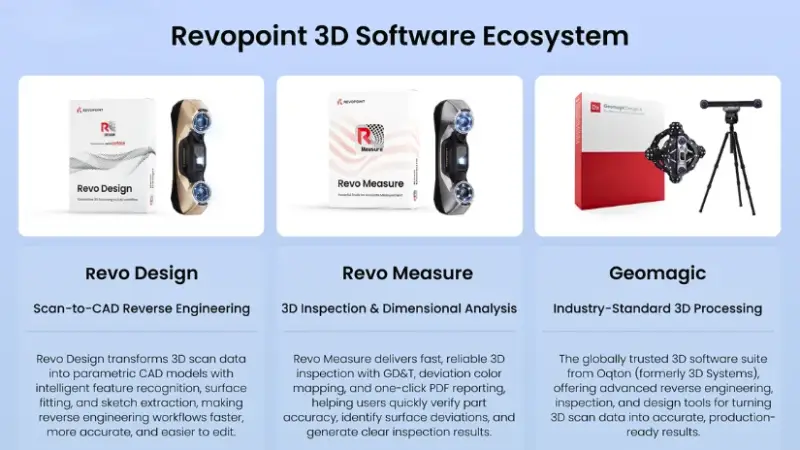
Scanner hardware is only one part of the workflow. Revo Design is aimed at scan-to-CAD and reverse engineering, while Revo Measure provides dimensional inspection, deviation analysis and GD&T tools. Revopoint also offers access to Geomagic Design X and Control X for more advanced reverse-engineering and inspection work. These tools address the steps after capture: turning scan data into editable engineering models, comparing geometry with design intent and producing measurement reports.
The range now includes scanners for mobile capture, wide-field scanning, marker-free tracking and measurement-oriented work. For engineers choosing among them, the useful starting point is the job: object size and surface detail determine the capture method, while required accuracy and downstream CAD or inspection needs determine how the data must be processed.
 AMD Venice Uses 2.5D Packaging to Feed More Bandwidth Into EPYC Zen 6
 CNC Controller Board Design: Interfaces, PCB Specs and Assembly Testing
 Xometry Q3 2026 Revenue Reaches $252.4 Million as Marketplace Margins Rise