Electric-Field Direction Could Tune Heat Flow in Aluminum Nitride
Cornell modeling predicts electric-field direction can shift heat conduction in aluminum nitride; boron nitride tests measured thermal resistance drops of up to 25%.
Electric-field direction may become a design variable for managing heat in high-power electronics. Cornell University researchers modeled how an applied field changes phonon-mediated thermal conductivity in aluminum nitride (AlN), while experiments on hexagonal boron nitride (hBN) flakes found thermal resistance reductions of up to 25% under strong electrical fields. Together, the results point to a possible way of adjusting heat flow through crystal orientation and electrical bias.

That prospect matters because AlN combines an ultrawide bandgap with the ability to withstand higher electric fields than many other materials. Those properties make it a candidate for high-voltage power electronics and high-power radio-frequency devices, where high power density can also produce substantial heat. A material whose heat transport responds to an operating field could offer designers another factor to consider alongside device geometry and the thermal path into a package.

Modeling the field’s effect on the crystal
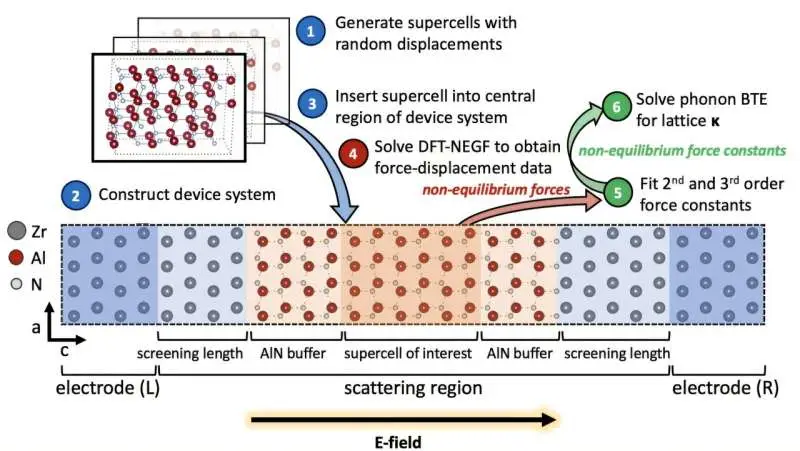
A team led by Zhiting Tian at Cornell developed a theoretical method that combines density functional theory (DFT) with the nonequilibrium Green’s function (NEGF) approach. The researchers adapted this DFT-NEGF framework to calculate thermal conductivity carried by phonons when an electric field is present. Their simulations placed AlN crystals between two electrodes.

Phonons are collective atomic vibrations that carry thermal energy through a crystal lattice. Their movement is interrupted when they scatter through interactions with other phonons, limiting how efficiently heat travels. The Cornell team’s model examines how an electric field can change that process by altering the electronic distribution in the crystal. The changed distribution affects the forces between atoms, which can strengthen or weaken atomic bonds depending on the field’s orientation relative to the crystal’s polarity.

The model’s predicted baseline for heat flowing perpendicular to an AlN film is 334 watts per meter-kelvin with no applied electric field. Applying a field in one direction raises the predicted thermal conductivity; reversing the field lowers it. The reported results establish the directional effect, but they do not provide a numerical conductivity for either field direction. The 334 W/m·K value therefore serves as the stated zero-field reference, rather than a complete set of operating points.
For device design, the key implication is that the field and crystal orientation may need to be considered together. If a crystal is oriented so that the operating field favors stronger heat transport, the modeled mechanism suggests heat could move more readily through the material. The reverse orientation could produce a different result. That makes electrical bias relevant to thermal behavior at the material level, rather than treating conductivity as a fixed property independent of operation.

Experimental evidence from boron nitride
A separate study examined single-crystal hBN flakes, another material with a wide bandgap, used here as an electrical insulator. Researchers applied strong electric fields to flakes fitted with metal electrodes and used laser-based frequency-domain thermoreflectance to measure thermal resistance. In one device, repeated experiments showed reductions of up to 25%.

That measurement is a complementary result, not a direct experimental confirmation of the AlN simulation: the materials and methods differ. The hBN work reports a change in thermal resistance, while the Cornell AlN calculations predict a change in thermal conductivity. Both results, however, support investigating whether electrical conditions can affect heat transport in crystalline materials.
The distinction matters when interpreting the potential for practical use. The reported hBN reduction applies to one particular device and is the largest value described; the source provides no broader range, operating conditions, or device lifetime data. Likewise, the AlN result is computational, and the reported zero-field value does not by itself show how much conductivity changes under a usable field. More measurements across materials, field orientations, and device structures would help establish where the effect is large enough to influence thermal design.
A new variable for thermal design
For engineers working with high-power electronics, the work suggests a possible design question: can the crystal’s polarity and orientation be matched to the direction of the field that the device will experience? If so, thermal management might draw on a material’s field-dependent response as well as its conventional heat-spreading geometry. The findings do not establish a ready-to-use cooling method, but they give researchers a mechanism to test and quantify.
The next useful step is to connect the predicted conductivity changes and measured resistance changes to well-defined operating conditions and device layouts. Until those links are established, electric-field control of heat flow remains a promising material-level effect. Still, the results make crystal orientation worth tracking when assessing how wide-bandgap materials behave under electrical stress.
 AMD Venice Uses 2.5D Packaging to Feed More Bandwidth Into EPYC Zen 6
 CNC Controller Board Design: Interfaces, PCB Specs and Assembly Testing
 Stratasys and Nano Dimension End $42.5 Million Markforged Sale Agreement