Flinders University Tests a 9V-Activated Antibacterial Coating Made with Gallium and Carbon Nanotubes
A cracked gallium and nanotube film showed higher bacterial cell death after a one-minute 9V stimulus, though current and application limits remain unclear.

A one-minute connection to a 9V battery increased bacterial cell death in tests of a flexible coating made with liquid gallium and carbon nanotubes, researchers at Flinders University report. The material uses microscopic cracks formed during drying as part of its design: the team proposes that these features concentrate the electric field and help activate antibacterial effects.

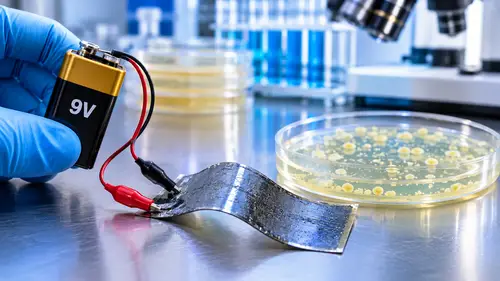
Electrical stimulation raised cell death in tests
The reported experiment applied a one-minute electrical stimulus using a standard 9V battery connected to the coating with conductive clips. Within three hours, cell death exceeded 80 per cent for the tested bacteria. For Pseudomonas aeruginosa, the unstimulated control had a cell death rate of 65 per cent; stimulation raised that figure above 80 per cent. For methicillin-resistant Staphylococcus aureus (MRSA), the control rate was 72 per cent, compared with more than 85 per cent after stimulation.

Those control results matter when assessing what the battery contributes. The unstimulated samples already showed substantial cell death, so the reported comparison points to an increase associated with electrical activation rather than an effect that appears only when the battery is connected. The results describe these laboratory tests; they don't establish performance in a wound, on a wearable device, or under routine use.

The source account does not state the current delivered to the coating. A 9V battery identifies the supply voltage, but without a current measurement and more detail about the electrical conditions, it doesn't fully describe the stimulus experienced by the material. The one-minute exposure and three-hour assessment window provide useful boundaries for the reported result, while other testing conditions aren't specified there.
Drying cracks become part of the material design
The coating combines liquid gallium, which melts close to room temperature, with carbon nanotubes. As the film dries, small cracks form over its surface. Flinders researchers describe these features as “stress-programmed microcrack networks,” treating them as functional structures rather than simply defects that must be eliminated.

The proposed mechanism centers on electric-field concentration. According to the researchers, crack edges and the points where cracks meet can create localised hotspots when the film is stimulated. These regions may intensify the coating’s antibacterial activity. That explanation remains a proposed mechanism in the reported work; the available account does not provide field measurements or enough detail to quantify how much each crack network contributes.

The team also carried out separate tests in which the material generated atmospheric plasma. Those tests produced reactive species capable of inactivating bacteria. This offers another possible route for antibacterial action, but it should be kept distinct from the battery-stimulation result: the reported information does not establish that plasma generation explains the cell-death increase in the battery experiment.
Early biocompatibility results leave application questions
Associate Professor Vi Khanh Truong, who led the work at Flinders University’s Biomedical Nanoengineering Laboratory, described the ability to trigger an antimicrobial response when needed as a potential advantage. A coating that can be activated on demand could be useful where a material is intended to respond to a specific condition or treatment step. The experiment, however, does not establish how often the coating could be activated, how long an effect would last, or how its performance would change with repeated use.
Tests with HaCaT human skin cells showed cell growth and attachment. That is an early result relevant to possible skin-contact applications, but it does not by itself establish safety or suitability for patient use. The research account identifies smart wound dressings and wearable patches as possible applications. Such patches might combine health-signal monitoring, including heart or muscle activity, with an antibacterial function. No device performance, clinical outcome, or finished product is reported.
For engineers evaluating the concept, the next useful details would include the electrical current and stimulus conditions, the coating’s behaviour over repeated activation, and how the crack pattern and conductive properties vary across samples. Application work would also need to address how the film performs in the intended environment and how its contact with skin is assessed. These are open engineering questions; the reported findings do not yet answer them.
The work remains at the research stage, and Truong said further development is needed before the coating reaches patients. The university’s account of the research is available here. For now, the result is a laboratory demonstration that a low-voltage supply can activate a gallium and nanotube film, with the measured effect and its mechanism still needing fuller characterisation.
 AMD Venice Uses 2.5D Packaging to Feed More Bandwidth Into EPYC Zen 6
 CNC Controller Board Design: Interfaces, PCB Specs and Assembly Testing
 Stratasys and Nano Dimension End $42.5 Million Markforged Sale Agreement