Rohde & Schwarz FNH Combines Spectrum, VNA and Power Measurements
The R&S FNH puts spectrum, real-time, two-port VNA and power measurements in a handheld platform, with options covering up to 26.5 GHz.
Field RF work often involves moving between signal analysis, cable checks and antenna measurements. Rohde & Schwarz’s R&S FNH brings several of those tasks into one handheld instrument, reducing the need to carry separate analysers for each measurement type. Its appeal will depend on the options fitted and the frequency range required, but the combination targets both field servicing and laboratory work.

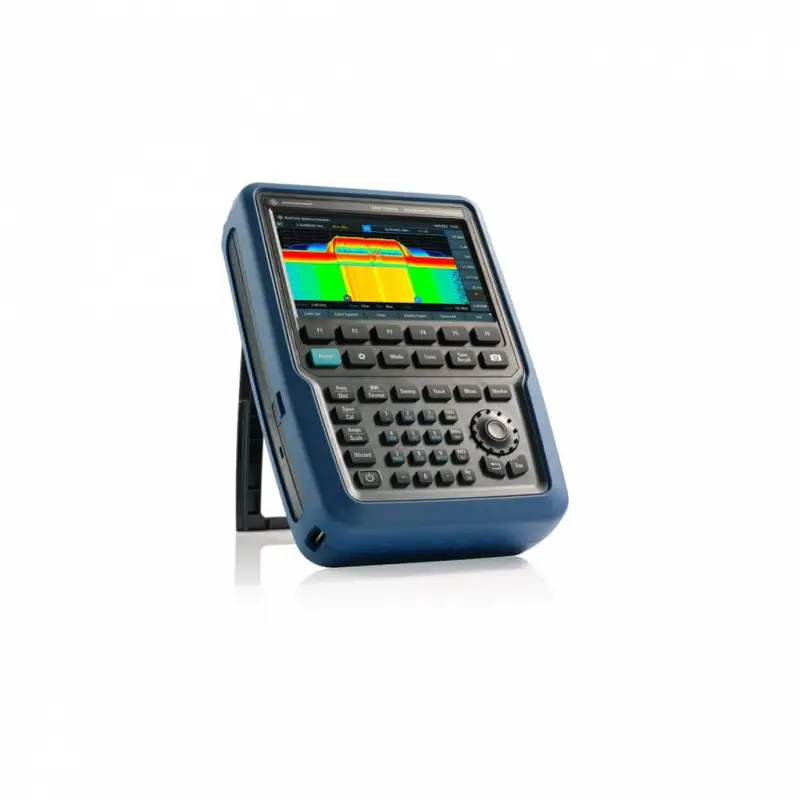
One platform, several RF jobs
Rohde & Schwarz describes the FNH as a handheld combi analyser. Spectrum analysis is included as standard. Real-time spectrum analysis (RTSA), cable and antenna testing (CAT) and two-port vector network analysis (VNA) can be enabled with keycodes. Power measurements require a compatible USB power sensor, while pulse analysis is an additional option.

That mix addresses a practical workflow: an engineer can inspect signal activity, investigate interference and assess cables or antennas using the same instrument. A VNA provides measurements of how a network behaves across frequency, while spectrum analysis shows signal energy across a selected span. RTSA adds a way to monitor changing signals, and the external power sensor extends the instrument to power measurement. These functions answer different questions, so combining them can reduce equipment changes during a site visit; it doesn’t make their setup or accessories interchangeable.

The licensing and sensor requirements matter when specifying a unit. Buyers need to identify which measurement functions are enabled, whether the intended work needs CAT or VNA, and whether a compatible USB power sensor is available. Pulse analysis also needs to be added. Those details determine how much of the advertised measurement set is ready to use on a given instrument.

Frequency coverage and transient capture
The FNH family is offered in three versions covering up to 6 GHz, 13 GHz or 26.5 GHz. The instrument’s VNA capability reaches 26.5 GHz, while spectrum analysis can extend to 32 GHz. Rohde & Schwarz says the spectrum range can be extended, although the available extension limits aren’t specified in the supplied product information.
These figures describe different capabilities: the top VNA frequency and the maximum stated spectrum-analysis frequency are not the same. Teams comparing configurations should match the model’s coverage to the signals, cables and antennas they need to test, then confirm the enabled functions and any required options. The three frequency versions provide a clear starting point, but the stated maximum for spectrum analysis shouldn’t be read as the VNA limit.

For transient signals, RTSA and IQ capture bandwidths support monitoring and recording, with intercept times down to 3.6 μs. That short intercept figure is relevant when the signal of interest appears briefly. The product information doesn’t provide test conditions or a detailed capture specification, so the number alone doesn’t establish performance for every signal type or measurement setup.

Field use and analysis software
The instrument has an IP51 rating and a stated operating temperature range of -10°C to +55°C. An optional rain holster raises the rating to IP54. That distinction gives field teams a concrete environmental specification to consider when selecting protection for outdoor work; the product details don’t describe additional environmental limits.
Rohde & Schwarz lists radar maintenance, satellite ground-station testing, communications servicing, interference hunting and spectrum monitoring among the intended applications. The FNH can also be used in a laboratory. Signal demodulation analysis is available through R&S VSE software, linking handheld acquisition and measurement work with software-based analysis.
Michael Fischlein, Rohde & Schwarz Vice President RF Test Solutions, said the device combines what he described as the widest real-time bandwidth in its class with spectrum analysis and two-port VNA measurements. That bandwidth comparison is the company’s characterization; the supplied product details give no comparative figures or test conditions to assess it independently.
The practical case for the FNH is consolidation: a field engineer can carry one platform for several RF measurement tasks, while configuring options and accessories around the job. Before choosing a version, the key checks are frequency coverage for both spectrum and VNA work, which functions are enabled, the need for a USB power sensor, environmental protection and the software required for demodulation analysis.
 AMD Venice Uses 2.5D Packaging to Feed More Bandwidth Into EPYC Zen 6
 CNC Controller Board Design: Interfaces, PCB Specs and Assembly Testing
 Stratasys and Nano Dimension End $42.5 Million Markforged Sale Agreement