TAPe+ML v3.5 Runs Detection, Classification and Segmentation on One CPU Core
Comexp’s 4.2 MB vision platform combines three image tasks and reports inference times of 20.4 ms on Raspberry Pi 5 and 34.7 ms on Pi 4.

Running object detection, image classification and instance segmentation on one CPU core could simplify vision deployments on compact systems. Comexp Research Lab’s TAPe+ML v3.5 combines those tasks in a software package measuring about 4.2 MB, with fewer than 100,000 parameters and no requirement for GPU acceleration.

The reported results make the platform relevant to edge projects where power, board size or system cost limits the choice of compute hardware. But the numbers describe a particular set of benchmarks; teams evaluating it will still need to check performance with their own image sizes, workloads and processor configurations.

One shared recognition core
Many vision pipelines rely on separate models for classification, detection and segmentation. TAPe+ML instead builds a structured representation of an image and uses that shared representation to support all three tasks. For larger images, it also applies a learned region selector, which identifies portions of the input for processing.
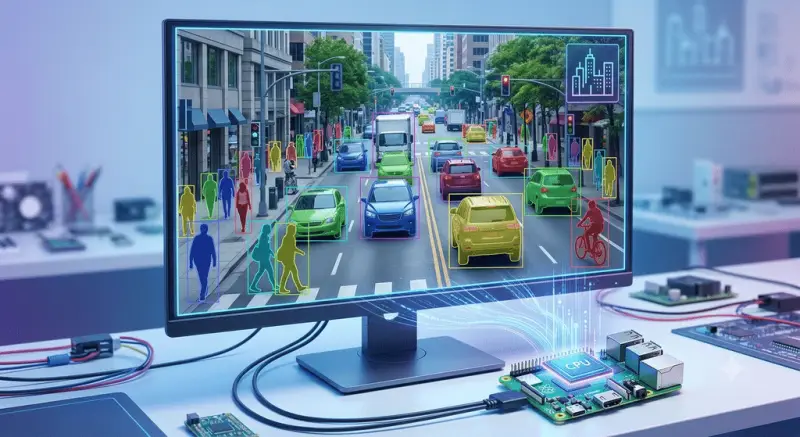
That design has practical consequences for deployment. A shared core can reduce the number of model files and inference components that need to be packaged and maintained. It may also make it easier to combine different outputs from one image pipeline. The available information does not specify how the system’s accuracy or latency changes when multiple tasks run together, however, so those details need to be measured against the intended application.

The three outputs serve different purposes. Classification assigns a label to an image, detection identifies objects and their locations, and instance segmentation marks object regions at the pixel level. Having them in one platform gives developers a route to build applications that need more than a single kind of visual output without assembling entirely separate model stacks.

Reported speed and accuracy
Comexp says it tested TAPe+ML on several CPU configurations, including Raspberry Pi 4, Raspberry Pi 5 and Intel N100 systems. Across the reported configurations, inference took between 8.6 ms and 34.7 ms per frame using one CPU core. The specific figures given for the Raspberry Pi boards are 20.4 ms on Pi 5 and 34.7 ms on Pi 4.
Those timings suggest that the software can process frames on small general-purpose computers without a GPU, while leaving other CPU cores available for application logic, communications or user interface work. A per-frame time alone does not establish end-to-end throughput: camera capture, image resizing, data transfer and downstream actions can all add delay. The test conditions and input resolution are not stated, so direct comparisons with other systems would require more detail.

On ImageNet-1k, the model recorded 88.0% top-1 accuracy. For object detection, it reached 71.1 box average precision (AP) on the COCO validation set. The reported instance segmentation result was 60.3 mask AP. On the COCO test set, the system scored 66.0 and 58.0; the supplied details do not identify which task corresponds to each of those two values.

These figures provide a useful starting point for evaluation, but benchmark scores don’t settle whether the platform fits a particular deployment. Image distribution, object scale, lighting and the cost of missed or incorrect detections can all affect suitability. A production trial should measure the target task and hardware together.
Small package, flexible deployment
The complete package is about 4.2 MB, including model weights, inference code and libraries. TAPe+ML can be used through an online workbench for uploading images, annotation, training and evaluation, with API integration also supported. The platform is available online, and Comexp says it can also be provided for local use on devices or on-premise systems.
Local deployment is the more relevant option for devices that need to process images without sending them to a hosted service, though the stated information doesn’t detail supported operating systems, memory requirements or offline setup. Some newer processors may need adjustments before they work with the system, so compatibility should be confirmed on the exact target board.
For engineers considering compact vision hardware, the main appeal is the combination of three tasks, a small software footprint and single-core operation. The next useful evidence will be measurements under clearly specified input and workload conditions, especially when detection and segmentation must meet a real-time deadline on the chosen device.
 AMD Venice Uses 2.5D Packaging to Feed More Bandwidth Into EPYC Zen 6
 CNC Controller Board Design: Interfaces, PCB Specs and Assembly Testing
 Stratasys and Nano Dimension End $42.5 Million Markforged Sale Agreement