Nuvoton Gerda and Qt for MCUs Target Rich HMIs Without External Memory
Nuvoton and Qt pair Gerda’s integrated resources with compressed graphics to support animated interfaces while reducing memory and component requirements.

Rich graphics on an embedded display can bring a hardware cost: external memory, its board space and the design work needed to integrate it. Nuvoton Technology Corporation Japan (NTCJ) and Qt Group are combining the Gerda HMI controller platform with Qt for MCUs to target that trade-off. The companies say the setup can run graphical interfaces for products such as motorcycle dashboards, head-up displays and washing machines without adding external memory. The pitch is straightforward: fit more of the display system into the controller and its software, then avoid a separate memory device where the application allows it.

That claim matters because memory affects more than the component list. It can shape the board layout, power and signal routing, software architecture and the amount of work needed to bring a display subsystem into production. This is more significant than it looks for products built at high volume, where removing a component may also simplify assembly and sourcing. But “without external memory” is a design target, not yet a quantified performance result in the announcement.

Keeping the display system compact
The approach brings together resources inside Gerda and a graphics software stack. Gerda provides internal RAM alongside display, connectivity and control interfaces. Qt for MCUs supplies the graphics engine, reusable interface components and development environment. Nuvoton says its texture compression works with Qt’s optimised graphics to reduce the memory needed for images and animation. The intended division of work is clear: the controller supplies the hardware resources, while the software stack manages how interface assets are represented and rendered.

For an embedded product, avoiding a separate memory device can reduce the number of components on the board and help contain system cost, particularly in products made at high volume. It can also simplify the hardware design by removing an external memory connection from the display subsystem. That said, the announcement does not specify Gerda’s RAM capacity, supported display resolutions, frame rates or the amount of memory saved. Designers will need platform-level data before they can tell which interface designs fit, and whether the savings justify any limits on screen complexity.

The memory constraint shapes more than the bill of materials. Animated transitions, layered graphics and detailed screens all consume storage and runtime memory, and those demands can vary with the assets and the way an interface is built. Compression can make visual assets more compact, while the controller’s internal RAM provides the working space the interface needs. The practical result depends on the assets, display configuration and application workload; the companies haven’t published quantitative limits for those conditions. In other words, compression is part of the engineering answer, but it doesn’t remove the need to measure the actual design.
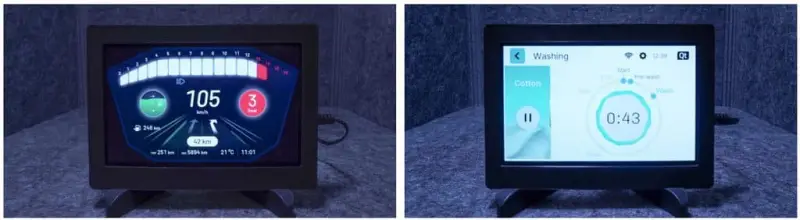
NTCJ and Qt describe the combination as suitable for automotive displays and appliance interfaces. Demonstrations include a motorcycle instrument cluster and a washing machine user interface. These examples show the intended range: a display that presents operating information in a vehicle, and a touch panel used to configure a household appliance. The announcement also names head-up displays as a potential application, without giving details on optical systems or display performance. Those omissions leave open how the platform would handle the specific rendering, timing and integration demands of each product.

Software tools and update support
Qt for MCUs includes a component library and the QML language for describing user interfaces. Its development environment also provides simulation tools, and the companies say AI-driven tools can help reduce development effort. Reusable components and simulation may help teams build and review screens before they run on the target controller, though no development-time comparison or benchmark is provided. If you’re working in this space, the useful question is how much of the simulated design carries through to the hardware and how much still needs tuning on the actual display.
The platform also supports over-the-air updates, allowing manufacturers to revise interface graphics and add features after deployment. Nuvoton says Gerda’s security features work with Qt for MCUs to enable this capability. For connected vehicles, two-wheelers and home appliances, remote updates can extend the life of an interface, but product teams still need to establish how updates are authenticated, managed and recovered if an installation fails. (And this is the part most people overlook.) An update path is a system feature, so it has to be considered alongside the product’s connectivity, security and maintenance design. The announcement doesn’t describe those implementation details.

Yoshihide Kanakubo, Nuvoton’s Vice President of Battery and Automotive BG, said the pairing is intended to balance graphical performance, memory efficiency and system cost. That balance is the central engineering question for manufacturers evaluating the platform: whether the required screen behavior and update needs fit within Gerda’s integrated resources while meeting the product’s cost target. The software tools may help teams develop interfaces, but they can’t answer that hardware fit question on their own. Here’s the thing: the value of the combination will depend on the limits the companies haven’t yet detailed.

What product teams still need to establish
NTCJ and Qt haven’t provided pricing, availability, detailed hardware specifications or compatibility information in the announcement. Product teams will need those details, along with display and application limits, to assess a design. They’ll also need to understand how the compression behaves with their own images and animation, since asset choices and interface behavior affect memory demand. Until those details are available, the announcement describes an approach and its intended applications rather than a fully bounded design envelope.
For now, the combination points to a practical route for adding richer embedded interfaces where board area, component count and memory cost are constrained. The case is strongest where the desired interface can fit within the controller’s internal resources and where avoiding a separate memory device meaningfully simplifies the product. And yet. Without published limits, engineers still have to treat the trade-off as something to validate on the target system, not assume from the platform description alone.
 AMD Venice Uses 2.5D Packaging to Feed More Bandwidth Into EPYC Zen 6
 CNC Controller Board Design: Interfaces, PCB Specs and Assembly Testing
 Stratasys and Nano Dimension End $42.5 Million Markforged Sale Agreement