Renesas RZ/T2N Combines Four-Axis Motor Control and Industrial Ethernet
Renesas’ RZ/T2N pairs application and real-time cores with motor-control and Ethernet hardware for robots, servo systems and PLCs.
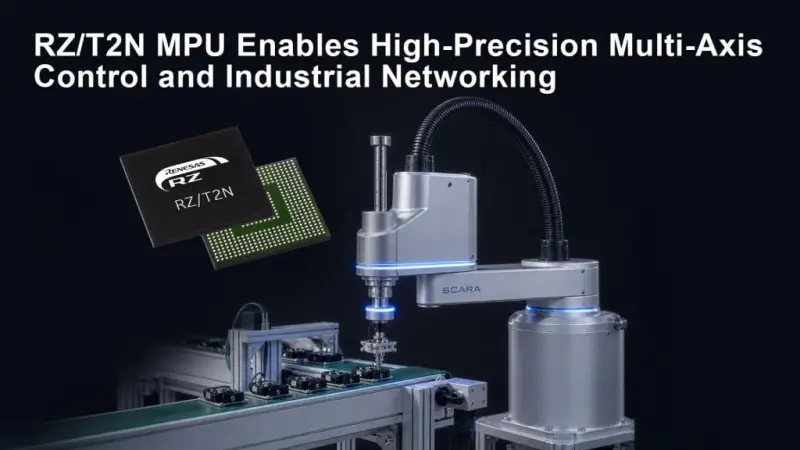
Putting motion control, network communication and application processing on one chip can simplify the control architecture of industrial equipment. Renesas Electronics Corporation’s RZ/T2N 64-bit microprocessor (MPU) combines those functions for equipment such as industrial robots, multi-axis servo systems and programmable logic controllers (PLCs). Its main engineering proposition is integration: designs that previously used separate devices for real-time control, networking and application code may be able to consolidate those roles on a single platform.

Two processing domains on one MPU
The RZ/T2N uses two Arm Cortex-A55 application cores running at up to 1.2GHz, alongside two Arm Cortex-R52 real-time cores operating at up to 800MHz. This split gives a system designer distinct processing resources for application tasks and time-sensitive control. The application cores can handle higher-level equipment functions, while the real-time cores are intended for work where predictable execution matters, including motor control.

Each Cortex-R52 core has 576KB of error-correcting-code (ECC) protected tightly coupled memory (TCM). Keeping critical code and data in TCM can reduce variation in execution time by avoiding some of the unpredictability associated with shared or external memory access. For servo control, timing consistency matters alongside raw processing speed: control loops need to respond at regular intervals as they process feedback and update motor commands.

The integrated approach may reduce the number of processors and communication components on a control board, as well as the board area and design effort associated with connecting them. That can make a common hardware platform practical across several equipment types. The actual savings will depend on the design: the MPU’s integration does not, by itself, establish the required external memory, analog front end, power stage or safety circuitry for a particular machine.
Motion hardware for as many as four axes
Renesas specifies motion-control peripherals for up to four motor axes. That capacity aligns with machines that coordinate several motors, including SCARA and Delta robots. The MPU also provides two encoder interface channels per axis, giving the controller multiple feedback connections for each supported motor axis.

Encoder compatibility spans several named interfaces: Tamagawa T-Format, HIPERFACE DSL, A-format, EnDat 2.2, EnDat 3, BiSS C and BiSS Line. Supporting these interfaces at the MPU level can simplify the connection between position feedback and control processing, especially in systems built around established encoder families. Designers still need to check the specific interface requirements of their selected motor and encoder, along with the electrical implementation and software support in the complete system.

For a multi-axis machine, bringing the processing and motion peripherals together can reduce the coordination work between separate control devices. It also gives equipment makers a platform they can adapt across applications. The four-axis figure describes the supported motion capacity; it does not specify the performance of a complete machine, such as achievable positioning accuracy, cycle time or payload.
Ethernet options and network resilience
The device integrates three Gigabit Ethernet media access controllers (MACs), a three-port Ethernet switch and an EtherCAT SubDevice Controller. Renesas lists support for EtherCAT, PROFINET RT/IRT and EtherNet/IP, as well as Time-Sensitive Networking (TSN). These features target industrial systems that need to exchange control and status data over Ethernet while coordinating network traffic with real-time operation.
Because the Ethernet hardware is part of the MPU, a design may not need separate communication ICs for the functions the RZ/T2N provides. The chip can be configured to act as a network controller or as a networked device, allowing it to fit different positions in an equipment architecture. The available port count and protocol support give designers options, but they still need to match the intended topology, protocol stack and timing requirements.
Renesas also lists High-availability Seamless Redundancy (HSR), Parallel Redundancy Protocol (PRP) and Frame Replication and Elimination for Reliability (FRER). These network redundancy methods are intended to help maintain communication when a connection is interrupted. Their practical value depends on the network design and the equipment connected to it; the protocol support alone does not establish a system-level availability figure.
Security and design choices
Security features include secure boot, secure firmware updates and Arm TrustZone. Together, they provide hardware and software mechanisms that designers can use to protect startup and firmware handling and to isolate parts of an application. Implementing them still depends on the product’s firmware architecture and configuration.
The RZ/T2N’s appeal is clearest where one controller must combine application-level work, deterministic motor control and industrial networking. Its four-axis motion support, encoder interfaces and Ethernet functions could help reduce component count in robot controllers, servo equipment and PLCs. Engineers evaluating it will need to confirm that its processing, interface and network features fit their specific design, then account for the external circuitry and software that complete the system.
 AMD Venice Uses 2.5D Packaging to Feed More Bandwidth Into EPYC Zen 6
 CNC Controller Board Design: Interfaces, PCB Specs and Assembly Testing
 Stratasys and Nano Dimension End $42.5 Million Markforged Sale Agreement