Tektronix EA-ELR 21000 Tests 800 V DC Data Centre Power with Regenerative Loads
Tektronix’s EA-ELR 21000 simulates fast-changing loads on 800 V DC systems and returns up to 95% of test energy to the grid.
Power testing for AI data centre infrastructure must account for rapid changes in demand while managing the heat and energy produced during long test runs. Tektronix’s EA-ELR 21000 Dynamic Test System is designed to address both constraints, using regenerative electronic loads to exercise high-voltage DC equipment and return much of the absorbed energy to the grid. That approach could make sustained testing easier to manage at high power, though the practical benefit depends on the operating conditions and the test facility’s electrical setup.

The system targets 800 V DC distribution equipment, including power shelves, power racks and solid-state transformers. These systems must respond to changing computing loads; a test setup that reproduces abrupt demand shifts gives engineers a way to examine how the power equipment behaves under those conditions. Tektronix introduced the platform for validating this class of infrastructure, where a static load test alone may not reveal how equipment handles a fast transition. The test system’s value therefore rests partly on how closely its programmed load profiles match the behavior engineers need to study.

Load response and energy recovery
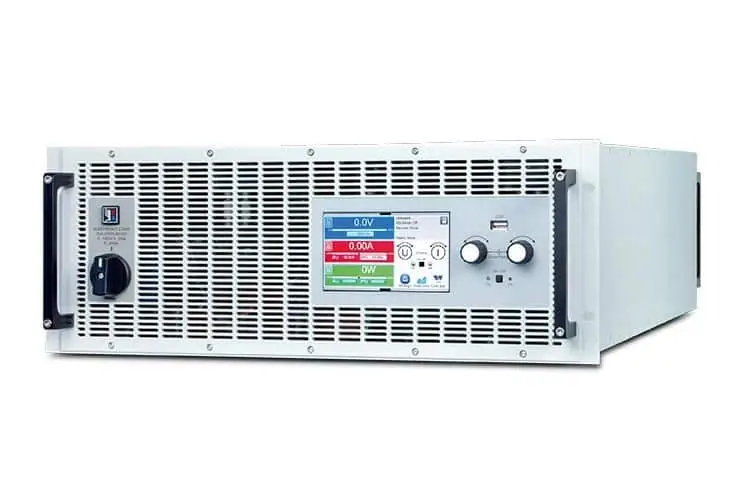
The EA-ELR 21000 uses electronic load modules to draw power from the device under test and reproduce changing electrical demand. Its EA-ELR 21000-80 4U HS module is rated for up to 1000 V, 80 A and 30 kW. Those are upper limits for the module, rather than a description of every operating point, so engineers will need to check how voltage, current and power constraints interact across their intended test profiles. Tektronix says the regenerative design can return up to 95% of the energy it draws to the grid, whereas conventional electronic loads dissipate that energy as heat.

That energy path matters in sustained testing. A conventional load turns most of the consumed electrical power into heat that the test facility must remove, adding a thermal burden to an already demanding test area. Regeneration can reduce that burden and the energy wasted during repeated test cycles, although it doesn't eliminate the need to plan for cooling and electrical losses. The stated figure is “up to” 95%; actual recovery will depend on operating conditions, which the product information doesn't detail. This is more significant than it looks when a test must run for long periods: heat management can shape how a facility schedules and accommodates high-power work.

The system can change its load with current slews of 12 A/µs, with power capacity specified at 240 kW. That rapid response is intended to recreate sharp changes in demand associated with AI computing workloads. Engineers can use such profiles to assess whether a power shelf or rack maintains stable operation as its load shifts, and to evaluate efficiency and reliability under dynamic conditions. The slew rate describes how quickly current can change; by itself, it doesn't show how accurately the system reaches and holds a target load. That distinction matters when comparing a headline response figure with the needs of a specific validation procedure.
Scaling the test capacity
The system is modular. One rack provides 240 kW, and capacity can be increased in 30 kW increments. Tektronix specifies a maximum configuration of 1.92 MW across eight racks and 64 loads. This allows a test installation to be sized around the equipment under evaluation, then expanded as higher-capacity systems need to be exercised. The staged increments may also help teams avoid installing the maximum capacity before they have equipment that requires it, though the source doesn't describe the cost or practical limits of expansion.

Modularity also affects maintenance: individual modules can be serviced, so a module-level issue needn't require replacing an entire rack. That's a useful design consideration for equipment expected to operate as part of a busy test facility, where serviceability can affect availability. The product information doesn't specify service procedures, module interchangeability, control interfaces or the maximum test duration, so teams assessing fit will need those details from Tektronix. A modular rack also doesn't, on its own, establish how quickly a failed module can be diagnosed or returned to service.

What engineers should assess
The combination of high voltage, substantial power and fast load transitions makes the platform relevant to teams developing or qualifying data centre power distribution equipment. Its ratings indicate the envelope available for test design, while regenerative operation addresses a practical facility concern: how much energy becomes waste heat during repeated high-power runs. If you're working in this space, the useful comparison is between the system's stated limits and the load profile your equipment must actually withstand.
Before selecting a configuration, engineers will need to match the test system’s voltage, current and power limits to the device under test and confirm how the load profiles are programmed and measured. The supplied specifications establish the headline capabilities, but don't state accuracy, transient settling time, grid connection requirements or applicable test standards. Those details will determine how the EA-ELR 21000 fits into a particular validation workflow. Here's the thing: a fast load transition is only useful evidence if the measurement chain can capture the response the engineer is trying to evaluate.
The system's fit will also depend on the test facility itself. Returning energy to the grid requires a compatible connection, while the site's power arrangements and operating procedures will shape how a high-capacity setup can be used. The product information doesn't provide those installation details, so the stated recovery figure and maximum capacity should be treated as specifications to verify against site conditions. (And this is the part most people overlook.) A load system's ratings describe what it can do; they don't establish that every facility can support a particular configuration without additional planning.
Implications for 800 V DC testing
For facilities testing increasingly capable 800 V DC infrastructure, the key engineering question is whether the system’s dynamic range and energy recovery align with the required test profiles and site power arrangements. Tektronix’s stated maximum of 1.92 MW provides a path to larger test setups, while the modular 30 kW increments allow capacity to grow alongside the equipment being evaluated. That gives teams a defined scaling path, but the available information leaves important questions about measurement performance and integration unanswered.
The platform addresses a real testing challenge: power equipment designed for variable loads needs to be evaluated under changing conditions, and repeated high-power runs can create significant heat in a conventional test setup. Yet the advertised limits don't tell engineers how well the system reproduces a particular workload or how its results compare across test configurations. Those are questions for detailed specifications and hands-on validation. For now, the EA-ELR 21000 presents a high-capacity, regenerative approach to testing 800 V DC equipment. The numbers here are promising, but incomplete.
 AMD Venice Uses 2.5D Packaging to Feed More Bandwidth Into EPYC Zen 6
 CNC Controller Board Design: Interfaces, PCB Specs and Assembly Testing
 Stratasys and Nano Dimension End $42.5 Million Markforged Sale Agreement