Arduino Nano XL Link Adds CAN FD, RS485 and Ethernet for Automation
Arduino’s Nano XL Link pairs a 120MHz Cortex-M33 with CAN FD, RS485 and Ethernet; a carrier adds screw terminals, RJ45 and DIN-rail mounting.
Three wired network interfaces are built into Arduino’s Nano XL Link, bringing CAN FD, RS485 and 10/100Mbps Ethernet to a board that keeps the Nano form factor. For engineers prototyping automation or building-control equipment, the main change is the option to connect to these networks directly, without adding separate communication modules.

Arduino introduced the Nano XL Link and its companion Nano XL Link Connector Carrier at electronica 2026. The board is intended for industrial and building automation applications. Its combination of network connections, general-purpose I/O and a 32-bit microcontroller puts control and communications on one compact platform, though the available details don’t specify dimensions, operating conditions or electrical isolation for the interfaces.

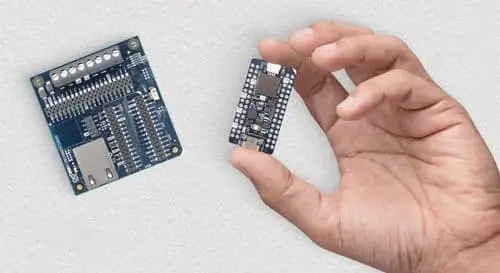
Controller and network hardware
The controller is Microchip’s PIC32CK2051SG01144, built around a 32-bit Arm Cortex-M33 processor running at 120MHz. It has 2MB of flash and 512KB of RAM. Those resources give a design room for application code alongside communication and control tasks, although the product details don’t describe execution timing, memory use by the software stack or performance under a particular workload.

Separate transceiver and interface components handle the wired connections. A Texas Instruments TCAN3414 provides the CAN FD interface, while an RS485 connection uses the THVD2410 transceiver. Ethernet uses a Microchip KSZ8081 PHY. The stated maximum speeds are up to 8Mbps for CAN FD and 10/100Mbps for Ethernet; no data rate is given for RS485.
That mix suits designs that need to exchange data across different kinds of equipment. CAN FD can connect the controller to devices on a CAN network, RS485 supports wired links commonly used in industrial and building systems, and Ethernet provides a network connection at 10/100Mbps. The practical value is integration: a prototype can include these interfaces on the controller board, while the designer still needs to check the required protocol, wiring, topology and electrical characteristics for the intended equipment.

Expansion and enclosure mounting
Two 30-pin, double-row connectors expose digital and analogue I/O, PWM, UART, SPI and I2C for expansion. A Qwiic connector is also provided for connecting compatible sensors and devices. These options let a design combine network communication with local sensing or control hardware, without limiting expansion to the three built-in wired interfaces.

The Nano XL Link Connector Carrier changes how the board can be installed and wired. It provides screw terminals for CAN FD and RS485, an RJ45 Ethernet connector and a DIN-rail mounting arrangement. Arduino describes the carrier as suitable for integration into industrial enclosures up to 4U in size. The board and carrier therefore address different parts of a build: the Nano XL Link supplies processing and interfaces, while the carrier provides more practical connection points and a mounting format for an enclosure.
For a bench prototype, the board’s connector set can support connections to peripherals and network equipment. For an enclosure-based setup, the carrier’s terminals and RJ45 jack can make wiring more direct. The published information doesn’t specify connector pin assignments, cable limits or enclosure dimensions beyond the stated 4U size, so those details will matter when assessing fit and compatibility.
Software support and intended uses
The board can be programmed with the Arduino IDE and Arduino Cloud, and it supports Arduino Zephyr core. That software range gives developers familiar Arduino tooling as well as a Zephyr-based option. The stated applications include real-time machine control, fieldbus gateways, smart lighting, HVAC and energy-management systems. These are intended uses; no timing results, system demonstrations or supported industrial protocols beyond the named interfaces are specified.
For machine-control work, the combination of a 120MHz Cortex-M33 and wired interfaces offers a single-board starting point for control logic and network communication. A gateway design could use the available ports to bridge equipment connections, while building-control prototypes could combine network links with local sensors over the exposed I/O and Qwiic connector. The exact fit depends on software support and the electrical requirements of the connected devices.
Pricing and availability for both the Nano XL Link and Connector Carrier have not been announced. The key details to check when those are published are interface specifications, board and carrier dimensions, and the supported software libraries and protocols. For now, the Nano XL Link’s clearest distinction is its built-in combination of CAN FD, RS485 and Ethernet in the Nano family, with an optional carrier aimed at enclosure mounting and field wiring.
 AMD Venice Uses 2.5D Packaging to Feed More Bandwidth Into EPYC Zen 6
 CNC Controller Board Design: Interfaces, PCB Specs and Assembly Testing
 Xometry Q3 2026 Revenue Reaches $252.4 Million as Marketplace Margins Rise