Solar Panel Vibration Sensors Estimate Light Rainfall at 1.88 mm/h Deviation
Fraunhofer IDMT’s solar panel sensors estimated light rain with a 1.88 mm/h mean absolute deviation; performance in heavy rain remains untested.

Solar panels could provide extra, local rainfall measurements without adding a conventional rain gauge at every site. A prototype developed by Fraunhofer Institute for Digital Media Technology (IDMT) researchers in Ilmenau, Germany, detects the vibrations raindrops create when they strike photovoltaic modules. Early field results cover light rain; the system’s accuracy in heavy rain is still unknown.

Reading rainfall from panel vibrations
The measurement chain starts with structure-borne sound sensors attached to solar modules. As raindrops hit a panel, they excite mechanical vibrations that travel through its structure. A sensor node captures those signals, then uses a machine learning algorithm running on an energy-efficient microcontroller to estimate rainfall. The node sends compact measurement data wirelessly for central analysis.

Pan Acoustics, based in Wolfenbüttel, developed the sensor-node hardware and wireless transmission technology with IDMT. Processing measurements at each node before transmission means the system does not need to send raw vibration data, according to the project description. Data collected at multiple sites can then be combined at IDMT to build a more detailed view of local rainfall.
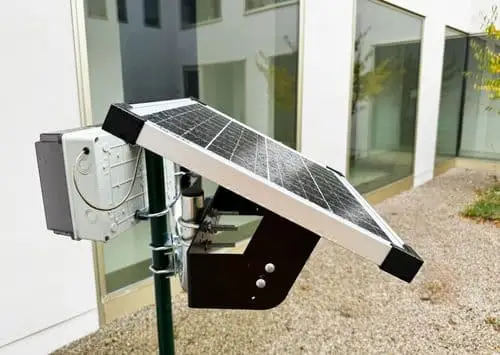
The approach makes use of existing photovoltaic surfaces as the part of the sensing system that interacts with the rain. Because the sensor arrangement has no moving parts, it may require less maintenance than equipment built around mechanical elements. That is a potential practical advantage, though the prototype still needs further work on the sensor housing and electronic components.

Light-rain results and the heavy-rain gap
Researchers first evaluated the method with a laboratory rain simulator, varying rainfall rates, drop sizes and photovoltaic modules. They then installed three outdoor measurement systems: in the IDMT courtyard, at Pan Acoustics and in the weather garden of the Technical University of Ilmenau.

For light rainfall between 2 and 5 mm/h, the system recorded a mean absolute deviation of 1.88 mm/h against reference measurements. Fraunhofer says this meets Class C in the World Meteorological Organization’s accuracy classification for low rainfall intensities, which permits a maximum deviation of 2 mm/h. That result gives the project a defined performance point, but only within the tested light-rain range.
Heavy precipitation remains an open question. The team does not yet have enough training and test data at high rainfall intensities to establish how well the estimator performs in those conditions. Jakob Bergner, IDMT’s group leader for Smart Acoustic Solutions and scientific head of the project, said the team had demonstrated feasibility for light rain. More measurements are needed before the method can be judged across a broader range of weather.

Wireless reach and intended role
During field trials, the wireless link covered four kilometers in urban settings and more than 35 kilometers in rural settings under line-of-sight conditions. Those figures describe the trial link reach; they do not by themselves establish coverage in every deployment, where site layout and obstructions may differ.

The project positions the technology as a complement to established rain gauges. Potential uses include urban digital twins, municipal control rooms and flood monitoring, where additional measurements across multiple locations could help fill gaps between conventional instruments. Operators of municipal infrastructure and firefighting brigades have expressed interest, according to Fraunhofer.
That role depends on what further testing shows. The current evidence supports rainfall estimates in the 2 to 5 mm/h range, while the team still needs data from heavy rain and varied environmental conditions. Until those tests establish performance, the system is best understood as a possible source of supplementary local readings, not a replacement for calibrated rain gauges.
Prototype development continues
The lokalRAIN project ran from October 2024 to June 2026 as part of Germany’s Central Innovation Program for SMEs (ZIM) and produced a prototype, not a market-ready product. Further development includes improving the housing around the sensor and electronics and carrying out system quality assurance.
The next technical milestones are clearer characterization at high rainfall rates and tests across differing environmental situations. For engineers assessing the concept, the key question is whether panel vibration signals can support reliable estimates beyond the light-rain conditions measured so far. The project’s results make that a testable prospect, while leaving the operating envelope to be established.
 AMD Venice Uses 2.5D Packaging to Feed More Bandwidth Into EPYC Zen 6
 CNC Controller Board Design: Interfaces, PCB Specs and Assembly Testing
 Xometry Q3 2026 Revenue Reaches $252.4 Million as Marketplace Margins Rise