Maryland Battery Test Cell Reaches 80% Charge in 12.8 Minutes
A 4 Ah lithium-ion pouch cell uses modified electrolyte chemistry to charge rapidly; its 200-cycle result still needs longer-term validation.
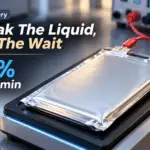
A change to the electrolyte helped a University of Maryland research team charge a lithium-ion pouch cell to 80% in 12.8 minutes and 90% in 14.7 minutes. The result points to a way of easing a transport bottleneck inside the cell during fast charging. It remains a laboratory demonstration with a single 4 Ah cell, rather than a validated charging performance for a complete vehicle battery.


Reducing solvent drag inside the cell
During charging, lithium ions move through the electrolyte between the electrodes. Solvent molecules accompany those ions, a transport effect the researchers call electro-osmotic drag. At lower charging rates, solvent can return toward the porous positive electrode. At high rates, the team says that return flow becomes difficult, leaving the electrode short of solvent and limiting charging performance.

The researchers modified the solvent molecules by adding fluorinated functional groups. Their approach reduces the interaction between lithium ions and solvent molecules, allowing the solvent to detach more readily and move back toward the positive electrode. The proposed mechanism targets the electrolyte’s movement under fast-charging conditions; the reported result does not establish that the same improvement will carry over unchanged to larger cells or packs.

That distinction matters because charging performance depends on more than how quickly lithium ions can move. Electrolyte transport, electrode condition and cell design all affect how a cell behaves at high rates. Here, the team’s chemistry is intended to address solvent movement that can leave the positive electrode depleted during fast charging.

What the reported test establishes
The test article was a 4 Ah pouch cell, or 4000 mAh, with a capacity comparable to that of a large phone battery. The team reported charging it to 80% in 12.8 minutes and to 90% in 14.7 minutes. These are cell-level measurements; they do not account for the additional design and system requirements involved in a vehicle pack.
The research paper also reports an energy density of 252 Wh/kg for a graphite-NMC811 pouch cell. In cycling tests, the cell showed stable performance with no noticeable capacity degradation over 200 cycles. Those tests used a 4C charge rate and a 1/3C discharge rate. The figures describe the reported test conditions; they are not evidence of service life over years of vehicle use or of repeated fast charging across a broad range of operating conditions.

The University of Maryland compares the 12.8-minute result with a target of charging an electric-vehicle battery to 80% in under 15 minutes, and places current DC fast-charging times at 20 to 60 minutes. That comparison offers a useful benchmark, but a small pouch cell is not a full vehicle battery. Pack-level performance will depend on whether the chemistry can be scaled and integrated while meeting the other requirements of a working battery system.

Scale-up and durability remain open questions
Lead researcher Chang-Xin Zhao works in the laboratory of Distinguished University Professor Chunsheng Wang. The group has described a goal of bringing charging time closer to 10 minutes. Zhao said, “By the time you finish your coffee, the vehicle is charged.” For now, that line expresses the intended practical benefit; the demonstrated cell reached 80% in 12.8 minutes.
Fast charging to 100% remains a separate challenge. The university notes that reaching a full charge quickly without compromising other battery characteristics is difficult. Wang’s team also wants to improve shelf life and expand the operating temperature range, goals that have not been demonstrated in the reported results.
For engineers evaluating the work, the strongest evidence is the combination of a rapid charge result and the reported cycling data under specified test rates. The next useful evidence would show how the cell performs through longer testing, repeated fast charging, and operation at different temperatures. It would also need to show whether the chemistry and charging behaviour can be retained at pack scale. Until then, the 12.8-minute figure is a promising cell-level result, with durability and practical integration still to be established.
 AMD Venice Uses 2.5D Packaging to Feed More Bandwidth Into EPYC Zen 6
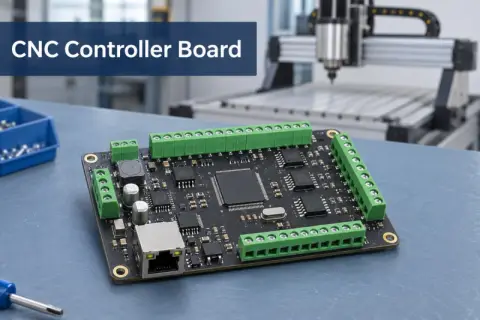 CNC Controller Board Design: Interfaces, PCB Specs and Assembly Testing
 Stratasys and Nano Dimension End $42.5 Million Markforged Sale Agreement