Nordic nRF71 Series Combines Wi-Fi 6, Wireless Connectivity and Edge AI
Nordic’s nRF71 SoCs pair Wi-Fi with on-chip AI and claim up to 20 times lower standby power than the nRF70 Series.

Putting Wi-Fi, local machine learning and several wireless options on one low-power chip could make battery-powered connected devices easier to design. Nordic Semiconductor’s nRF71 Series combines Wi-Fi with Thread, Bluetooth LE and edge AI, and the company says standby power is up to 20 times lower than its current-generation nRF70 Series Wi-Fi products.

That comparison is a vendor claim; the announcement provides no test conditions or power figures for the standby result. Even so, the direction is clear: Nordic is targeting products where Wi-Fi connectivity has traditionally competed with long battery life. Wearables, industrial IoT equipment and smart-home devices are among the applications identified by the company.
Local inference and wireless connectivity
The nRF71 approach puts AI inference on the device. A product can analyze sensor or other input locally instead of sending it to a cloud service or adding a separate AI processor. That can reduce the need to transmit data and may shorten the time between detecting an event and responding to it. The actual energy and latency benefits will depend on the model, workload, radio use and system design.

Nordic says the integrated Axon neural processing unit (NPU) runs machine-learning models 10–17 times faster than a 256MHz Arm Cortex-M33 processor operating alone. The company names keyword spotting, anomaly detection and image classification as supported workloads. Those tasks cover a range of input types, from audio patterns and sensor readings to images, but no model sizes, accuracy figures or benchmark conditions are provided.
Hardware acceleration can matter when a device must perform inference within a limited time or energy budget. The NPU takes on suitable machine-learning calculations, while the main processor remains available for application code and system tasks. Engineers will still need to assess whether a model fits the available memory and meets their response-time and power requirements; the stated speedup alone doesn’t establish performance for a particular application.
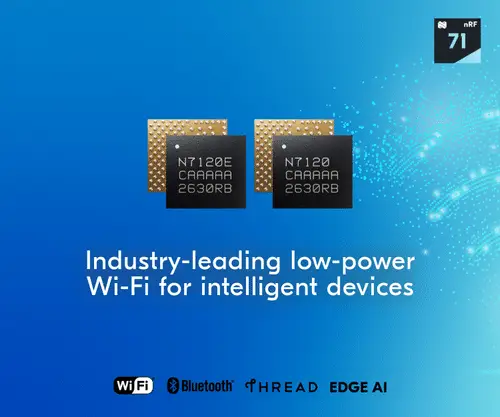
Two parts, with different Wi-Fi options
The series includes the nRF7120 and nRF7120E. Nordic specifies dual-band Wi-Fi 6 for the nRF7120, while the nRF7120E offers tri-band Wi-Fi 6E and includes the Axon NPU for hardware-accelerated edge AI. Both parts have 4MB of on-chip non-volatile memory and 1MB of user-accessible RAM.
Those shared memory capacities give developers a starting point for evaluating firmware, application data and model storage. The announcement doesn’t specify how much memory is available to a model after the operating system and application are accounted for, nor does it provide details such as interfaces, package options or radio throughput. Design teams will need the full product documentation to determine how each part fits an existing hardware and software architecture.
The Wi-Fi distinction is also a practical selection point. A design that needs dual-band Wi-Fi 6 has the nRF7120 as an option; one requiring tri-band Wi-Fi 6E can consider the nRF7120E. The announcement’s description of the E variant’s NPU is explicit, while it does not provide a detailed feature-by-feature comparison of the two SoCs. Compatibility, regional radio requirements and system-level power draw therefore need to be checked against the eventual product specification.
Model development and updates
Nordic’s Neuton software is intended to help developers create small machine-learning models from their own data. According to the company, these models can run directly on the processor without the NPU. That offers a different route for workloads that fit a small model and don’t need hardware acceleration, while the Axon NPU is aimed at workloads that benefit from its processing capability.

Nordic also describes over-the-air AI model updates through nRF Cloud. This gives product teams a way to deploy revised models after devices are in service, alongside the chip’s wireless connectivity and local inference. For battery-powered equipment, update size and frequency can affect radio activity and energy use, so the practical value will depend on how model changes are managed in the finished product.
The company presents the nRF71 Series as a platform for combining application processing, wireless links and AI on a single chip. Fewer separate components may simplify a design, though the available information doesn’t quantify board-area or bill-of-material savings. Kjetil Holstad, Nordic Semiconductor’s EVP of Wi-Fi and Power Management, said the series is intended to bring Wi-Fi and edge AI to the company’s low-power platform and tools already used for Bluetooth LE.
For engineering teams, the key evaluation points are the standby-power claim under relevant test conditions, the NPU’s performance on the intended model, and whether the memory and wireless features match the product’s requirements. Those details will determine whether the integration translates into longer battery life and a simpler design in a specific application.
 3DCERAM Employees Set to Take Control as Sinto Transfers Ceramic AM Stake
 ST VL53LB ToF Sensor Combines 8-Metre-Plus Range With a 4 mm Package
 Sophrosyne Validates Biomedical Sensor Chip for Wearable ECG Monitoring