SiGaN Launches Validated 20 W GaN RF Power Amplifier
SiGaN’s commercially available 20 W GaN amplifier passed fabrication and RF validation on the first cycle; detailed operating specifications remain undisclosed.
SiGaN Semiconductors has brought a 20 W gallium nitride (GaN) radio-frequency power amplifier through fabrication and RF validation on its first design and manufacturing cycle. The company says the product is commercially available and ready for integration into compatible RF systems. For equipment teams sourcing high-power RF components, the immediate news is a local supply option; the next design decision still depends on specifications SiGaN has not yet published.

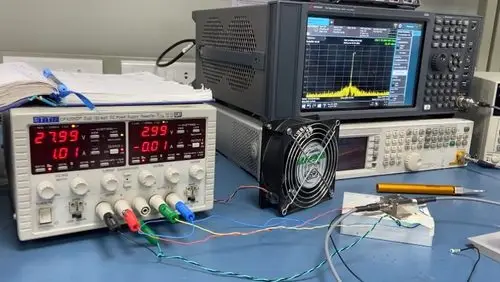
What the validation establishes
SiGaN reports that the amplifier completed fabrication and validation without another design or manufacturing cycle. That first-pass result indicates the company reached its reported validation milestone with the initial build. It does not, by itself, describe the test limits or establish how the amplifier performs across different frequencies, operating conditions or system configurations.
The company identifies the device as a 20 W GaN RF power amplifier for high-power wireless communications and radar applications. An RF power amplifier raises the level of a radio-frequency signal before transmission, allowing a transmitter to deliver more power to its antenna. In a complete system, the amplifier works alongside signal-generation, filtering, matching, control and thermal-management circuits; its suitability depends on how those elements are designed together.

GaN is used in applications that require both high-frequency operation and substantial output power. Those broad material characteristics explain the technology choice, but they are not enough to select a part for a particular transmitter. Designers typically need the operating band, gain, efficiency, linearity, impedance conditions and thermal limits to assess performance against a system’s requirements. SiGaN has not disclosed detailed specifications for this 20 W product, including its frequency range, gain, power-added efficiency or package.
Integration depends on the missing details
The stated 20 W rating gives prospective users a useful starting point, but it does not settle whether the amplifier will fit an existing RF chain. The output-power figure needs to be considered alongside the conditions under which it is specified, the required input drive, the operating band and the system’s modulation and linearity needs. Those particulars are not available in the information released so far.
Package details also matter: they affect board layout, RF connections and the path for removing heat. Without package and thermal information, teams cannot determine how much redesign an integration would require or compare the part directly with alternatives. The company describes it as ready for compatible systems, while also inviting RF module designers, communications equipment manufacturers and system integrators to request technical specifications and discuss configuration.
SiGaN offers custom configurations and application-level engineering support, and says it can undertake semiconductor development for specific applications. That may give equipment makers a route to discuss requirements with the supplier, though the reported information does not state which custom options are available, how long development would take or what commercial terms apply. Buyers will need to obtain those details directly before making a component selection.

A domestic sourcing option
SiGaN says the product is intended to help reduce Indian manufacturers’ reliance on foreign-sourced high-power semiconductors. The company describes availability problems, procurement restrictions and long lead times as challenges for local equipment makers. A domestically developed and commercially available amplifier could give those teams another supplier to evaluate, particularly when overseas sourcing complicates procurement schedules.
That potential benefit depends on practical fit and supply conditions. Engineers will still need to confirm electrical compatibility, obtain the full data needed for circuit and thermal design, and establish availability for their required quantities. The announcement does not provide pricing, production volumes or delivery timelines, so those remain open questions for prospective customers.
A 50 W device is also prepared for manufacturing
SiGaN says it has also developed a 50 W GaN RF power amplifier and that this higher-power device is ready for manufacturing. No further technical specifications are provided for it. The 50 W part therefore signals a broader product effort, but it cannot yet be compared with the 20 W amplifier on frequency coverage, efficiency, package or integration requirements.
For now, the 20 W amplifier’s clearest milestone is successful first-pass fabrication and validation, followed by commercial availability. The next useful evidence for RF designers will be a full datasheet and application details: frequency range, gain, power-added efficiency, package, operating conditions and test setup. Those parameters will show where the amplifier fits in a real signal chain and how much additional design work an implementation requires. SiGaN’s product and customization inquiries are available through the company’s website.
 3DCERAM Employees Set to Take Control as Sinto Transfers Ceramic AM Stake
 ST VL53LB ToF Sensor Combines 8-Metre-Plus Range With a 4 mm Package
 Sophrosyne Validates Biomedical Sensor Chip for Wearable ECG Monitoring