Nexperia Adds 48 Fast-Recovery Diodes Rated at 400 V and 650 V
Nexperia’s 4 A to 15 A diode family pairs low forward voltage with ultrafast or hyperfast recovery for automotive and industrial power conversion.

Nexperia has introduced 48 silicon fast-recovery rectifier diodes rated at 400 V or 650 V, giving designers a range of forward-voltage and switching-speed trade-offs for power conversion. The devices cover current ratings from 4 A to 15 A and come in two variants: PNU ultrafast rectifiers and PNE hyperfast rectifiers.

The selection is aimed at single-phase, low-power automotive on-board chargers, industrial power supplies and air conditioners. In these converters, rectifier losses affect both efficiency and the heat that the surrounding design must remove. Lower forward voltage reduces conduction loss while the shorter reverse-recovery interval can help limit switching losses. How much each parameter matters depends on the circuit’s operating conditions and design priorities.

Recovery speed and conduction loss
A rectifier conducts current in the forward direction and blocks it when the circuit voltage reverses. In a switching converter, a diode may need to stop conducting as the power switch changes state. Reverse recovery describes the brief interval in which stored charge is removed and the diode transitions from conducting to blocking. Faster recovery can reduce the time and energy associated with that transition, though the diode’s forward drop also contributes to losses whenever it conducts.
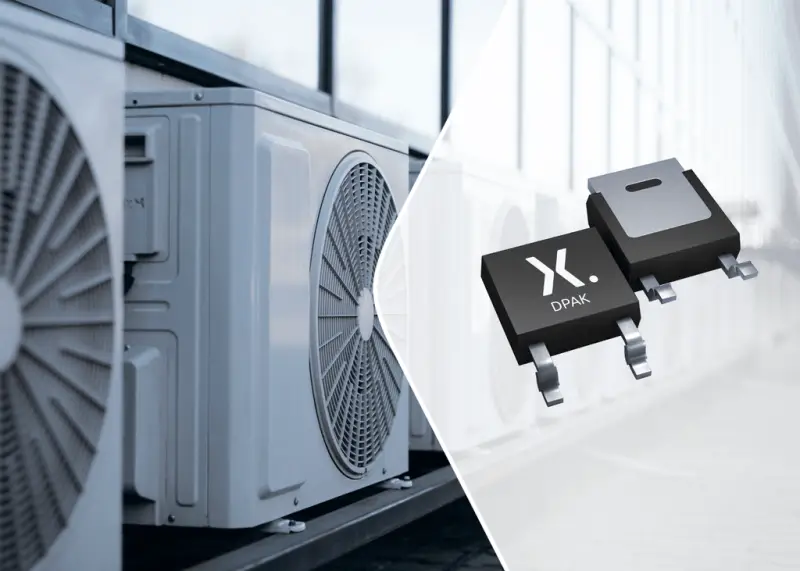
Nexperia’s PNU and PNE variants let designers choose between ultrafast and hyperfast recovery within the family. The stated portfolio combines these switching characteristics with low forward voltage, but the source provides no comparative recovery-time or voltage figures across all 48 parts. A suitable choice therefore requires checking the individual device specifications against the converter’s switching frequency, current, thermal limits and circuit topology.
One specified example is the PNU650100EH, a 650 V ultrafast rectifier rated at 10 A. Nexperia lists a forward voltage, VF, of 1.2 V and a typical reverse-recovery time of 27 ns. The device is identified as a candidate for use as a boost diode in a power-factor-correction (PFC) circuit. Those figures provide a concrete starting point for evaluation, but they don’t alone establish total converter efficiency or thermal performance; those outcomes depend on the complete circuit and its operating conditions.

Package spacing for high-voltage layouts
The devices use a DPAK (TO-252) Real-2-Pin (R2P) package. In this version, the standard centre lead pin is removed, leaving greater separation between the anode and cathode pins. Nexperia gives the resulting creepage and clearance distance as up to 3.6 mm.
That spacing can give board designers more room to manage separation between the diode’s terminals in high-voltage layouts. The stated maximum is a package feature; it shouldn’t be treated as a complete insulation rating for a finished assembly. Board geometry and the surrounding design still determine the distances available in the application.
The package and rating range make the family relevant to compact power-conversion designs where both electrical performance and board layout constrain component selection. The source does not give dimensions beyond the package designation, nor does it state availability, pricing or qualification details. Designers comparing parts will need the individual datasheets for those particulars and for the complete electrical limits.
Silicon alongside SiC options
The new rectifiers add silicon devices to the options available alongside silicon-carbide (SiC) Schottky diodes. That gives designers another technology to assess when balancing cost and performance in a converter. The family description does not provide a direct silicon-to-SiC comparison, so it makes no quantified claim about relative efficiency, switching behaviour or price.
For engineers developing an on-board charger, industrial supply or air-conditioning power stage, the practical value lies in the breadth of the selection: 400 V and 650 V ratings, 4 A to 15 A current ratings, and ultrafast or hyperfast recovery variants in one package family. The PNU650100EH’s 1.2 V forward voltage and typical 27 ns recovery time offer one defined reference point. Final selection still turns on the device-level datasheet and the losses measured or calculated in the intended circuit.
 3DCERAM Employees Set to Take Control as Sinto Transfers Ceramic AM Stake
 ST VL53LB ToF Sensor Combines 8-Metre-Plus Range With a 4 mm Package
 Sophrosyne Validates Biomedical Sensor Chip for Wearable ECG Monitoring