3DCERAM Employees Set to Take Control as Sinto Transfers Ceramic AM Stake
Four 3DCERAM employees plan to take ownership of the ceramic AM company, with Sinto and its founders continuing to support the business.
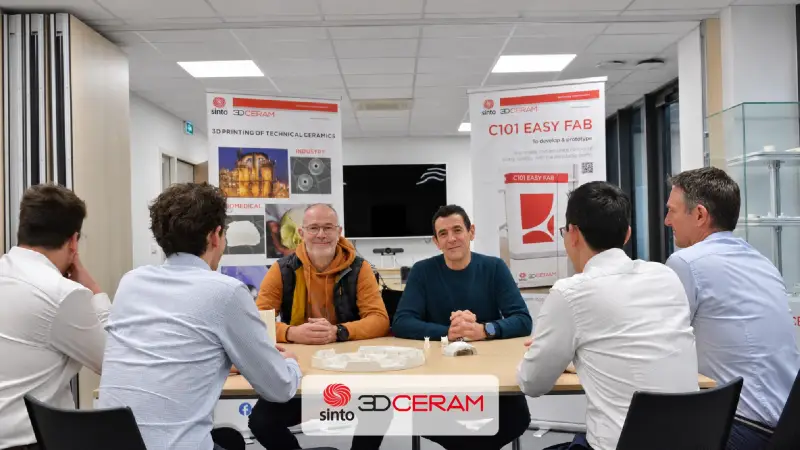
3DCERAM is set to move from corporate majority ownership to employee control through a proposed management buyout led by four members of its existing team. The transaction would change who owns the Bonnac-la-Côte, France-based ceramic additive manufacturing company while preserving key relationships with Sinto and its founders.

Maxence Bourjol, who is due to become 3DCERAM’s president, heads the buyout team. Marc Nguyen, Stéphane Schweizer and Vincent Auclair are the other incoming managers. The company’s current shareholders, Sintokogio Group (Sinto), Christophe Chaput and Richard Gaignon, support the plan.
The transfer will take effect after the customary closing conditions have been satisfied or waived. Until then, the proposed structure remains subject to completion of the transaction.
What changes for 3DCERAM
Sinto will transfer its shares to the incoming management group and leave the company’s ownership structure. The Japanese industrial group has supported 3DCERAM’s development for several years, and the handover is intended to let Sinto concentrate on its own ceramic additive manufacturing activities, including the production of high-performance technical ceramic components made with 3D printing processes.
Sinto will still work with 3DCERAM as a preferred commercial partner. That continuing relationship matters because ceramic additive manufacturing depends on more than the printer itself. Equipment, ceramic feedstocks, debinding and sintering processes, application development and customer support all have to work together to produce usable parts. Keeping an established commercial connection could help 3DCERAM retain access to market knowledge and technical experience while its ownership changes.
The founders will also remain involved as shareholders. Chaput and Gaignon’s continuing stake gives the company access to its original leadership and preserves a direct connection with the people who established the business. For customers, that may reduce the operational uncertainty that can accompany a change in ownership.
Why employee ownership matters in ceramic AM
A management buyout is particularly significant for a specialist engineering company because much of its value sits in practical knowledge. Ceramic printing requires control of material behavior across several stages. A printed “green” part must retain enough shape and strength for handling, then undergo binder removal and firing without unacceptable cracking, distortion or dimensional change. Customer applications also depend on process repeatability and on the team’s ability to match materials and machine settings to the required geometry and performance.
When the people responsible for those activities take ownership, day-to-day technical decisions can remain close to the manufacturing and application teams. That structure can support continuity in customer programs, machine development and materials work, although the longer-term effect will depend on how the new management funds development and expands production.
3DCERAM says it plans to continue developing ceramic AM equipment, materials and services for customers worldwide. The company’s existing offer is aimed at applications where ceramic properties justify the added process complexity of printing and thermal treatment. These can include parts that need high temperature resistance, chemical stability, electrical insulation or complex internal geometry, subject to the material and process qualification required for each use.
A wider pattern among additive manufacturing businesses
3DCERAM’s proposed ownership change follows other cases in which a larger company has handed an additive manufacturing operation to its existing managers. In 2026, Materialise transferred its RapidFit business to its management team. RapidFit supplies custom 3D printed jigs, fixtures and quality control solutions, and continues under its existing name and leadership. Materialise redirected its focus toward software, services and 3D printed medical devices.
That transaction shows why a carve-out can appeal to both sides. A specialist unit can keep serving its established customers with a focused management team, while the former parent can direct capital and staff toward the activities that fit its main business priorities.
BASF followed a similar route in 2024. The leadership of BASF Forward AM, headed by CEO Martin Back, acquired the additive manufacturing business and formed Forward AM Technologies. The new company brought together 3D printing materials and solutions with the Sculpteo service bureau. BASF worked with the management team during the buyout, which preserved jobs and retained the associated 3D printing technologies.
Forward AM later continued as an independent materials brand under Mass Additive Manufacturing GmbH, a new legal entity within Stratasys, after Stratasys acquired assets from Forward AM GmbH. The transaction expanded Stratasys’ materials portfolio, including capabilities associated with Selective Absorption Fusion (SAF) and Digital Light Processing (DLP).
What to watch after closing
The practical test for 3DCERAM will be continuity after the ownership transfer. Customers will want to see whether equipment and material development schedules remain intact, whether service support continues at the same level and how the company manages qualification work for ceramic parts. The founders’ involvement and Sinto’s commercial relationship should help preserve continuity during the transition.
My read is that the buyout gives 3DCERAM a focused ownership structure while keeping much of the technical and commercial knowledge already tied to the business. Its next stage will be measured by the products it brings forward, the applications it qualifies and its ability to turn ceramic AM expertise into repeatable customer production.
 Sophrosyne Validates Biomedical Sensor Chip for Wearable ECG Monitoring
 MIT’s 244 mg Flapping-Wing Robot Navigates Without Motion Capture
 Nexperia Adds 48 Fast-Recovery Diodes Rated at 400 V and 650 V