MIT’s 244 mg Flapping-Wing Robot Navigates Without Motion Capture
MIT researchers added onboard sensing and computing to a 244 mg microrobot, enabling it to follow trajectories and land on a sunflower.

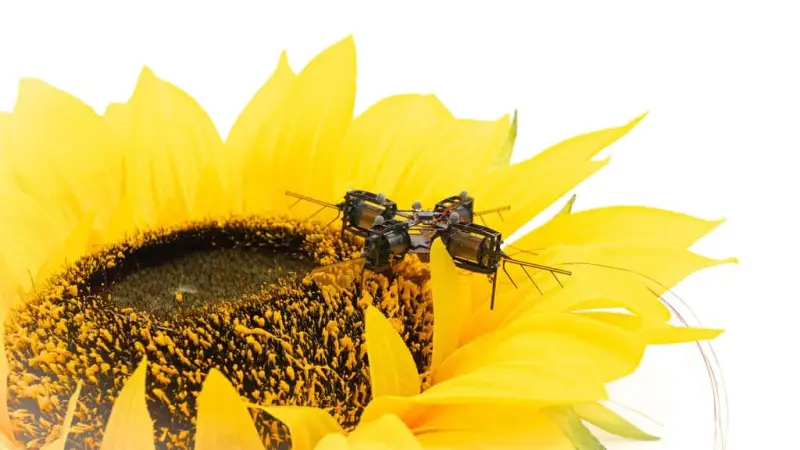
A 244 mg flapping-wing microrobot developed by researchers at the Massachusetts Institute of Technology (MIT) can navigate without the external motion-capture cameras that have guided earlier machines of this scale. It has followed point-to-point trajectories, changed height, moved between plants and landed on a sunflower. The engineering advance lies in fitting sensing and computation into a flying platform whose power and payload budgets are exceptionally tight.

Three sensors estimate flight state
The robot combines three sensing functions to estimate its motion. An inertial sensor measures attitude; a visual-flow sensor detects horizontal movement and location; and a time-of-flight sensor measures altitude. Onboard computing processes those signals so the vehicle can track its own position and movement during flight.
That arrangement changes the operating setup. Motion-capture systems can provide detailed position information, but they require cameras around the flight area and a suitable environment for tracking. An onboard estimate lets the microrobot fly beyond that instrumented space. The reported demonstrations show it executing controlled movement in that setting, including a landing on a flower.

The researchers also developed code to process sensor data quickly and reduce position-estimation error. The approach evaluates likely location at a higher rate, although each rapid estimate is less accurate on its own. The group reports that the resulting position accuracy is similar to that achieved when external cameras monitor the robot. The account does not give a numerical error figure or specify the test conditions behind that comparison.
More lift makes room for electronics
Adding sensors and a computer increases the mass that the wings must carry. To make room for the payload, the team modified the four-wing drive system. Its artificial-muscle actuators were enlarged by 50%, and their shape was changed to increase lift generation by 46%. The robot retained its flight capability with the onboard equipment installed.
Those figures describe linked design changes: larger actuators and a revised shape supported the added load by boosting lift. The trade-off is that every extra component competes with the mechanisms needed to keep the robot airborne. In this prototype, electronics consume about 6% of total power, leaving most of the available energy for wing movement.
That power split is encouraging for onboard autonomy, but it does not mean the vehicle is self-contained. The robot is still externally powered. Its flight demonstrations establish that the sensing and computing package can operate on the airframe; battery integration and onboard power electronics remain future work.

Demonstrations and next engineering steps
The flight trials included hovering at different heights, following routes between specified points, moving from plant to plant and landing on a sunflower. These tasks test more than straight-line motion: the vehicle must estimate its state while controlling wing motion well enough to reach a target and settle onto it.
The next planned additions address two limits of the current system. The researchers aim to embed batteries and power electronics, removing the external power connection, and to add a camera that could support object recognition and collision avoidance. Neither capability is described as completed. A camera would also add mass and require processing, so its integration will have to fit the same lift and energy constraints already shaping the design.
For agriculture, the proposed uses include monitoring plant health, identifying pests and assisting with pollination. The small airframe could also enter industrial spaces that are difficult for larger robots to reach. Those applications depend on developments beyond the demonstrated navigation: the present account establishes onboard flight-state sensing and controlled manoeuvres, while autonomous object recognition, collision avoidance and untethered power remain on the roadmap.
For engineers working on miniature aerial robots, the practical result is a demonstrated route to camera-free navigation at a 244 mg total mass, with sensor roles, actuator changes and power share reported. Battery integration and visual perception will show whether the approach can progress from controlled demonstrations to longer, more independent operation.
 3DCERAM Employees Set to Take Control as Sinto Transfers Ceramic AM Stake
 ST VL53LB ToF Sensor Combines 8-Metre-Plus Range With a 4 mm Package
 Sophrosyne Validates Biomedical Sensor Chip for Wearable ECG Monitoring