Infineon CTRX8144FS Radar Chip Sends 76–81 GHz Data to Central Vehicle Computers
Infineon’s 4Tx/4Rx radar MMIC supports up to 4 GHz bandwidth and 1.2 Gbps per CSI-2 lane for front and corner sensors.
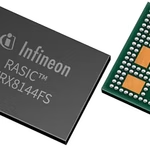
Infineon’s CTRX8144FS is designed to move automotive radar processing toward a central vehicle computer. The 76–81 GHz radar MMIC provides four transmit and four receive channels, with a CSI-2 interface that can transfer raw radar data at up to 1.2 Gbps per lane. For sensor designers, the main change is architectural: more of the radar data can be sent onward for processing instead of being handled within the sensor.

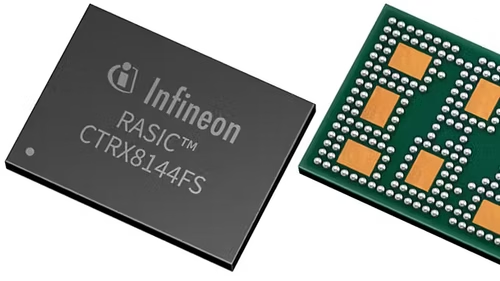
Designed for front and corner radar
Infineon Technologies AG says the chip is intended for front radar and corner radar sensors used in automotive applications. Its four transmit and four receive channels provide the radio-frequency interface for those radar configurations. The company positions the part for software-controlled vehicle systems that use radar sensing as an input.
The CTRX8144FS supports bandwidths of up to 4 GHz. In radar, available bandwidth is one factor affecting range resolution: wider bandwidth can help a system distinguish objects that are close together in distance. The chip also supports frequency changes of up to 200 MHz/μs, a specification Infineon associates with detecting and tracking objects quickly. Actual system performance will depend on the radar configuration and the processing applied to the data.

A digital phase-locked loop (PLL) and flexible sequencer support different radar configurations. These functions give designers ways to configure frequency generation and measurement sequences for a sensor’s intended use. The announcement does not specify particular waveforms or operating modes, so system teams will need the device documentation to assess how those controls fit their designs.
Raw data link and central processing
The chip’s CSI-2 interface transfers raw radar data at up to 1.2 Gbps per lane. That high-speed path is central to the proposed architecture: the radar sensor can send data to a central advanced driver-assistance systems (ADAS) compute unit, where processing resources are pooled. Infineon’s Head of Radar Product Line, Andreas Kopetz, says this approach removes memory and computing constraints at the sensor level and lets the central unit work with larger radar data sets and more advanced algorithms.
Keeping more processing in the central computer may give ADAS developers room to refine algorithms for detection range, sensitivity and target separation. Kopetz describes those as potential benefits of higher-quality radar data, which can also provide input for sensor-fusion methods based on artificial intelligence and machine learning. Those outcomes are system-level possibilities, rather than performance figures guaranteed by the chip alone.
Central processing also changes the data path engineers must design around. The sensor still needs to acquire and transmit radar measurements, while the central compute platform must receive and process them. The 1.2 Gbps-per-lane figure therefore matters alongside the radar’s RF specifications: it describes the interface capacity Infineon provides for moving raw data out of the sensor.

RF integration and automotive requirements
Integrated RF waveguide ports are intended to reduce signal loss and avoid complex high-frequency transitions on printed circuit boards. At 76–81 GHz, the RF path is a significant part of the sensor design, so reducing transitions can simplify the connection between the chip and the antenna structure. The practical effect will depend on the surrounding layout and implementation.
Infineon also lists low thermal resistance, integrated diagnostics and built-in power management with LDOs. The diagnostics monitor RF performance and internal temperatures, while the LDOs can reduce the need for external components. Together, these features address integration and monitoring within the radar sensor; the company has not provided thermal-resistance values or a component-count comparison in the announcement.
The device is AEC-Q100 Grade 1-qualified and was developed as an ISO 26262 Safety Element out of Context (SEooC). Infineon says it supports safety requirements up to ASIL B for the stated ADAS applications. These qualifications and development claims are relevant to automotive design teams evaluating component suitability, but they do not by themselves establish compliance for a complete vehicle system.
The CTRX8144FS combines a 4Tx/4Rx radar front end, high-bandwidth raw-data transfer and features aimed at reducing sensor-side integration work. For teams considering centralized ADAS processing, the key design questions are how the chip’s radar configurations, CSI-2 data path and RF ports fit the intended sensor and compute architecture. Infineon’s product announcement provides the stated specifications and application details.
 Nuvoton MA35 Platform Adds Redfish Remote Management for Industrial Edge Devices
 TVS Diodes Target Transient Protection in High-Voltage DC Systems
 XJTAG 4.4 Adds Direct Voltage Probing and Selective PCB Tests