YINCAE UF 120HA-10 Underfill Targets Flux-Cleaning Removal in Semiconductor Packaging
YINCAE says its UF 120HA-10 underfill can eliminate separate flux-residue cleaning in compatible assembly systems and withstand 10 reflow cycles at 260°C.
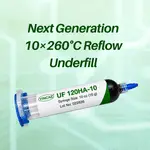
YINCAE’s UF 120HA-10 underfill is designed to combine package reinforcement with a change to the assembly sequence: in compatible systems, manufacturers can leave flux residue in place instead of adding a separate cleaning operation. That could simplify processing, but the practical benefit depends on how the material performs with a given flux, package design and manufacturing process. Underfill is part of a larger materials system, so a claim about one step can’t be assessed in isolation from dispensing, curing, inspection and later thermal exposure.

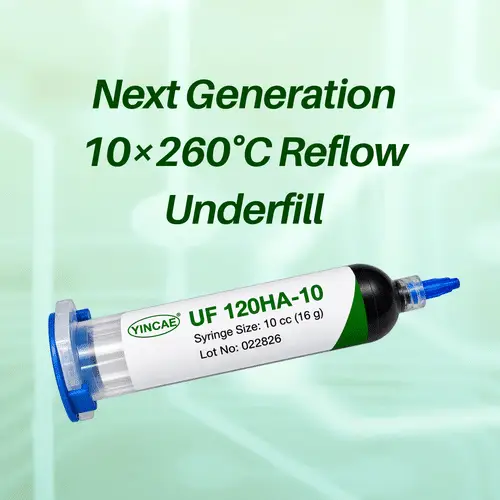
The material, launched by YINCAE, is intended to cure at a low temperature and remain compatible with flux residue. The company says those properties remove the need for separate flux-residue cleaning in certain assembly systems. Avoiding that step can reduce process time and cost, while also simplifying production flow. The savings won’t come automatically: a manufacturer would have to account for the cleaning operation’s role in its current line, as well as any added checks needed when residue remains. YINCAE hasn’t specified which flux chemistries or assembly conditions qualify, so manufacturers would need to assess compatibility for their own materials and process window.
Thermal performance and package stress
UF 120HA-10 has a low coefficient of thermal expansion (CTE), according to YINCAE. Underfill occupies the space around chip connections and helps support the package; when temperature changes, differences in expansion between materials can place stress on the die and interconnects. A lower CTE can reduce that mismatch-driven stress, although package reliability also depends on the full material stack and geometry. The benefit is therefore relative to the other materials in the assembly, not a property that guarantees reliability by itself.

YINCAE reports that the material passed 10 reflow cycles at 260°C. Repeated exposure to reflow temperatures matters for assemblies that undergo multiple thermal passes during manufacturing, since the package and its materials must tolerate more than one trip through the heating profile. The reported result is a specific test claim; the company hasn’t supplied further details here about the test method, package construction, inspection criteria or measured failure rates. Those details would help engineers judge how closely the test represents a particular production line. A cycle count and peak temperature are useful starting points, but they don’t describe the full thermal profile or the acceptance criteria.
The company also describes UF 120HA-10 as a low-temperature-curing material. Lower curing temperature can limit heat exposure during that stage of processing, which may be useful when assembling temperature-sensitive components or managing thermal budgets. The available information doesn’t state the curing temperature, cure time or viscosity, however. Those parameters are needed to compare the material with an existing dispensing and curing process, including whether current equipment and line timing can accommodate it. A nominally lower cure temperature only helps if the material reaches the required state within the process window.
Intended packaging applications
YINCAE lists GPUs, flip-chip packages, AI processors, high-performance computing, high-bandwidth memory (HBM), memory devices and advanced 2.5D/3D packaging among the intended uses. Its application list also includes mobile devices, photonic assemblies, automotive electronics and optical assemblies. This range points to a material meant for both dense, high-performance packages and other microelectronic assemblies where mechanical support and thermal cycling matter. These applications vary substantially in geometry and process requirements, so the breadth of the list shouldn’t be read as proof that one recipe fits them all.
For engineers evaluating an underfill, the flux-cleaning claim is likely the first point to test against the current process. Residue compatibility can affect whether a cleaning stage can be removed, while cure conditions and thermal behavior determine whether the material fits the rest of the assembly sequence. Here’s the thing: removing a step changes the process boundary, and the saved operation has to be weighed against the validation needed to establish that the remaining residue causes no problem for the package or downstream work. The announcement doesn’t provide comparative data on yield, long-term reliability, throughput or total process cost, so those benefits remain matters for application-level validation.

What to verify before a process change
The reported reflow result gives a useful temperature and cycle count, but it doesn’t establish performance across every package configuration in the company’s application list. Engineers will need to check the material against their substrate, die, interconnect and flux combination, and confirm that cure and reflow conditions match the production recipe. They’ll also need to determine whether residue remaining in the assembly affects inspection or downstream operations. That review is especially relevant when the proposed change removes a cleaning step that may currently be part of how a line controls process variation.
YINCAE says UF 120HA-10 can be evaluated in conventional and advanced semiconductor packaging technologies. The near-term engineering question is whether its claimed residue compatibility and low-temperature cure hold under a specific line’s process conditions. If you’re working in this space, the practical comparison is with the complete existing sequence: dispensing, cure, cleaning, inspection and thermal exposure. The 10-cycle, 260°C reflow result provides one reported data point for that evaluation. And yet. The missing process details leave the central compatibility claim to be established package by package.
Why the process claim matters
Underfill selection is often treated as a materials decision, but a product that permits residue to remain could also affect how a manufacturer organizes its process. A cleaning operation takes time and adds equipment and handling steps; removing it may simplify the route through the line. That’s more significant than it looks, provided the material works as claimed and the removed step isn’t serving another purpose in the production flow. The announcement doesn’t quantify any potential savings, so the operational case remains a question for manufacturers to measure.
The strongest evidence in the announcement is bounded: a stated reflow result and a claimed compatibility with flux residue in certain systems. The next useful information would be the conditions behind those claims, including the relevant flux and package combinations and the cure parameters. Until then, UF 120HA-10 is best understood as a candidate for targeted process evaluation. A successful trial could support a simpler assembly sequence; the broader application list alone can’t establish that outcome across different packages.
 Nuvoton MA35 Platform Adds Redfish Remote Management for Industrial Edge Devices
 TVS Diodes Target Transient Protection in High-Voltage DC Systems
 XJTAG 4.4 Adds Direct Voltage Probing and Selective PCB Tests