TVS Diodes Target Transient Protection in High-Voltage DC Systems
Littelfuse’s AK-FB and AK-A TVS diode series target surge protection for HVDC power switches, with different approaches to clamping and latch-up tolerance.

Transient protection in high-voltage DC systems has a difficult balance to strike: a suppressor must limit the voltage seen by sensitive power switches while avoiding sustained conduction after the surge passes. Littelfuse’s AK-FB and AK-A TVS diode series are designed around that problem, with separate approaches to snapback behavior and pulse handling.

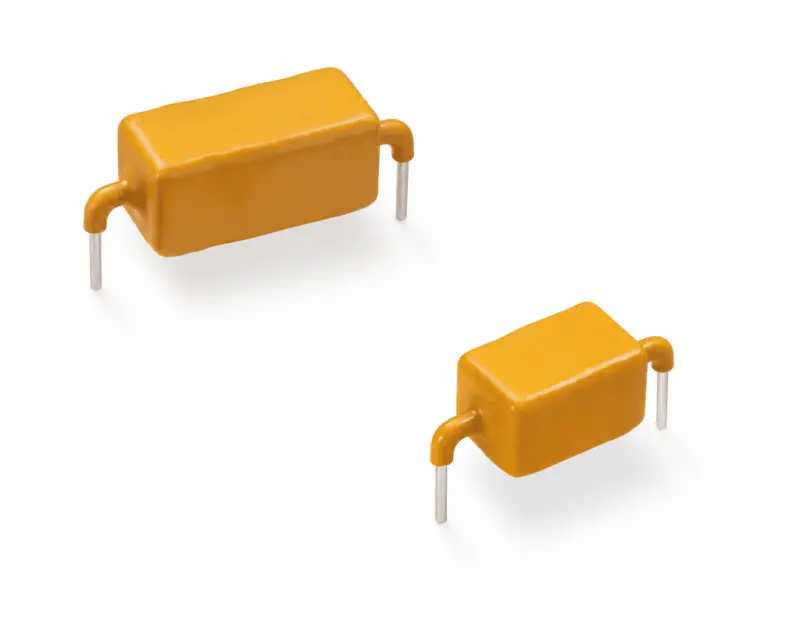
Keeping transient protection from latching on
A transient voltage suppression (TVS) diode responds to an overvoltage by conducting and limiting the voltage across the protected circuit. In DC systems, the behavior after the transient matters as much as the initial clamp: a protection device that continues conducting can leave current flowing when the surge is over. That latch-up risk is a particular concern when protection sits alongside power switches made from silicon carbide (SiC), gallium nitride (GaN) or silicon.
Littelfuse says the AK-FB series uses controlled fold-back to keep its minimum snapback voltage at or above the reverse standoff voltage. The stated aim is to avoid latch-up in DC circuits while retaining a low clamping voltage. Lower clamp voltage means less voltage stress reaches downstream components during the event, though the actual protection margin depends on the system’s operating voltage, transient profile and component ratings.

The AK-A series takes a different tack. It is designed to maximize power handling across its operating current range. Its clamping voltage is higher than the AK-FB’s, but Littelfuse says it remains below the levels provided by standard TVS diodes and metal oxide varistors (MOVs). The company presents this as a way to give designers more tolerance to latch-up while prioritizing pulse handling.
Published clamp and pulse ratings
The example supplied by Littelfuse gives a sense of the AK-FB’s stated voltage advantage. For a 430V-rated device subjected to a peak pulse current of 6000A, the AK-FB clamps to 580V. Littelfuse’s existing AK-Y series clamps to 625V under the same example conditions. The 45V difference is specific to that stated comparison; it does not establish performance across other pulse shapes, temperatures or circuit layouts.
The two new series cover different peak pulse current ratings. AK-FB versions are available at 3, 6, 8 and 10kA, while AK-A versions are offered at 1, 3 and 6kA. The devices share dimensions, according to Littelfuse, and both series come in through-hole and surface-mount formats. That common footprint may simplify mechanical comparison during design selection, but package compatibility and board-level thermal behavior still need to be checked against the intended implementation.
These ratings are selection inputs, not a complete design case. Engineers will need to compare the device’s standoff and clamping behavior with the DC bus and the protected switch’s limits, and account for the surge waveform and energy the protection path must absorb. The information provided here does not specify those conditions or give thermal, lifetime or qualification data, so those details need to come from the relevant device documentation.

Where the series may fit
Littelfuse identifies HVDC conversion, battery storage, data centre power, solid-state transformers and solid-state circuit breakers as target applications. In these systems, the TVS diode is one part of a protection network intended to limit transient stress on power electronics. Its value depends on coordination with the switch, bus structure and other protective elements; a lower clamp by itself does not establish that the whole system is protected.
The company also says reduced clamping voltage could allow the use of lower-voltage-rated downstream components, potentially reducing bill-of-materials cost. That is a design possibility rather than a guaranteed saving: engineers would still need to confirm voltage margins and system requirements before changing component ratings.
Ben Huang, Director Product Management, SBU, at Littelfuse, said the series was designed for HVDC applications and intended to help protect SiC, GaN and silicon components from overvoltage transients. The practical distinction for design teams is clear: AK-FB emphasizes controlled snapback and lower clamping, while AK-A emphasizes power handling across its operating current range. Selecting between them will come down to the system’s pulse conditions and the protection margin required at the switch.
Further device details are available from Littelfuse’s product announcement.
 Nuvoton MA35 Platform Adds Redfish Remote Management for Industrial Edge Devices
 XJTAG 4.4 Adds Direct Voltage Probing and Selective PCB Tests
 YINCAE UF 120HA-10 Underfill Targets Flux-Cleaning Removal in Semiconductor Packaging