Self-Folding Quadcopter Shrinks from 31.3 cm to 14.1 cm for Tight Gaps
A quadcopter uses contact-driven folding arms and rolling cam joints to pass through openings less than half its normal width.
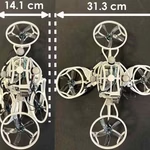
A quadcopter that changes its shape through contact with an opening could make confined-space flight easier without a separate folding command. Developed by researchers at the Norwegian University of Science and Technology, ETH Zurich and the University of Bonn, the drone reduces its width from 31.3 cm to 14.1 cm as it passes through a narrow gap, then returns to its usual form in flight.

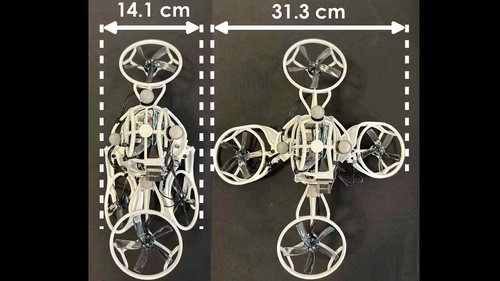
The change is mechanical and triggered by the surroundings. The four arms form a plus shape: the front and rear arms remain rigid, while flexible joints let the two side arms pivot inward. As those arms meet the edges of a gap, contact pushes them toward the body. After the drone clears the obstruction, they spring back. That lets the aircraft adapt its footprint while continuing to fly, without a person manually reconfiguring it.
Balancing flight stiffness with folding
The engineering trade-off is straightforward to state and harder to solve: the arms need to hold their positions against propeller forces during ordinary flight, yet yield when the drone encounters a constriction. A joint that folds too easily could compromise the intended geometry in the air; one that resists too strongly could prevent the aircraft from narrowing when it needs to.

The team addressed this with elastic rolling cam joints. Each joint uses two spring-loaded cams with interlocking teeth, which help keep the cams from slipping against one another. The profiles are shaped so the joint resists movement during normal operation but bends with little effort after reaching a designed threshold. In practical terms, the mechanism gives the arms a preferred stable position while still allowing an external push to fold them.
That threshold matters because the drone has to respond to physical contact without relying on a commanded folding sequence. The gap itself supplies the force that moves the arms. Once the side arms are past the edges, the joint’s elastic action restores their original position. The account of the design does not specify the contact forces, joint dimensions or the range of opening shapes tested, so the reported results describe the demonstrated configuration rather than a general operating envelope.
Search across 26 design parameters
Choosing arm lengths, propeller positions and joint properties involved more than tuning one part at a time. The researchers built an automated optimisation process that considers 26 parameters and uses performance results to guide subsequent design choices. This approach is useful for a tightly coupled mechanism: changing an arm or motor position can affect both the aircraft’s flight behaviour and its ability to fold through an opening.
Candidate designs were evaluated in NVIDIA’s Isaac Lab simulation environment. Each one was tasked with flying through 100 openings of different widths. The team recorded the results and fed them back into the optimisation algorithm, which then generated and assessed improved candidates in later rounds. Across the process, the researchers evaluated 800 designs in approximately 18 hours on a laptop equipped with an NVIDIA RTX 4080 GPU.

The simulation loop gave the team a way to compare many combinations before settling on a final configuration. Its value lies in evaluating the whole task: a design has to approach, make contact, fold enough to clear the opening and recover its shape while flying. The reported account does not provide individual scores for the 800 candidates or details about how closely the simulation matched physical testing, so those figures should be read as the scope and speed of the design search.
Flight penalty reported as small
The researchers compared the prototype with the same type of drone. During unobstructed flight, the folding design used less than one per cent more power and added two millimetres of position-tracking error. Those are modest reported differences for a mechanism that can more than halve the aircraft’s width, though the source does not give the test setup, duration or measurement method behind the comparison.
For engineers, the result points to a useful design direction: passive, contact-driven shape change can add access to narrow spaces without a large reported penalty in ordinary flight. It also shifts some of the design burden onto the joint. Its stiffness, return behaviour and resistance to slipping must work together with arm geometry and propeller placement.
The next practical questions concern operation beyond the reported simulations and comparison: how consistently the arms fold across different gap edges, how the mechanism behaves after repeated contact, and how much clearance the drone needs to recover its normal shape. Those details would help determine where this arrangement fits. For now, the key result is a quadcopter that uses its own flexible structure to pass through a gap less than half its normal width while remaining airborne.
 3DCERAM Employees Set to Take Control as Sinto Transfers Ceramic AM Stake
 ST VL53LB ToF Sensor Combines 8-Metre-Plus Range With a 4 mm Package
 Sophrosyne Validates Biomedical Sensor Chip for Wearable ECG Monitoring