Harwin Adds 14 Industrial USB-C Connectors Rated for 10,000 Mating Cycles
Harwin’s 14 new USB-C connectors cover USB4, USB 3.2 and USB 2.0, with gold-plated contacts and a 10,000-cycle rating.

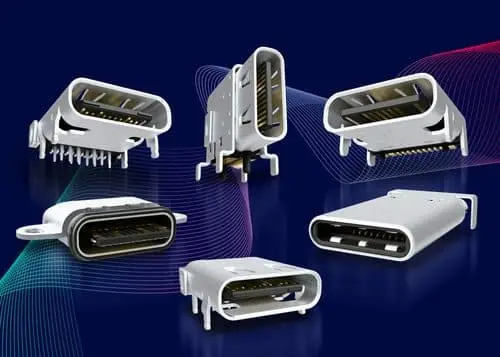
Repeated connection is the central design requirement behind Harwin’s new USB Type-C range. The 14 products, spanning seven types, are certified for 10,000 mating cycles and use gold-plated electrical contacts. That rating gives engineers a concrete durability figure to assess when specifying USB-C for equipment that will be connected and disconnected throughout its service life.

The connectors are being added to Harwin’s existing BBi product range. The company positions them for embedded and industrial systems, as well as automotive, aerospace, medical and premium consumer electronics. Product counts and headline ratings are provided, but the available details don’t identify individual part numbers, dimensions, mounting styles or operating temperature limits. Those omissions matter at the design stage: the cycle rating alone can’t establish whether a connector suits a particular enclosure, cable, board layout or environment.

Three USB generations in the range
The family includes USB4, USB 3.2 and USB 2.0 products. Harwin lists two USB4 product types, with data transfer rates of up to 40 Gbps and power delivery up to 240 W. Four USB 3.2 types are included, but the published specifications don’t state their transfer speeds or power delivery limits. The range also has one USB 2.0 type, with no corresponding speed or power figure given.
| USB type | Product types | Data transfer speed | Power delivery | Water protection |
|---|---|---|---|---|
| USB4 | 2 | Up to 40 Gbps | Up to 240 W | Not specified |
| USB 3.2 | 4 | Not specified | Not specified | IPX7 in 2 types |
| USB 2.0 | 1 | Not specified | Not specified | Not specified |
These figures describe capabilities associated with the listed USB4 types; they don’t establish that every connector in the family supports the same data rate or power level. Engineers selecting a part will need to match the specific variant to the system’s data and power requirements. In particular, the published information doesn’t assign the stated 40 Gbps and 240 W limits to named parts, or detail the conditions under which those maxima apply.
Contact finish and environmental claims
Harwin says the contacts are gold-plated. Gold’s resistance to corrosion and oxidation can help preserve a conductive contact surface as connectors see repeated handling. That makes the finish relevant where connection reliability over repeated mating is a design concern. The stated 10,000-cycle certification gives a defined endurance target, though the information provided doesn’t describe the test method, mating conditions or acceptance criteria behind that figure.

Water protection is specified for two of the four USB 3.2 types: those variants carry an IPX7 rating. The other entries in the product table have no water-protection rating specified. IPX7 therefore shouldn’t be treated as a family-wide feature, and the published details don’t identify which two types have it or provide further installation conditions. A system design that depends on water protection will need the relevant variant’s documentation before the connector can be assessed for the intended application.
Harwin says it has run a range of tests to evaluate data and power performance, durability and resistance to environmental conditions. The company hasn’t provided test results or named the specific test procedures in the details available here. The breadth of testing is therefore a manufacturer claim, while the 10,000 mating cycles and the two USB 3.2 IPX7 variants are the concrete performance details listed for the range.
What engineers still need to check
For embedded and industrial designs, USB-C can bring data and power connections together in a widely used connector format. But a family-level launch description is only a starting point for component selection. Designers still need variant-level information on mechanical dimensions, board or cable termination, electrical ratings, environmental limits and compatibility with the intended mating connector. The published figures also don’t specify whether the 240 W capability applies under particular cable or system conditions.
Harwin Head of Product Management Sam Bennett said the launch pairs USB-C with the company’s reliability focus and engineering support. The practical value of the range will depend on the detail available for each product type: the connector’s cycle rating and contact finish address repeated use, while the USB4 figures and limited IPX7 coverage help frame selection. Part-level specifications and test conditions will determine how those claims map to a real system.
 3DCERAM Employees Set to Take Control as Sinto Transfers Ceramic AM Stake
 ST VL53LB ToF Sensor Combines 8-Metre-Plus Range With a 4 mm Package
 Sophrosyne Validates Biomedical Sensor Chip for Wearable ECG Monitoring