KIMM Develops 32-Channel EEG Helmet That Automatically Adjusts Electrodes
KIMM’s helmet monitors scalp contact across 32 EEG channels and mechanically repositions electrodes to improve signal collection.
Maintaining electrode contact is one of the practical challenges in repeated EEG measurements. A helmet developed by a team at the Korea Institute of Machinery and Materials (KIMM) addresses that problem with 32 scalp sensors that monitor their contact and adjust their vertical position automatically. The system records 32 channels at 500 Hz, with the aim of making data collection more consistent across users. That is a mechanical answer to a measurement problem: even a capable signal chain can’t recover information cleanly if an electrode loses contact or sits poorly against the scalp.

Contact monitoring drives the adjustment
The team was led by Dr Seungchan Lee, a senior researcher in the Department of Diagnostic Sensors at KIMM’s Daegu-Gyeongbuk Convergence Research Division. Each of the helmet’s 32 electrodes sits at a distinct scalp location and measures electrical activity associated with brain signals. Keeping those locations consistent matters because EEG comparisons depend not only on recording electronics, but also on where and how the sensors meet the skin.

Rather than relying on a fixed fit, the helmet checks whether its electrodes are making suitable contact with the skin. It sends a small electrical test signal through a bias electrode; feedback from that signal helps assess contact at the other sensors. When the system detects inadequate contact, it moves the affected electrode up or down and checks again. In effect, the design gives the helmet a way to detect a poor interface before treating the resulting channel as dependable data.
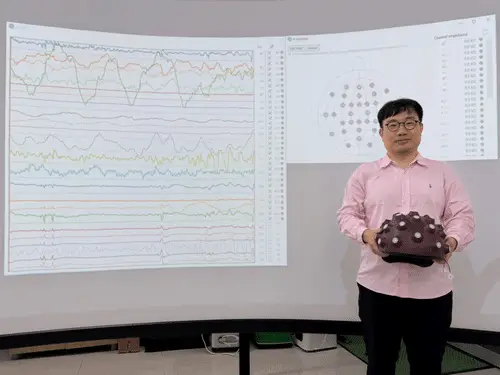
That repeated measurement and movement forms a closed-loop process: the helmet uses contact feedback to guide electrode repositioning, then evaluates the result. A built-in algorithm continues to monitor contact, so the adjustment can respond to changes during setup instead of depending entirely on a user to spot and correct a poor fit. The useful engineering idea is the feedback loop itself. A motorized adjustment without a measurement of contact would merely automate movement; here, the reported system links movement to a sensor condition.

Why a self-adjusting fit matters
EEG electrodes need reliable skin contact to collect useful measurements. Head dimensions and hair vary from person to person, making it difficult for a single fixed arrangement to maintain the same contact conditions for every wearer. In practice, manually fitting multiple electrodes can also make setup more involved, particularly when measurements need to be repeated. A system that checks each contact could make this part of preparation less dependent on the operator’s judgment.
Automating the contact check and position correction could reduce that source of variation. The design combines two functions that are often treated separately: sensing brain activity and assessing whether the sensors are positioned to collect it. The helmet’s mechanical adjustment is limited to vertical movement, according to the information provided; no other axes of motion or adjustment range are specified. That’s a meaningful constraint, since contact problems can reflect several aspects of fit, and vertical travel addresses only the component the system is designed to correct.

That distinction matters when considering what the system can and can’t address. The reported mechanism responds to electrode contact by moving sensors vertically. It isn’t described as changing the helmet’s overall size, selecting new scalp locations, or correcting every factor that can affect EEG quality. Its stated role is narrower: monitor contact and adjust electrode positions to improve it. This is more significant than it looks as a design choice, but the mechanism shouldn’t be read as a general solution to every source of variation in EEG recordings.

Recording rate and intended use
The helmet samples each of its 32 EEG channels at 500 Hz, meaning it records each channel 500 times per second. That rate describes the acquisition frequency; the available description doesn’t provide further details such as resolution, noise performance, electrode material, contact thresholds, data-processing methods, or validation results. Those details would be needed to compare its measured signal quality with other EEG systems, because a channel count and sampling rate alone don’t establish how useful the recorded signals are.
Lee said EEG has potential uses in medicine, healthcare, and cognitive science, while electrode contact adjustments have been complicated and signal quality can vary among users. He described the helmet as a way to monitor contact automatically and reposition electrodes in real time, supporting easier and more consistent data collection, including in settings where measurements are repeated. The claim is practical rather than sweeping: reduce the effort involved in checking electrode contact, then assess whether that helps recordings stay consistent.
For teams collecting EEG data across multiple sessions or users, the practical value will depend on whether automatic repositioning produces stable contact without adding unwanted movement or setup time. If you’re working in this space, the key question is whether the contact checks correspond to better recordings under real setup conditions, not simply whether the electrodes can move. Here’s the thing: the available description explains the control concept, but it doesn’t report validation results that would settle that question.
What the design still needs to show
The reported design offers a clear engineering approach: use a test signal to assess electrode contact, then close the loop with mechanical correction. Its stated specifications establish the channel count and sampling rate; further performance data will show how consistently that approach improves recordings in actual use. Repeated measurements would be a particularly relevant setting, since consistency across sessions is part of the problem the helmet is meant to address.
And yet, automation is only useful if its corrections are both appropriate and repeatable. The description doesn’t say how quickly the helmet detects poor contact, how far an electrode can travel, or how the system behaves when movement fails to improve contact. Those are open engineering questions, not evidence that the approach doesn’t work. For now, the concept is clear; its practical case rests on results that connect contact feedback and adjustment to recording quality.
 CNC Controller Board Design: Interfaces, PCB Specs and Assembly Testing
 Stratasys and Nano Dimension End $42.5 Million Markforged Sale Agreement
 Xometry Q3 2026 Revenue Reaches $252.4 Million as Marketplace Margins Rise