EV Battery Health Ranges from 86.3% to 92.8% at 150,000 km in AVILOO Data
AVILOO’s analysis shows substantial battery-health variation among used EVs, making individual diagnostics more informative than mileage alone.
At 150,000 km, the median battery state of health in AVILOO’s data ranges from 86.3% to 92.8% across four electric vehicle models. The spread between individual cars is wider still: a mileage figure alone gives a used-car buyer only a rough indication of battery condition.

The Austrian battery-testing company analysed more than 500,000 battery tests conducted from 2022 to 2026, covering 20 EV models. Its published figures compare median results at different mileage ranges for four models. They offer a snapshot of tested vehicles, rather than a record of the same cars followed as they accumulated distance.

Four models, different median results
AVILOO reports the following battery state-of-health (SoH) medians at 50,000 km and 150,000 km. SoH describes current battery capacity relative to capacity when new.
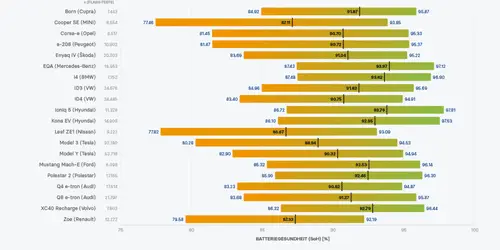
- Tesla Model Y, 78.8 kWh: 94.5% at 50,000 km and 90.3% at 150,000 km.
- Volkswagen ID.4, 77 kWh: 95.3% and 90.6%.
- Hyundai Ioniq 5, 72.6 kWh: 97.2% and 92.8%.
- Nissan Leaf, 40 kWh: 91.1% and 86.3%.
These values are medians from AVILOO’s tested vehicles; they are not guaranteed outcomes for every car of the same model. The reported range at 150,000 km does show that the four model groups did not have identical results. The figures also shouldn’t be read as a controlled comparison of battery designs: the available information does not establish that the cars had the same use, charging patterns, climate exposure or test history.

Why mileage doesn’t tell the whole story
Vehicles of the same model and similar mileage can differ materially in measured SoH. At 150,000 km, AVILOO found differences of about 11 percentage points among Model Ys and 13.5 points among Leafs. Those gaps can affect usable range and the value or suitability of a particular used vehicle, as AVILOO chief executive Marcus Berger said: “The truth in this data is that averages hide a lot.”
For a buyer, the practical point is straightforward: the odometer records distance travelled, but it doesn’t reveal the present capacity of an individual battery. A model-level median can help frame expectations, yet it cannot confirm the condition of the car under consideration. A battery assessment tied to that specific vehicle is more directly relevant to a purchase decision.

What the diagnostic test measures
AVILOO’s FLASH Test connects through a car’s diagnostic port and takes about three minutes to estimate SoH using predictive models. The company says at least 95% of reference measurements have a maximum deviation of ±3% compared with its PREMIUM Test. That is AVILOO’s stated comparison between its test methods; it does not, by itself, describe the uncertainty of every individual result or establish performance under all vehicle and testing conditions.

The company has not disclosed how many individual cars contributed to the analysis. The total of more than 500,000 tests therefore shouldn’t be mistaken for a count of unique vehicles. The test volume signals a large set of measurements, while the missing vehicle count limits how precisely readers can judge the sample’s breadth.
Limits on interpreting degradation
The reported data does not separate vehicles by fast charging and home charging, or provide a breakdown by climate. It also compares mileage ranges rather than tracking the same cars over time. As a result, the figures cannot show how a particular charging pattern or temperature history contributed to a battery’s measured condition, and they do not establish a degradation rate for an individual vehicle.
There is no India-specific dataset in the analysis, so these results cannot establish battery ageing under Indian driving conditions or temperatures. Buyers in that market should treat the reported medians as context from the tested vehicles, not as a forecast for local use. Battery warranty terms also vary by manufacturer and model, so the applicable coverage needs to be checked for the specific car.
AVILOO’s data suggests many tested vehicles retain a substantial share of their initial capacity at 150,000 km, while the car-to-car spread makes individual measurement central to evaluating a used EV. The next useful evidence would be transparent sample counts and results broken down by charging behaviour, climate and vehicle history.
 CNC Controller Board Design: Interfaces, PCB Specs and Assembly Testing
 Stratasys and Nano Dimension End $42.5 Million Markforged Sale Agreement
 Xometry Q3 2026 Revenue Reaches $252.4 Million as Marketplace Margins Rise