KIMM Spray and Partial Immersion Cooling Cuts Battery Coolant Use by Up to 85%
KIMM’s hybrid cooling system used up to 85% less dielectric fluid and held a 9S7P battery pack to about 34°C at 4C discharge.
A hybrid cooling layout from the Korea Institute of Machinery and Materials (KIMM) reduced dielectric coolant use by up to 85% in battery pack tests while delivering the lowest maximum cell temperature among the configurations evaluated. Its combination of targeted sprays and a shallow liquid reservoir could help address the mass and thermal challenges of high-rate battery operation.

Two cooling paths in one pack
Conventional battery thermal management can rely on air channels or aluminium cold plates, but these approaches can struggle to remove heat at high electrical loads. Immersion cooling offers another route: the battery modules sit in a non-conductive dielectric fluid, which transfers heat from the cells. The trade-off is the volume of fluid required, adding mass to the cooling system.

The KIMM system, developed by a team led by Dr Jinsub Kim, uses less fluid by splitting the cooling task. Precision nozzles spray dielectric fluid onto the upper portions of the lithium-ion cells, while the lower portions remain partially submerged in a small reservoir. The spray provides direct liquid cooling at the top of the cells; movement of the fluid around the immersed lower section supports forced convection.
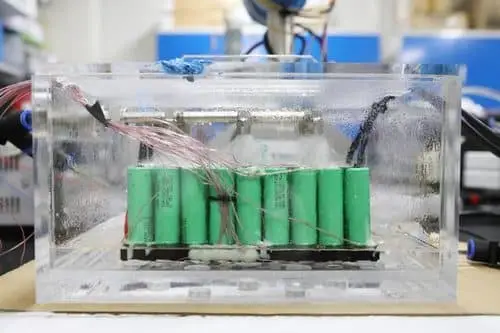
That arrangement concentrates coolant where the researchers’ design directs it while retaining liquid contact at the base of the cells. The reported reduction of up to 85% refers to dielectric fluid consumption compared with the tested immersion approach. It does not, by itself, establish a corresponding reduction in total cooling-system mass or energy use.

Pack tests show temperature control at 4C
The researchers tested the system using a 9S7P battery pack. They ran charge and discharge tests at rates from 1C to 4C, with coolant flow rates between 2 and 4 litres per minute. Across the configurations compared, spray-based partial immersion produced both the lowest maximum cell temperatures and the smallest temperature difference within the pack.
At a 4C discharge rate, the system held the maximum temperature to around 34°C. At higher coolant flow rates, it also reduced peak temperature by up to 19% relative to conventional flow-based immersion cooling. Those figures describe the experimental setup and its tested operating conditions; the reported results do not specify performance across other pack geometries or operating environments.

For battery designers, peak temperature and cell-to-cell temperature spread matter together. A low maximum can limit the hottest cell’s thermal burden, while a smaller spread suggests more even heat removal across the pack. The KIMM results point to a potential benefit on both measures, though the size and arrangement of the tested 9S7P pack set the bounds of what can be inferred.

What needs to be established next
The fluid reduction makes the approach relevant to applications where battery cooling must handle high rates without carrying a large coolant inventory. Electric vehicles and data-centre backup power are among the possible use cases identified for further consideration. The experiments do not yet show how the system performs in a commercial vehicle pack or a larger energy-storage installation.
Scaling will require more than reproducing a laboratory temperature result. A practical design would need to maintain spray coverage and fluid circulation across its cell layout and operating range. The available findings do not report long-duration operation, performance under vehicle vibration, coolant management details, or system-level comparisons of mass and pumping demand. These factors remain open questions, rather than demonstrated advantages or drawbacks.
For now, the strongest evidence is specific: in tests on a 9S7P pack, the hybrid arrangement used up to 85% less dielectric fluid, reached around 34°C maximum cell temperature at 4C discharge, and delivered up to 19% lower peak temperature than flow-based immersion at higher coolant flow rates. Further testing on larger and application-specific packs will show whether those gains carry through to production cooling systems. The research paper is available here.
 CNC Controller Board Design: Interfaces, PCB Specs and Assembly Testing
 Stratasys and Nano Dimension End $42.5 Million Markforged Sale Agreement
 Xometry Q3 2026 Revenue Reaches $252.4 Million as Marketplace Margins Rise