Relativistic Scattering Could Drag Laser Sails Near 75% of Light Speed
A theoretical study finds diffuse scattering may oppose a laser sail’s motion at high speed, even as incoming light continues to provide thrust.

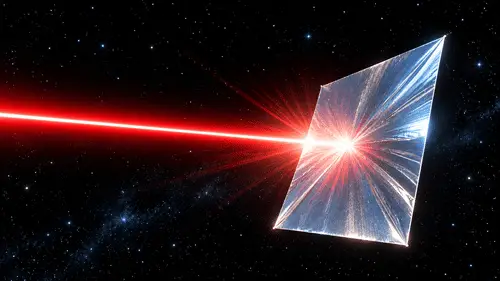
Diffuse scattering could become a source of drag on a laser driven spacecraft once it reaches roughly 75 per cent of the speed of light. A theoretical study by Chao Shen and Jiaze Li of Harbin Institute of Technology examines how the balance of forces from incoming, reflected and scattered light changes as a sail accelerates. The result points to a surface interaction that can work against forward motion even while the laser continues to push.

Laser sails gain momentum from photons, avoiding the need to carry propulsion fuel. That advantage comes with a demanding operating regime: as the sail pulls away from its laser beam, the light reaching it is Doppler shifted to lower energy. The resulting thrust falls as speed rises. Shen and Li’s analysis adds a second effect at relativistic speeds, when the sail’s motion changes the apparent direction of incoming photons.
Three contributions to the force
The researchers distinguish among the incident beam, mirror-like reflection and diffuse scattering from a rough sail surface. Incoming light produces the strongest force in their comparison, reflection ranks second and diffuse scattering contributes the least. Those contributions combine to determine the net force on the moving sail.

Reflection is the familiar operating principle: photons change momentum when they bounce from the sail, transferring momentum to it. A rough surface sends some light in many directions instead of reflecting it as a clean mirror would. The outgoing photons still carry momentum, so their changed directions affect the force on the sail as well.
At low speeds, that diffuse component is weaker than the main forward push. But its role depends on the sail’s velocity and on how the scattered light appears in the sail’s frame of motion. The study identifies a crossover near 75 per cent of light speed, where diffuse scattering can begin to act as drag.
Why scattered photons can oppose motion
The mechanism is relativistic aberration: at high relative speeds, an observer sees light arriving from a different direction than a stationary observer would. In the researchers’ account, an external observer sees photons’ apparent direction shift increasingly forward as the sail speeds up. When those photons scatter, the momentum carried away can exert a backward force on the sail.
This is a subtle distinction between light that arrives at the sail and light that leaves it after scattering. The incoming beam still transfers forward momentum, though Doppler shifting reduces its energy and therefore its ability to accelerate the craft. Scattering can meanwhile redirect photon momentum in a way that increasingly resists the sail’s motion. At sufficiently high speed, that part of the interaction changes from a weak contribution to a drag term.
The reported threshold is not a point at which the sail stops accelerating. The study’s forces act together, and the net result can remain forward while the spacecraft continues to gain speed. Instead, the acceleration rate declines as velocity increases. The paper also notes that most of the increase in velocity occurs during the acceleration period; the later part of the journey therefore brings diminishing returns from continued laser pushing.
What the result means for laser sail concepts
Laser propulsion remains attractive because the spacecraft can leave its fuel behind. Breakthrough Starshot is one proposal built around that idea: powerful lasers on Earth would accelerate very small spacecraft to a significant fraction of light speed for travel to other stars. The analysis by Shen and Li addresses one theoretical factor that could shape performance in such concepts: how a sail’s surface scatters light while the vehicle is moving rapidly.

For design work, the finding makes surface behavior part of the propulsion picture. A model that treats a sail only as a perfect mirror would omit the distinct contribution from diffuse scattering described in the study. That does not establish what a particular sail material or surface finish would do in flight; the reported result is theoretical, and the available account gives no material specifications or measured test data. It does show why optical assumptions matter when estimating force at relativistic speeds.
The practical takeaway is that a laser sail’s net thrust depends on more than beam power and distance. Doppler energy loss weakens the incoming push, while relativistic aberration changes the momentum balance of scattered light. For proposed missions, the next question is how those effects depend on realistic sail surfaces and how they should be included in trajectory calculations.
The study is available at arXiv:2606.04052.
 Nuvoton MA35 Platform Adds Redfish Remote Management for Industrial Edge Devices
 TVS Diodes Target Transient Protection in High-Voltage DC Systems
 XJTAG 4.4 Adds Direct Voltage Probing and Selective PCB Tests