ASUS ProArt GR1X Mini PC Pairs Grace CPU and Blackwell GPU for Local AI
ASUS’s ProArt GR1X runs AI models locally on Windows 11, with up to 128GB of shared memory, 10GbE networking and support for four 4K displays.
ASUS’s ProArt GR1X puts a substantial AI compute platform into a 150 × 150 × 51mm desktop enclosure. Built around NVIDIA’s RTX Spark platform, it is designed to run AI agents and large language models locally on Windows 11, giving teams a way to process files and use software without sending every request to a cloud service. ASUS says it supports models with up to 120 billion parameters and context lengths up to 1 million tokens.

That capacity makes the GR1X more than a compact workstation for occasional inference. ASUS describes it as able to keep AI agents running continuously, with local execution intended to reduce dependence on services that charge by token or generation. The practical value will depend on the models, workloads and software a user runs; the stated model and context limits describe platform support, not a guarantee of a particular response speed or quality.

CPU and GPU share memory over NVLink-C2C
The system combines a 20-core NVIDIA Grace CPU with a 6144-core Blackwell RTX GPU. ASUS says the processors connect through NVLink-C2C and use shared memory, with configurations offering either 64GB or 128GB. That arrangement is relevant to large-model workloads because the CPU and GPU can work with a common memory pool rather than relying solely on separate CPU and graphics memory allocations.
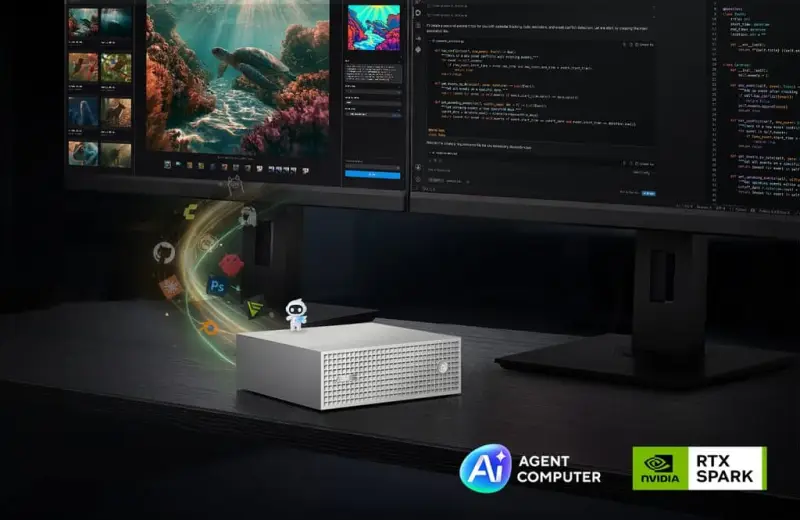
Memory capacity is a key constraint when loading large models and handling long prompts. The GR1X’s stated support for up to 120-billion-parameter models and one-million-token contexts is therefore closely tied to its memory configuration and the way the workload is managed. ASUS hasn’t provided performance figures or detailed conditions for those limits, so they should be read as capability claims rather than benchmarks for a specific model.
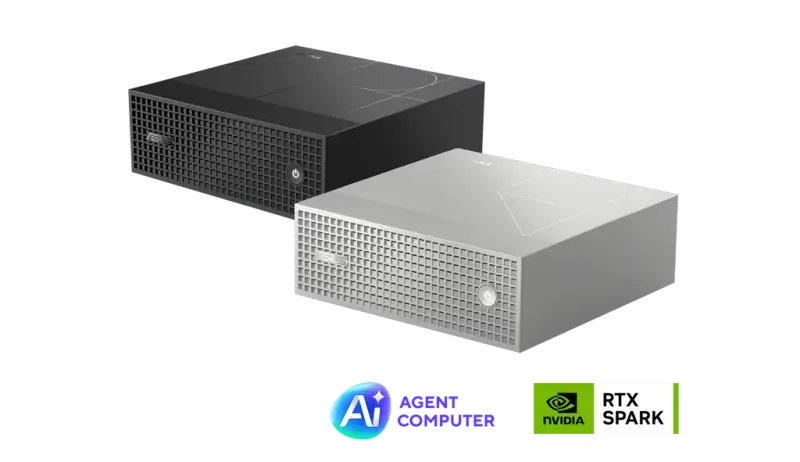
For software compatibility, the PC supports NVIDIA CUDA on Windows 11. That gives developers and users access to CUDA-based tools and applications, while the RTX graphics hardware also targets 3D work, video and AI tasks. ASUS lists gaming features including DLSS, Reflex and ray tracing, extending the system’s use beyond model execution.

Cooling is sized for continuous operation
The compact chassis has to remove heat from a system with a stated thermal design power of 140W. ASUS uses two fans, each described as having 218 blades, alongside 57 wide ultra-fins and four heat pipes. Fan speed can be selected across seven levels, giving users control over the cooling response and associated operating noise, though ASUS has not supplied acoustic or temperature measurements.
At 1.48kg, the GR1X is small enough to fit into a desk-side or studio setup, but its cooling hardware reflects the demands of sustained compute. For workloads that keep an AI agent active over long periods, thermal behavior and fan noise will matter alongside raw model capacity. The available specifications explain the cooling design; they don’t establish how the PC performs under a particular room temperature, workload or ventilation arrangement.

High-speed networking, display and storage connections
Network options include 10GbE LAN, Wi-Fi 7 and Bluetooth 5.4. The wired 10GbE connection may suit workflows that move large datasets across a local network, while Wi-Fi 7 provides a wireless option. The system also has four USB 3.2 Gen 2×2 Type-C ports and HDMI 2.1.

ASUS specifies support for as many as four 4K displays, with HDMI output reaching up to 8K. Storage expansion comes through two M.2 NVMe SSD slots: one supports PCIe 5.0 and the other PCIe 4.0. Those slots give the machine room for fast local storage, useful where models and working datasets need to remain on the PC, although the supplied details don’t state drive capacities or transfer rates.
Local, cloud and hybrid execution are all possible, according to ASUS. That flexibility lets users choose where a workload runs based on its software requirements, cost and confidentiality needs. The GR1X’s central proposition is the combination of a small footprint with a high-memory CPU–GPU platform and Windows CUDA support; its fit for a particular deployment will turn on measured workload performance, software compatibility and sustained cooling behavior.
ASUS announced the ProArt GR1X as an available product. Its specifications and configuration details are listed in the ASUS announcement.
 Stark Future Orders Farsoon FS4X Printers for Titanium Motorcycle Production
 Rolls-Royce and INFINITY Plan Derby Manufacturing Hub for Nuclear Engineering
 Smarten’s 3kW Grid-Tied Inverter Enters Pilot Production