Stark Future Orders Farsoon FS4X Printers for Titanium Motorcycle Production
Stark Future is expanding its Farsoon partnership from a validated run of titanium parts to a multi-machine LPBF line designed for serial output.
Stark Future’s order for several Farsoon FS4X metal printers marks a shift from proving that titanium parts can be made repeatedly to building a production line around that capability. The electric motorcycle maker and Farsoon plan to develop the manufacturing workflow together, covering part preparation, printing, post-processing and inspection. Their challenge is to keep parts consistent as output grows, while controlling scrap, rework and machine interruptions.

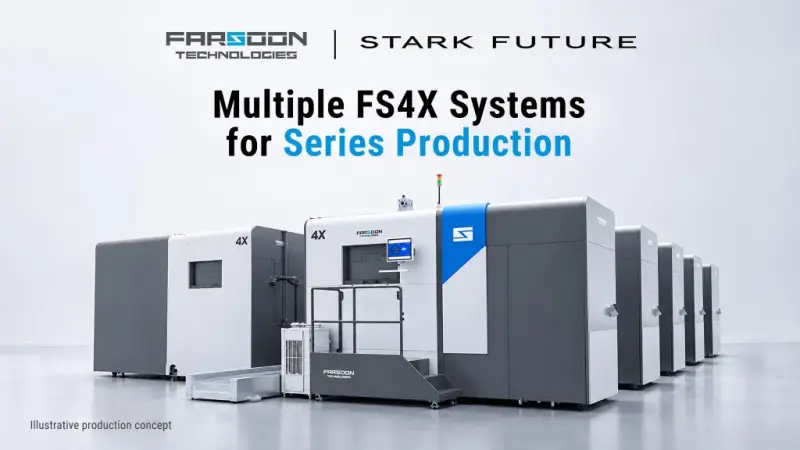
The companies announced the agreement on November 17 at Formnext 2026 in Frankfurt, Germany. Stark intends to use the systems for selected metal motorcycle components, replacing conventional production methods where additive manufacturing suits the part. The order extends work that began in 2024, when Stark adopted a single large-format Farsoon platform. Several FS4X machines will now operate in parallel as part of a dedicated series production line.
Qualifying the full process
The plan covers more than printer installation. Stark and Farsoon will work on material selection and print parameters, build preparation, heat treatment and finishing. The workflow also includes quality inspection, part traceability and production validation. Those steps matter because a repeatable build depends on controlling the whole route from feedstock and machine setup to the finished component, rather than relying on a successful print alone.
The partners’ stated goal is a qualified line capable of serial output with less scrap, rework and downtime. That makes process control central to the deal. Multiple machines can add capacity, but they also need to produce parts that meet the same requirements across builds. The planned development work is intended to establish that consistency while the process moves toward routine production.
Oliver Huizhi Li, managing director of Farsoon Europe GmbH, described the target as making metal additive manufacturing a practical alternative to conventional production, with demanding requirements for quality, repeatability, productivity and cost. Those are the measures that will determine whether this line has a useful role beyond demonstration parts.
What the FS4X brings
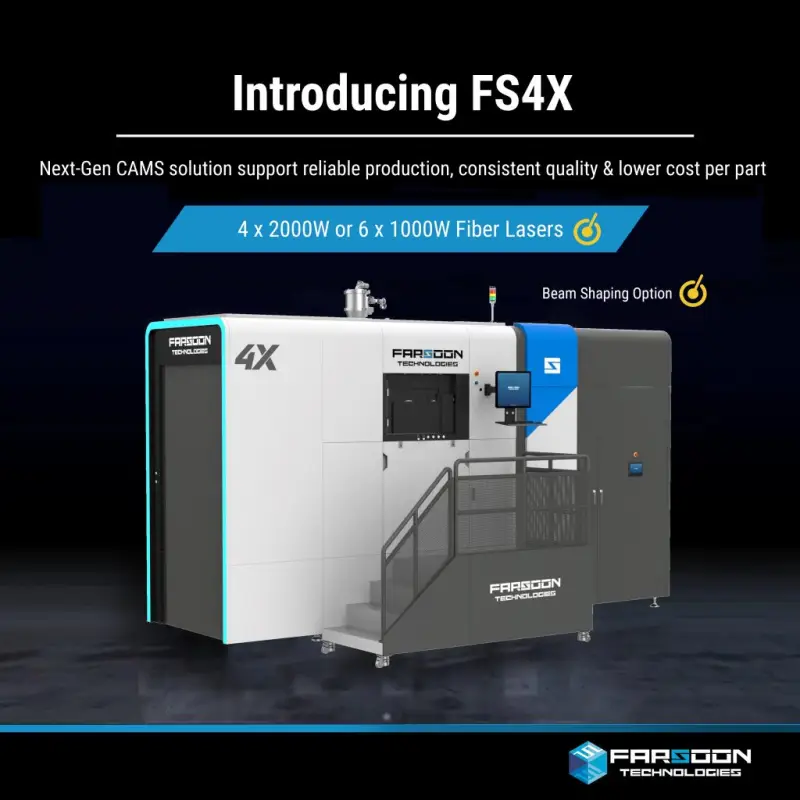
Farsoon describes the FS4X as an LPBF platform for industrial series production. It combines multi-laser processing with stable build conditions, and uses an open-platform architecture that lets manufacturers adjust processing parameters to suit particular parts. The company presents this combination as a way to pair throughput with consistent accepted output.
Farsoon also emphasizes repeatable operation, day-to-day reliability and maintenance. It says these design priorities can reduce scrap, rework and unplanned downtime, helping manufacturers manage cost per part as volumes increase. The company has not provided specific production rates, machine configuration details or cost figures for Stark’s order, so the practical performance of the line will depend on the qualified process and its results in production.
Building on a titanium production record
The earlier phase of the partnership used Farsoon’s FS721M-H-8-CAMS large-format system. In the joint KLINGA project, Stark and Farsoon produced more than 1,000 titanium parts, establishing a record of high-precision, repeatable output that the companies cite as the basis for the FS4X order. The new line extends that experience across several machines and a broader production workflow.
Stark founder and CEO Anton Wass said metal 3D printing gives the company more freedom to shape parts, reduce material use and tune flex, strength, fatigue performance and weight. He said some designs reduce weight by 50%. That figure is Wass’s statement about the company’s parts; the announcement does not specify which components achieve that reduction or the comparison method.
Stark had set a goal in December 2024 of becoming the first automotive manufacturer to mass-produce titanium 3D-printed components. The FS4X order is a step toward that stated aim, but the key measure will be whether the partners can maintain qualified output at a competitive cost over routine production.
Series production remains the test
Other manufacturers are also adding additive capacity for production work. BMW agreed to add ATLIX xBUILD 5000 systems at its Oberschleißheim campus for aluminum prototyping and series production. The systems are described as automating loading, calibration and print start, with closed-loop operation intended to support unattended runs overnight and on weekends. The campus has produced more than 1.6 million parts since production began there.
Farsoon has also introduced the FS722M, developed with feedback from customers already running series production. At Formnext 2026, it showed one-piece titanium exhausts made for all ten Apollo Automobil Evo hypercars. The parts were printed on an FS811M-6 without internal supports.
These examples point to the same practical question: can metal additive manufacturing deliver qualified parts reliably at the cost and pace a product line requires? Stark’s multi-machine FS4X project will test that question through its material and parameter development, inspection and validation work. Its progress will be measured by repeatable production results, not by printer count alone.
 Rolls-Royce and INFINITY Plan Derby Manufacturing Hub for Nuclear Engineering
 Smarten’s 3kW Grid-Tied Inverter Enters Pilot Production
 L&T Technology Services’ SDVault.ai Targets Traceable Software-Defined Vehicle Development