ROHM's BM85060FV PFC Controller Targets MHz GaN Totem-Pole Designs
ROHM's BM85060FV PFC controller pairs MHz switching with GaN HEMTs for 300 W to 500 W AC-DC supplies, claiming up to 99% system efficiency.
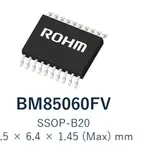
ROHM's new BM85060FV power factor correction controller is built for MHz-range switching with GaN HEMTs, aiming at smaller, more efficient 300 W to 500 W AC-DC supplies.


What the controller is aimed at
ROHM has introduced the BM85060FV, a PFC controller IC for high-efficiency, compact AC-DC power supplies. It's paired with GaN HEMTs that can switch in the MHz range, and the target is 300 W to 500 W units for consumer electronics and industrial equipment. That power band covers a lot of ground: laptop-class adapters at the low end, projector and compact machinery supplies toward the top.
The headline claim is system-level conversion efficiency of up to 99% in 300 W to 500 W class AC-DC supplies. That's a system figure, so it includes the controller, the power stage and the rest of the conversion chain, not the IC alone. Treat it as ROHM's stated target and check it against your own loss budget and test conditions before you put it in a spec sheet.

Why bridgeless totem-pole and GaN go together
Conventional boost PFC runs the rectified line through a diode bridge. Every current path then carries two diode drops, and those drops appear as conduction loss at every line cycle. A bridgeless totem-pole topology removes that bridge. One leg of fast switches handles the high-frequency commutation, while a slower leg handles the line frequency, so the current path has fewer semiconductors in series.
That topology only pays off with devices that can switch fast without penalty. GaN HEMTs have no reverse-recovery charge in the way silicon MOSFET body diodes do, and their output charge is low, which is why they suit hard-switched totem-pole stages. Higher switching frequency then shrinks the magnetics and filter capacitors, because the energy stored per cycle drops. That's the mechanism behind the "minimise peripheral components" claim in ROHM's positioning.

Here's the thing: going to MHz switching trades magnetics size for switching loss, gate-drive demands and EMI. Layout parasitics, dead-time control and gate-loop inductance start to dominate the design, and a few nanohenries of loop inductance can matter a lot at these edges. A controller that handles timing and protection on-chip takes some of that burden off the designer, but it doesn't remove the need for careful PCB work.
Key features as ROHM describes them
- Supports MHz-band switching operation.
- Designed for bridgeless totem-pole PFC architecture.
- Supports DOE Level 7 and CoC Tier 2 design targets.
- Available in a compact 6.5 mm × 6.4 mm × 1.45 mm (maximum) package.
- SSOP-B20 package configuration.
The package is small for a controller that's meant to run a totem-pole stage, and the SSOP-B20 format is familiar to anyone who has laid out a compact controller board. Confirm pin assignments and thermal data in the datasheet, since a package this size leaves little room for thermal error if the controller sits near the power stage.
Standby power and efficiency standards
The IC's quiescent current is 150 µA, which ROHM describes as a 70% improvement over conventional products. Quiescent current matters most at light load and in standby, where the controller's own draw becomes a visible fraction of the input power. Lowering it makes it easier to hold standby consumption down, and that's what lets a design target the DOE Level 7 and CoC Tier 2 efficiency targets the company cites.
Those targets are where many adapter and small-SMPS designs now get tight. At light load, every microamp of controller bias and every extra gate-drive cycle shows up in the no-load number. A controller that scales its own overhead down helps, but the designer still needs to look at the full light-load loss stack, including bias supplies and the startup network.

Protection and design simplification
ROHM says the chip includes other functions needed in AC-DC supplies, including a lightning protection circuit. Built-in protection like this reduces the external parts count, which in turn cuts board area and the number of places a design can fail. Whether the on-chip surge handling meets a given product's surge requirements is a separate question, and it depends on the standard and the test setup the product has to pass. Check the datasheet's stated ratings and your own certification plan rather than assuming the integrated function covers the whole requirement.
The stated application list is AC adapters, consumer devices such as projectors, and compact industrial machinery. Those products share a common pressure: more output power in a smaller enclosure, with tighter efficiency and standby limits. That's the niche where an integrated PFC controller that supports MHz GaN switching makes the most sense.
What to watch next
The BM85060FV is a controller, so its real-world value depends on the power stage around it. Evaluate it against your target topology, your GaN device choice, your gate driver and your thermal budget. If you're moving from a microcontroller-based totem-pole design, the main gains to verify are simpler firmware development and lower controller dissipation. The real test will be how the 99% system figure holds up on your bench at your operating points, and how the board behaves at MHz switching once the layout is finished.
 ProMateria Opens Metal Additive Plant, Starting With GMH Spare Parts
 Q.ANT's Photonic NPU Runs Fourier Transforms in Light for AI Workloads
 SiTime's FemtoClock 4 and VersaClock 8 Target AI Data Centre Timing