ProMateria Opens Metal Additive Plant, Starting With GMH Spare Parts
GMH Gruppe's ProMateria has started production at its metal additive facility, beginning with internal spare parts before taking on outside customers.
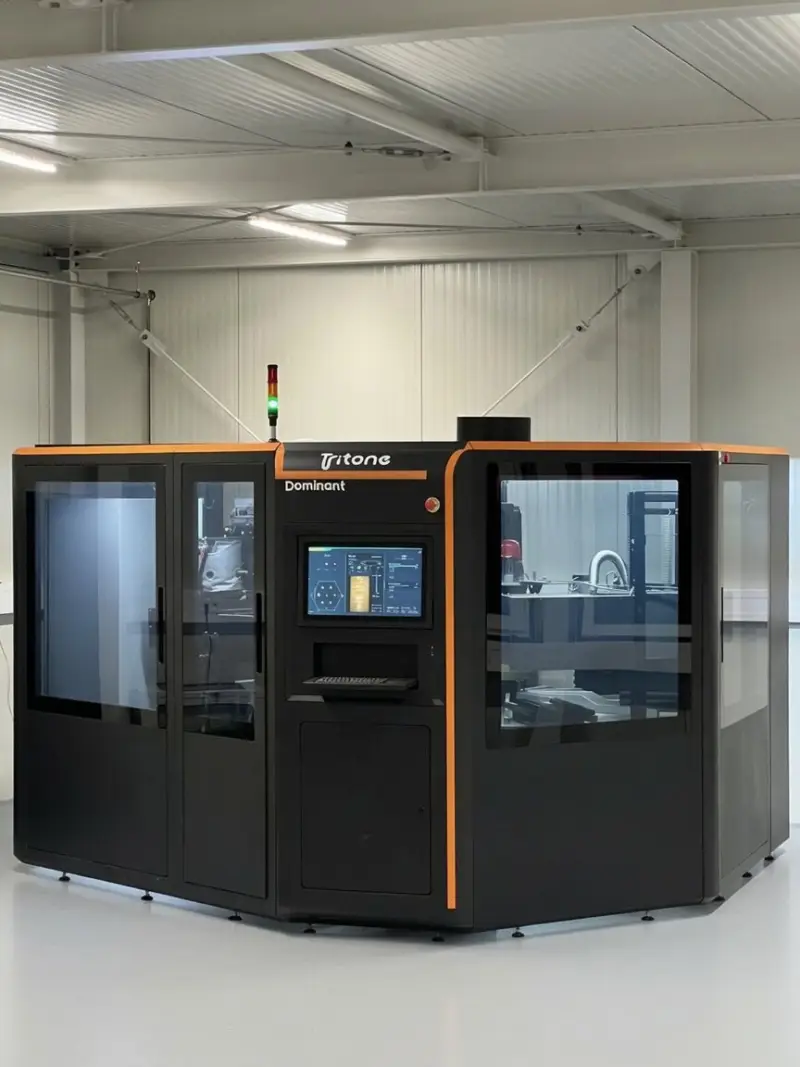
ProMateria GmbH has moved its metal additive manufacturing facility into production, roughly 12 months after planning began. The first batches of ready-to-install spare parts are due in the coming weeks, and they're headed for other companies within the GMH Gruppe. That sequencing matters. A captive spare-parts workload gives a new AM operation real production hours and a feedback loop on part quality before it has to win work from outside buyers on price and lead time.

Qualified parts first, external customers later
The components chosen for the initial phase have already completed qualification, which is the step many AM programs stall on. ProMateria is working through internal spare-parts projects before it opens its additive manufacturing services to external industrial customers. Its stated scope covers spare parts, small production runs and complex metal components.
Philip Stöhr, Commercial Director of ProMateria GmbH, framed the launch as a move "from technology development to industrial application." He said additive manufacturing "opens up entirely new opportunities for companies to produce components faster, more flexibly, and more economically," and that the goal is to turn those advantages into market-ready solutions with customers. He also pointed to the completion of the first spare-parts projects as confirmation that the technological foundation is in place.

Two processes, with room to add machines
GMH Gruppe set up ProMateria earlier this year to combine its metallurgical know-how with additive technologies. The company runs two production processes, and they're split by job type. MoldJet is aimed at serial production of complex metal components. Sintering covers serial production too, and it also handles development and qualification work.
That split makes sense to me. A process aimed at repeatable serial output and another suited to development runs answer different questions, and a shop that wants to qualify parts for a customer needs both. The facility's infrastructure was designed so additional equipment can be integrated as demand grows, which is the detail I'd watch most closely over the next year or two. Plants that plan for added machines from the start tend to avoid rebuilding their utilities, material handling and post-processing flow each time they add a printer.
The parent group behind the plant
GMH Gruppe is a privately owned European metal-processing company. It operates more than 20 steel, forging and casting sites and employs around 6,000 people. Its customers are in more than 50 countries, across automotive, mechanical engineering, railway, energy, logistics, aerospace, agriculture and construction machinery. The group also makes steel from recycled scrap in electric arc furnaces at four sites.
Dr. Alexander Becker, CEO of GMH Gruppe, said the milestone shows the group "combining advanced materials expertise with digital manufacturing technologies." He added that ProMateria expands the group's additive capabilities and creates new ways to support customers with what he called economically viable manufacturing solutions.

This matters for the parent's own supply chain. A metals group with in-house material science and casting or forging capacity has a clear reason to 3D print spares for its own machines: the parts are often low-volume, expensive to hold in inventory, and slow to source through conventional routes. Owning the pipeline from powder to qualified part lets the group test a design against its own metallurgy before offering it to anyone else.
What to watch next
ProMateria plans to develop more industrial applications with customers and partners once it moves past internal GMH Gruppe projects. The next phase focuses on parts that are hard to make economically with conventional methods. That's the right target, though it's also where qualification gets expensive. Complex geometries that only AM can produce still need material data, process control and inspection evidence that a buyer will accept, and that evidence takes time to build. Here's the thing: the practical test won't be the first batch of spares. It'll be whether ProMateria can take an outside customer's drawing, qualify it on one of its two processes, and hold cost and lead time against conventional casting or machining. Until that happens, the facility is a captive AM shop with a good starting position. If the first external projects land, it becomes a supplier. I'd expect the next announcements to show which of those it is.
 Q.ANT's Photonic NPU Runs Fourier Transforms in Light for AI Workloads
 SiTime's FemtoClock 4 and VersaClock 8 Target AI Data Centre Timing
 STM32G5 Brings 280 MHz Cortex-M33 Control to AI Power and Humanoid Motors