STM32G5 Brings 280 MHz Cortex-M33 Control to AI Power and Humanoid Motors
STMicro's STM32G5 mixed-signal MCUs pair a 280 MHz Cortex-M33 with a 12-channel high-resolution timer and PQC support for power and motor control.
STMicroelectronics has released a mixed-signal microcontroller family aimed at two very different loads: real-time power management in AI data centres and multi-motor control in humanoid robots. The two workloads share a need for fast, precise timing and more compute at the edge of the control loop.

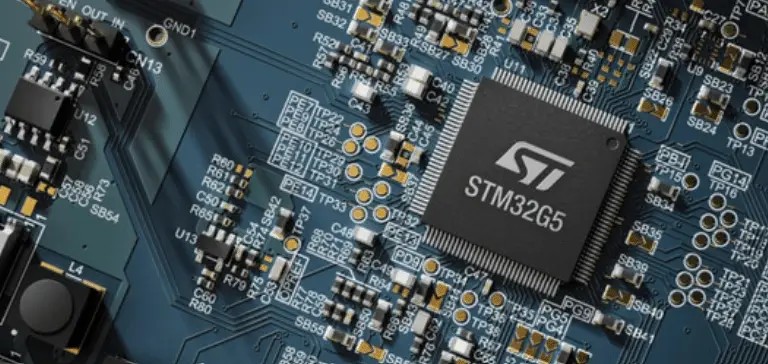
Why a power-control MCU is suddenly interesting to AI infrastructure people
Most of the attention on AI infrastructure goes to accelerators, but the power path feeding them is becoming a control problem of its own. The source points to GPU load in AI data centres pushing rack-level power consumption up to 1 MW. At that scale, a power supply that reacts a little more slowly to a change in load costs real efficiency, and a supply that overshoots costs component stress.
That's where STMicroelectronics is aiming the STM32G5. The company says the family is meant to give designers finer control over switching in power supply units as loads vary across servers. The source also makes the link to wide-bandgap devices: higher switching frequencies in SiC- and GaN-based supplies depend on tighter timing, and a timer that can place edges more precisely is what makes those frequencies usable in practice.

The core and the numbers ST is quoting
The STM32G5 family is built around an Arm Cortex-M33 running at 280 MHz. ST's figures, as reported, put the core at 420 DMIPS and 1,136 CoreMark at that frequency, and the company describes the series as offering double the computing performance of the previous STM32G4 generation.
Those are vendor-stated numbers, and they come from the company's own test conditions, which weren't detailed in the source. If you're comparing against a G4 design, run your own loop-latency measurement with your firmware and your interrupt load. A DMIPS or CoreMark score tells you about raw integer throughput, not about how long your current-loop ISR takes to finish while a PWM event is queued.

The chip also integrates instruction and data caches. For control code that sits in flash, caches help hide wait states, and that matters most when the loop is long enough to miss the tightly coupled memory you'd normally rely on for deterministic timing.
Timing and analogue peripherals
The headline peripheral is an enhanced 12-channel high-resolution timer. High resolution in this context means the timer can position PWM edges at finer steps than a standard general-purpose timer, which reduces the quantisation error in duty cycle. That's the mechanism behind the claim that finer timing supports better switching decisions: smaller steps mean the controller can hit the target voltage with less dithering around it.
The analogue side includes a 12-bit ADC, a 12-bit DAC, an operational amplifier and ultra-fast comparators. Integrating the comparator and op-amp on the same die as the timer is what lets a fault comparator shut down a PWM output within the same silicon, rather than through a board-level path with extra propagation delay. Whether a given design gets that benefit depends on how the comparator is wired to the timer's break input, which you'll need to verify in the datasheet and reference manual.
Multi-axis motor control for humanoids
On the robotics side, the source says the controllers provide multi-axis motor control and support for position encoders. A humanoid hand or finger assembly is a demanding case: many small motors, tight coordination between joints, and feedback that has to be read and acted on quickly. Encoder support on the MCU means position information can close the loop without an extra interface stage between sensor and controller.

Coordinating several motors on one device also means sharing timers, ADC bandwidth and interrupt time across channels. The 12-channel timer is one part of that budget. How many axes you can run at a given loop rate will depend on your current sampling scheme, your encoder interface and how much of the CPU your trajectory code consumes. Teams in this position typically prototype with one motor and then scale up, watching the worst-case loop time rather than the average.
Programmable logic and post-quantum security
The series includes what ST calls a programmable logic array, PLAy, which the source describes as letting developers build custom hardware functions on the chip without external logic. For a motor or power controller, that could mean implementing a fixed-function behaviour such as an interlock or a specific sequencing rule directly in the MCU's fabric. The trade-off is familiar to anyone who has moved logic from a CPLD into firmware: the logic is deterministic and fast, but it's fixed in hardware and needs its own design and verification flow.
On security, the source lists Arm TrustZone alongside ST's STM32Trust features: secure boot, firmware update, secure storage and tamper protection. It also mentions post-quantum cryptography (PQC) support. The practical point for a product team is that firmware signing and key storage can be designed around the chip's trusted execution boundary from the start, not bolted on later. PQC support matters most for devices with long service lives, where keys and signed images need to stay trustworthy for years.
Packages, memory and availability
The range spans performance and high-resolution variants in packages from QFN32 to LQFP128. Flash capacity runs from 64 KB to 512 KB. That's a wide band, and the pin count is the first filter: a 32-pin QFN suits a single-axis power stage, while a 128-pin LQFP leaves room for many timer channels, ADC inputs and encoder interfaces on one board.
For development, ST lists the NUCLEO-G564RE board, digital power and motor control discovery kits, and software libraries. The source says the parts are in production and gives a unit price of $1.034 for orders over 10,000 pieces, as stated by ST. Volume pricing at that level is aimed at OEM production runs, so hobbyists and small teams should expect different pricing through distributors.
For the original announcement and the full datasheet-level detail, the STMicroelectronics newsroom is the place to check. Confirm the variant-specific peripheral counts against the reference manual before you commit a layout, because the headline features don't always map one-to-one onto every package.
What I'd watch
My read is that the interesting question is whether this class of MCU starts taking over control functions that used to need a separate FPGA or a discrete gate driver with its own logic. The PLAy block and the timer resolution point that way. The caveat is that AI-driven power loads and humanoid robot joints both have long validation cycles, so the first designs using this family will probably be reference platforms and development kits rather than shipping products. Watch for independent loop-latency and EMI measurements on the discovery kits, and for how many real designs use the PLA for anything beyond simple interlocks. Those results will tell you more than the headline MHz figure.
 ProMateria Opens Metal Additive Plant, Starting With GMH Spare Parts
 Q.ANT's Photonic NPU Runs Fourier Transforms in Light for AI Workloads
 SiTime's FemtoClock 4 and VersaClock 8 Target AI Data Centre Timing