305 VAC Safety-Rated MLCCs From Vishay Aim at Line-to-Line Surge Protection
Vishay's Vitramon VJ series carries IEC 60384-14 X1 certification, a 305 VAC rating and a 5 kV peak impulse rating in 2220 MLCC packages.
The number that matters most in Vishay's new Vitramon VJ family is 305 VAC. That's the maximum operating voltage, and it puts these surface-mount multilayer ceramic capacitors (MLCCs) in a position to sit directly across the mains, line to line, in designs that previously needed leaded safety parts or bulkier film types. The series is certified to IEC 60384-14 for X1 safety usage, and it's pitched at circuits that see supply spikes and surges.

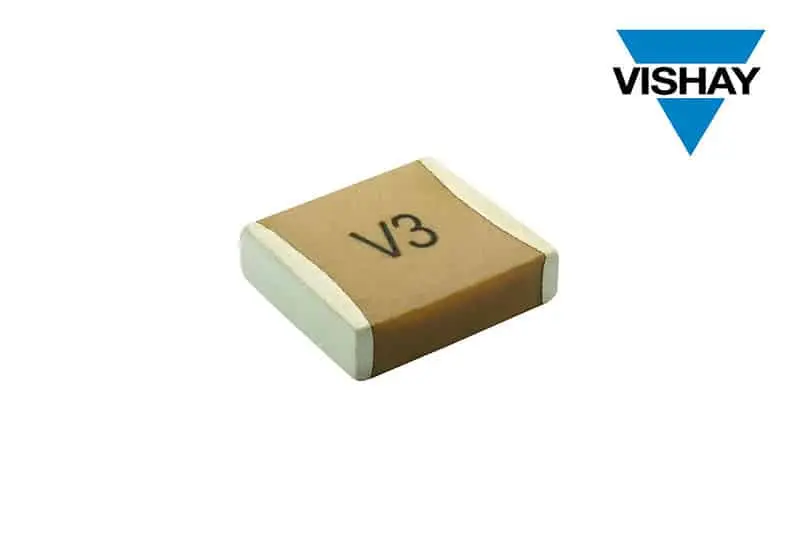
What the ratings actually say
Vishay's listed specifications for the VJ series are 305 VAC maximum operating voltage, 2 kVDC maximum voltage and 5 kV peak impulse voltage. Those three figures describe different stresses, and it helps to keep them separate. The AC rating sets the continuous voltage the part can sit at across the line. The DC rating is the ceiling the dielectric is qualified for in direct voltage conditions. The peak impulse rating addresses short, high-energy transients such as lightning-induced surges and switching events on the supply, which are the events that tend to punch through a design that only looked at steady-state voltage.

The X1 designation matters here too. In IEC 60384-14, X-class capacitors are intended for line-to-line connection across the supply, where a failure has to be handled safely rather than just tolerated. Y-class parts, by contrast, are normally connected between a line and earth. If you're designing EMI filters, the X-versus-Y decision determines where the part sits and what failure mode you're accepting, so the certification is more than a marketing badge. Vishay describes the VJ parts as suitable for EMI filtering, electrical isolation, and lightning strike and voltage surge suppression, which lines up with that line-to-line role.

Dielectric, electrodes and capacitance range
The series uses an X7R dielectric, which is a Class II ceramic. X7R trades some stability for much higher capacitance per unit volume than C0G, so the capacitance drifts with temperature and with applied DC bias. For a line-facing protection part that's usually acceptable, because the job is clamping or filtering rather than precision timing or resonant tuning. It does mean you should check the derated capacitance at your operating voltage, not just the nameplate value, if the filter corner frequency matters.
Vishay specifies noble metal electrode (NME) construction using a wet build process. In MLCCs, noble-metal electrodes are generally used so the internal electrodes can survive high-temperature firing without oxidising, which allows the ceramic and electrode stack to be co-fired. The wet build label is Vishay's own term, and the source doesn't go further into the process steps, so I'd treat it as a manufacturing description rather than a performance claim in itself.

Capacitance runs from 270 pF to 4.7 nF, and the case is 2220. That's a large package for an MLCC, and it's the physical reason these parts can handle the voltage and impulse levels: creepage and clearance on the board, and the dielectric thickness needed for the rating, both push the footprint up. Layout teams should expect the part to take real board area and to need appropriate creepage spacing around it, especially in mains-connected sections.
Operating range and compliance
Operating temperature is specified at -55°C to +125°C. That range covers most industrial enclosures and automotive-adjacent environments, and it's the range that matters when a part sits near power-stage heat sinks or inside appliance housings that run warm. Vishay lists the parts as RoHS-compliant, halogen-free and Vishay Green-certified. Those are declarations from the manufacturer, so verify them against the datasheet and your own compliance paperwork before release.
Vishay positions the series for energy and industrial equipment, consumer electronics and household appliances. In a practical sense, that's where line-connected filtering and surge clamping are most common: switch-mode power supplies, appliance control boards, metering and inverter front ends. Teams in those spaces typically move from through-hole safety capacitors to SMD parts when assembly volume or board density pushes them that way, and the 2220 case with an X1 rating is a direct option for that move.
Where this fits, and what to check
My read is that the real value here is a surface-mount X1 part with a 305 VAC rating, which narrows the gap that used to force designers toward leaded components for line-to-line duty. It doesn't remove the need for a proper surge analysis. Peak impulse ratings describe what the part can withstand, not what your circuit will deliver, so the upstream protection (fusing, varistors, gas discharge tubes, or whatever your design uses) still defines the actual stress. Check the derated capacitance at operating voltage and temperature, confirm the creepage and clearance against the applicable standard for your product, and run your own impulse test if the product will see lightning-class events.
Availability, pricing and sampling terms aren't covered in the announcement, so those will need to come from Vishay directly. The product page is the place to start for the full datasheet: Vishay product page for the VJ series. Parts from this family will be worth watching as more appliance and industrial designs move from leaded safety capacitors to SMD X1 options.
 ProMateria Opens Metal Additive Plant, Starting With GMH Spare Parts
 Q.ANT's Photonic NPU Runs Fourier Transforms in Light for AI Workloads
 SiTime's FemtoClock 4 and VersaClock 8 Target AI Data Centre Timing