Q.ANT's Photonic NPU Runs Fourier Transforms in Light for AI Workloads
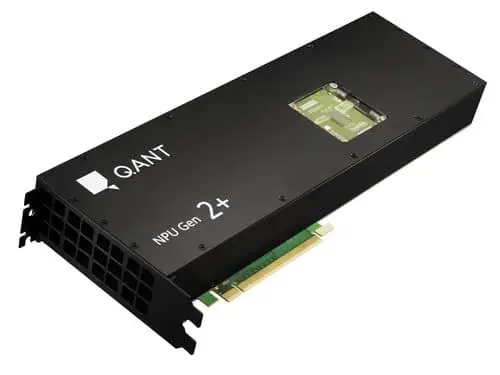
Q.ANT's NPU Gen 2+ performs discrete Fourier transforms optically and has run an LLM attention layer alongside an AMD GPU, according to the company.
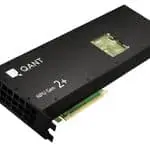
The interesting part of Q.ANT's NPU Gen 2+ isn't that it uses light. Optical computing has been a research topic for decades. What matters is the specific operation it's built to accelerate: the Discrete Fourier Transform (DFT). Q.ANT says the chip performs DFTs directly in light, and that's a different proposition from using photonics for general matrix multiplication. If the claim holds up in real workloads, it points to a co-processor that handles one well-defined, expensive kernel rather than a wholesale replacement for GPUs.

Why the DFT is the target
A DFT converts a signal from its time or spatial domain into its frequency components. It shows up across signal and image processing, simulation and data analysis, which is why it's one of the most widely used operations in numerical computing. On conventional digital hardware, a DFT is carried out as a sequence of multiply-and-accumulate steps. The cost scales with the size of the input, and every step moves data through memory and burns switching energy.

Q.ANT's pitch is that the photonic processor uses the physical behaviour of light to complete the transform in a single operation. Instead of stepping through the arithmetic, the optical hardware lets the wave interference do the work. For engineers who've profiled AI pipelines, that's the relevant distinction. Attention mechanisms and many signal-processing front ends spend a large share of their time in exactly this kind of transform, so offloading it could change the time and energy budget of the whole model, not just one layer.

Where it sits in a system
The company describes the NPU Gen 2+ as a co-processor that works alongside CPUs and GPUs. It isn't positioned to run an entire model on its own. The host processor keeps control of the program and the bulk of the workload, and the photonic unit takes selected, computationally intensive operations. That model is familiar from FPGA and DSP offload, and it has the same integration questions: how data gets to the optical unit, how results come back, and how much latency the round trip adds.
Q.ANT also says the chip can help AI models work with fewer parameters and less data. That claim deserves a careful reading. A transform that's cheaper to compute gives model designers room to choose architectures that rely more on frequency-domain representations, which can reduce what the model needs to learn. Whether that translates into smaller models in practice depends on the algorithms developers build around the hardware, and Q.ANT frames this as a tool developers will have to learn to use.

The hybrid LLM demonstration
The most concrete piece of evidence Q.ANT offers is a hybrid system pairing the NPU Gen 2+ with an AMD GPU to run a large language model. In that demonstration, optical Fourier transforms replaced a computationally intensive attention layer in the model. Attention is a known bottleneck in generative AI, because its cost grows quickly with sequence length, so it's a sensible place to show a hardware offload.
Here's the thing to keep in mind: the source describes a demonstration, not a published benchmark. It doesn't give throughput, latency, energy per token, accuracy impact or the model size used. Without those numbers, the demo shows the architecture is workable, not how much faster or cheaper it is. Anyone evaluating the approach should look for those figures before drawing conclusions, and should check whether the replaced layer changes model output quality.
Q.ANT's CEO, Michael Förtsch, framed the work this way: "With Gen 2+, we're opening the door to software that uses what light does naturally. That allows leaner AI models with fewer parameters and less data, and that is what will make the next wave of AI affordable." He added: "With the DFT performed natively, developers now have a new tool to reshape the mathematics of AI models. This is an important step on our roadmap to combine more optical components on our chips for even more sophisticated functions, driving new algorithms and applications. By running a large language model in a hybrid system with an AMD GPU, we have shown that our processors work as co-processors with GPUs. We're building a community with pioneering developers on the journey to a new era of computing."
What's hard about optical co-processors
Optical compute units have long faced the same practical obstacles, and they're worth keeping in view. Signals usually have to be converted between electrical and optical domains at the boundary, and those converters add latency and power of their own. The offload only pays off if the transform is large enough to amortise that overhead. Numerical precision is another question. Analogue optical arithmetic is typically less exact than digital arithmetic, so the acceptable error budget for a given workload matters as much as raw speed.
Software is the third hurdle. Developers need libraries, compiler support and a way to decide at runtime which operations go to the optical unit. Q.ANT's comments about building a developer community suggest it knows this. A co-processor with a narrow, well-documented interface is easier to adopt than one that requires rewriting a model from scratch.
What to watch next
The roadmap Q.ANT describes adds more optical components to its chips, which would extend beyond the DFT to other functions. If that happens, the next questions will be about how many operations the hardware supports, how it connects to standard host systems, and what performance figures independent groups can reproduce. For now, the NPU Gen 2+ is best read as a targeted accelerator with a credible demonstration behind it. Engineers responsible for AI infrastructure should watch for published benchmarks and integration details before treating it as more than an interesting option for transform-heavy workloads.
 ProMateria Opens Metal Additive Plant, Starting With GMH Spare Parts
 SiTime's FemtoClock 4 and VersaClock 8 Target AI Data Centre Timing
 STM32G5 Brings 280 MHz Cortex-M33 Control to AI Power and Humanoid Motors