Kaimou GS2.3 Global Shutter Sensor Delivers 2.3 MP at 120 fps
Kaimou’s GS2.3 pairs 1920 × 1200 global-shutter imaging with external camera sync, near-infrared sensitivity and MIPI CSI-2 output.
For robot vision, the useful question isn’t just how many pixels a camera can resolve. It’s whether multiple cameras can capture a moving scene at the same instant, and whether fast motion stays geometrically consistent within each frame. Kaimou Semiconductor’s GS2.3 targets those needs with a 2.3-megapixel global-shutter CMOS sensor, external frame triggering and frame rates up to 120 fps.

The sensor records 1920 × 1200 pixels and is intended for robot cameras, machine vision systems and barcode readers. A global shutter captures the frame across the sensor together, avoiding the skew that can occur when a rolling shutter reads rows at different times. That can help preserve the apparent shape and position of moving objects, though the sensor’s specifications alone don’t establish a system’s total motion accuracy; optics, lighting, exposure time and processing remain part of the result.

Synchronising camera views
GS2.3 supports external FSYNC triggering, which lets a system trigger multiple cameras simultaneously. Synchronized exposures can make it easier to compare views of a moving object, a practical requirement in multi-camera robot perception and machine inspection. The device can also run in free-running master mode, giving designers an operating option when an external trigger isn’t driving capture.
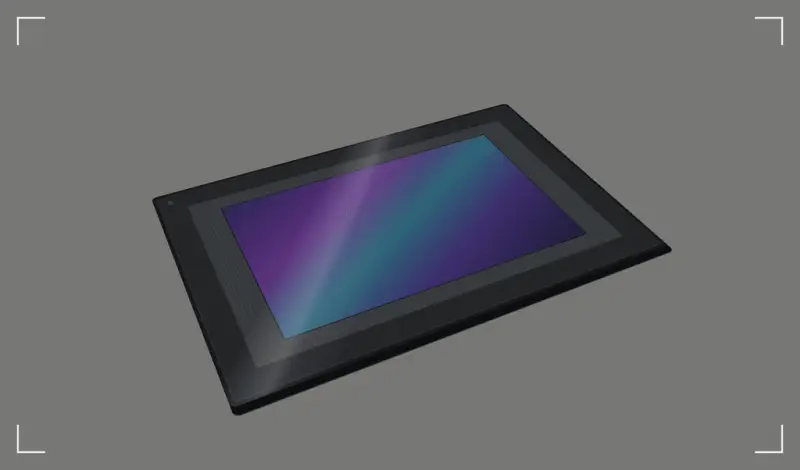
Trigger support provides a timing input, but the wider camera system still needs to handle trigger distribution, configuration and image transport. Integrators will need to check that their camera modules and host platform support the intended frame rate and output mode, and that exposure settings suit the scene’s motion and illumination.

Near-infrared response and image formats
Kaimou specifies a 1/2.6-inch optical format and 3 µm pixels. The monochrome version is rated at 44.6% quantum efficiency at 850 nm and 24.9% at 940 nm. Those figures make the sensor relevant to designs using near-infrared illumination, while the monochrome and RGB variants give teams a choice based on whether colour information is needed.
Image data can be output in RAW8, RAW10 or YUV422 over MIPI CSI-2. RAW formats leave more of the image-processing pipeline to the host, while YUV422 supplies image data in a format commonly used by video-processing systems. The available formats give designers room to match image handling to their processor and bandwidth requirements; the source specifications don’t state the data rate or lane configuration for every operating mode.

On-chip controls include automatic exposure and gain, alongside black-level adjustment, defective-pixel correction, lens-shading correction, gamma correction, sharpening and noise reduction. The sensor also supports scaling, windowing and up to four regions of interest. These functions can help tailor the image stream to an application, but teams will need to evaluate their effects on detail and image quality for the specific task.
Power, package and availability
The nominal digital supply is 1.2 V; Kaimou specifies that it rises to 1.5 V in 120 fps mode. At that frame rate, with a four-lane MIPI interface, active-mode power is 331 mW. That operating point gives designers a concrete figure for early power budgeting, but the stated number applies to the described configuration and doesn’t represent the total consumption of a camera module or host system.
The chip-scale package measures approximately 8.02 × 5.40 mm. Samples are expected in Q4 2026 at around $45, with volume production planned to start in Q2 2027. Camera modules and evaluation boards are available from partners using Raspberry Pi 5 and Luckfox Aura, offering development paths for teams assessing the sensor before designing a custom camera assembly.
The GS2.3’s combination of global-shutter capture, FSYNC triggering and near-infrared response is aimed at systems where timing and motion detail matter alongside resolution. For an engineering evaluation, the next checks are the required exposure and illumination, host compatibility with MIPI CSI-2, and whether the chosen frame rate fits the application’s power budget.
 AXT and Stärke-AMG Plan Adelaide SAF 3D Printing Capacity
 Fluke ii1050 and ii1030 Acoustic Imagers Add 202 Microphones for Industrial Inspections
 KIMM LED System Changes Object Colours While Keeping Room Lighting White