Fluke ii1050 and ii1030 Acoustic Imagers Add 202 Microphones for Industrial Inspections
Fluke’s ii1050 and ii1030 combine 202 microphones, on-device analysis and a 13 MP camera to inspect leaks, partial discharge and mechanical faults.
Finding a developing fault is often easier when a maintenance team can locate its sound and see where it comes from in the same inspection. Fluke’s ii1050 and ii1030 Acoustic Imagers are designed to do that for compressed air, gas and vacuum leaks, electrical partial discharge, and emerging mechanical problems. Their most notable hardware change is a microphone array of 202 elements, up from 64 in the previous models, packaged in devices Fluke says are around 40 percent smaller.

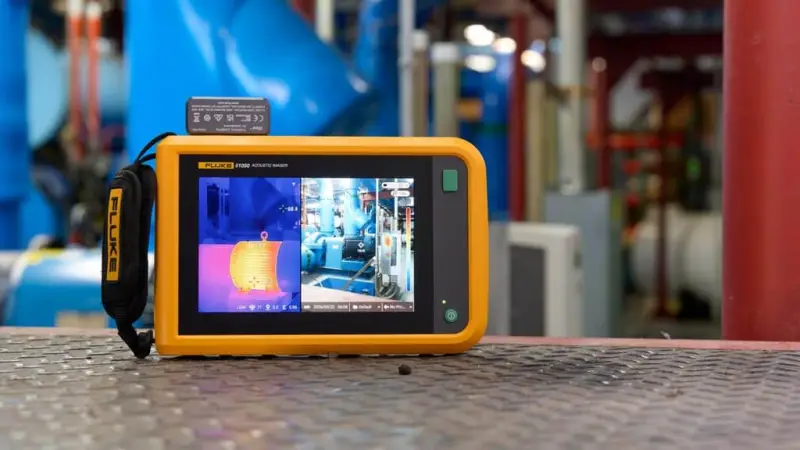
More microphones in a smaller instrument
The additional microphones are intended to improve sensitivity to sounds associated with leaks and other faults. In practice, an acoustic imager helps an inspector survey equipment and use the resulting sound information to identify a likely source. The integrated 13-megapixel camera supplies a visual reference for the inspected area, while an anti-glare screen is intended to keep that view usable in bright surroundings.

Fluke gives the weight as 1.2 kg and describes both models as around 40 percent smaller than their predecessors. That combination could matter on routes that involve extended handheld use or access to confined inspection points: a lighter, smaller instrument is easier to carry between assets and position around equipment. The stated figures do not specify the measurement method or comparison model, so they should be treated as manufacturer-provided product details rather than independent test results.

The imagers carry an IP54 rating. That rating gives teams a defined enclosure specification to consider when selecting equipment for an inspection environment, though it does not by itself establish suitability for every site condition. The source material does not give operating limits, acoustic frequency range, detection distance, battery life, or differences between the ii1050 and ii1030. Those details will matter to teams comparing the instruments against existing inspection procedures.
Inspection findings, captured on site
Both models include in-situ analysis and logging, so technicians can record findings while they are at the equipment. That can connect a detected sound with the asset and inspection context before the team moves on. The devices also have a built-in torch for poorly lit areas and are compatible with Fluke’s TC03A plug-in thermal camera.

The thermal camera adds another inspection modality to the acoustic instrument, but the available product information does not describe how the two data types are combined or whether thermal images are included in the same report. Teams evaluating the setup will want to check the workflow for saving, exporting and associating records with asset-management systems. Those practical details determine how easily an on-device observation becomes a maintenance action that another technician can review.
From detection to maintenance priority
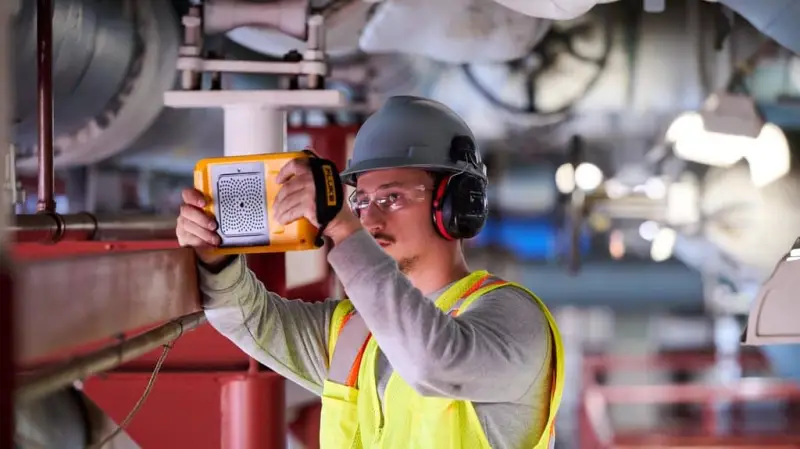
Compressed air, gas and vacuum leaks are among the applications Fluke identifies. Detecting a leak can help a maintenance team decide what to investigate and repair; the company also frames leak identification as a way to reduce wasted energy. For electrical assets, the instruments are intended to locate partial discharge, while mechanical inspections can use them to identify developing issues. These are inspection aids: the announcement does not provide detection thresholds, diagnostic accuracy figures or test results for specific equipment.
That distinction matters in a maintenance program. An acoustic indication can help narrow the location of a suspected problem and prioritize follow-up, but teams still need to interpret the finding in the context of the asset, operating state and established inspection practice. Fluke’s product details do not describe a universal severity scale or automatic fault classification, so no such capability should be assumed from the stated features.
“Maintenance is increasingly less about responding to failures reactively and more about preventing them,” said Tako Feron, Fluke’s Senior Product Manager for Acoustic Imaging. Feron said the devices are intended to turn inspection data into clearer insights that support faster decisions. Jaison Isaac, Managing Director of Fluke India, said the launch brings inspection capabilities to Indian industries in a more compact design and supports work on asset reliability and energy efficiency.
The practical change is a higher microphone count paired with a more portable format, visual documentation, on-device logging and an option to connect a thermal camera. For teams considering an upgrade, the next questions are how the models perform on their own assets, what reporting workflow they support, and which specifications distinguish the ii1050 from the ii1030. Those answers will determine whether the new form factor and inspection features fit the team’s routine.
 Addivate Adds ROBOZE ARGO 1000 HYPERMELT for Larger Polymer Parts
 AXT and Stärke-AMG Plan Adelaide SAF 3D Printing Capacity
 KIMM LED System Changes Object Colours While Keeping Room Lighting White