KIMM LED System Changes Object Colours While Keeping Room Lighting White
KIMM researchers demonstrated LED lighting that alters an object’s apparent colour while keeping the surrounding space illuminated in white.

A lighting system from the Korea Institute of Machinery and Materials (KIMM) changes how an object appears without changing its surface or shifting the room into coloured light. The approach could give exhibition and interior designers a way to vary an object’s visual presentation through lighting alone, while keeping the surrounding space white.

The principle rests on how colour is perceived: light illuminates a surface, the surface reflects part of that light, and the reflected wavelengths reaching the eye shape the object’s apparent colour. Change the mix of wavelengths in the illumination and the same object can look different. KIMM’s researchers built a system that adjusts light from multiple LEDs to control that effect remotely.

Changing the target without tinting the room
With conventional lighting, changing the colour of the illumination tends to alter the appearance of the whole space. KIMM’s approach uses the brightness of multiple LEDs to tune the light reaching a selected object. The reported result is that the object’s reflected colour changes while the surrounding area remains under white lighting.

That distinction is the system’s main practical feature. A coloured spotlight can make a target stand out, but it also changes the local ambience and can affect nearby surfaces. By coordinating LED brightness, the KIMM system aims to create a more selective effect: the object appears to change colour, while the room does not take on the same colour cast.
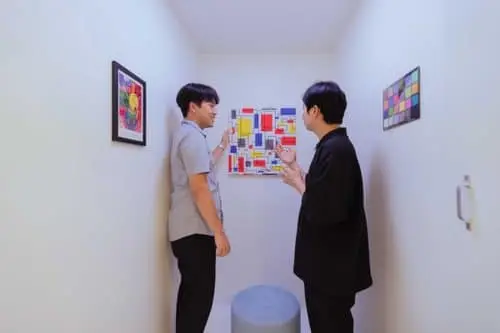
The method also leaves the object itself untouched. There is no need to attach an electronic device, repaint a surface or replace the object to produce a different appearance. The effect comes from the light directed at it, which makes the technique relevant where surface modification is undesirable or where an exhibit needs to present different visual treatments in the same installation.

Tests with colour cards and Morpho butterflies
The research team developed the colour-control principles, assembled an LED lighting system using different kinds of LEDs, and paired it with a measurement system. Experiments used colour cards and Morpho butterflies, whose vivid colours arise from structural features rather than conventional pigments alone. KIMM reported that both could appear in different colours under different combinations of illumination.
The butterfly tests matter because structural colour can respond strongly to lighting conditions. The team’s results show that the approach can affect the appearance of more than a uniformly coloured card. The reported experiments establish that changing the LED mix can produce visible changes in the tested objects; the available details do not specify wavelength ranges, LED counts, colour coordinates, measurement tolerances or the size of the colour shifts.

That missing measurement detail limits how precisely engineers can judge the system’s performance or compare it with other colour-control methods. The reported work demonstrates the effect, but it does not provide enough information to infer colour accuracy, repeatability, viewing-angle dependence or how the system behaves with a broader range of materials. Those factors would matter when moving from a demonstration to a design specification.

Where lighting-based colour control could fit
KIMM identifies exhibitions, interior design, product design and artworks as possible applications. In an exhibition, the same object could be presented with different visual emphasis as the lighting changes. In a designed interior, lighting could alter the appearance of selected objects while retaining white illumination elsewhere. Product and artwork settings could also use the technique to explore colour treatments without repainting or replacing the item.
For practitioners, the key design question is selectivity: how well can the system control the target’s appearance without unwanted changes to nearby objects? The answer will depend on the lighting arrangement, the surfaces involved and the viewing conditions, though the reported information does not quantify those limits. Deployment would also require a suitable LED array and control system; no cost, availability, installation requirements or commercial release details are given.
The demonstration points to a useful shift in how designers can think about colour. Instead of treating an object’s visible colour as fixed by its finish, the system treats illumination as a controllable part of the object’s appearance. Further performance data will determine how precisely that control can be applied in real spaces, but the experiments show that a single object can take on different apparent colours while the surrounding room stays white.
 Addivate Adds ROBOZE ARGO 1000 HYPERMELT for Larger Polymer Parts
 AXT and Stärke-AMG Plan Adelaide SAF 3D Printing Capacity
 Fluke ii1050 and ii1030 Acoustic Imagers Add 202 Microphones for Industrial Inspections