AMD Versal TR Adds Backside Attack Detection to Adaptive SoCs
Versal TR pairs a bonded sensor die and boot safeguards with AI compute, programmable logic and post-quantum cryptography support.

AMD’s Versal tamper-resistant (TR) devices put physical attack detection directly into an adaptive system-on-chip package. The design’s defining feature is a sensor-based protection die bonded to the compute die, extending coverage to the silicon backside—a part of the chip that conventional protection arrangements may leave exposed. For teams building security-critical embedded systems, the approach could reduce the need to assemble protection from separate board components, mechanical enclosures and application-specific ICs.

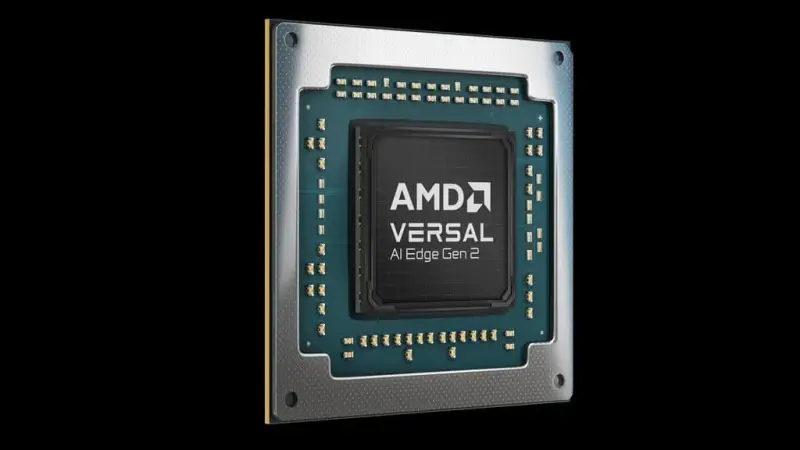
AMD introduced the devices in November 2026. They are based on the Versal AI Edge Series Gen 2 architecture and combine protection features with heterogeneous processing. The company identifies security-critical embedded applications as the target, including industrial infrastructure, data centre networking and fintech. The design also has defence applications, though its broader engineering significance lies in integrating tamper response with compute resources in one device family.

Protection built into the package
The protection die is joined to the main compute die using 3D active-on-active technology. AMD says this arrangement covers the silicon backside and senses physical attacks. If the protection die is tampered with or removed, the device prevents booting. That response ties the physical security mechanism to the system’s ability to start, rather than relying solely on an external enclosure or a separate board-level component.

That integration may change how designers allocate board area and assemble a security boundary around the processor. A discrete approach can require additional parts, enclosure provisions and custom silicon, each of which has to fit into the product’s mechanical and electrical design. AMD presents the bonded protection die as a way to reduce that extra circuitry and simplify board design. The source provides no dimensions, board-area figures or comparative cost data, so the size of any savings will depend on the existing implementation.
There’s also a practical design question: the protection mechanism is part of the silicon package, while the system still needs a complete security architecture around it. Boot configuration, key handling, software and board interfaces remain relevant to a finished product. The listed features indicate several ways the device addresses those layers, but AMD has not provided test conditions or performance data for the physical attack protections in the information available here.

Cryptography and fault detection
Versal TR includes hardware acceleration for post-quantum cryptography, with support for ML-DSA and SLH-DSA. Those algorithms extend the device’s cryptographic options for applications that need to verify software or other signed data. The devices also support hybrid boot flows with multiple signature algorithms, giving system designers a way to accommodate more than one signature method during startup.
Other security features focus on secrets and fault conditions. AMD lists an improved application security unit key vault and a memory element aging sensor. The company also describes enhanced glitch detection: it builds on the existing architecture and adds a detector for simultaneous glitches across two voltage rails. The dual-rail detail matters because a detector designed around a single supply disturbance may not cover every fault pattern a system designer wants to consider.
The supplied details do not specify detection thresholds, response timing, supported boot configurations or algorithm throughput. Engineers evaluating the parts will need those characteristics, along with the implementation guidance, to assess how the features fit their threat model and startup sequence. The available description establishes the functions included, but not how they perform under particular test conditions.
Compute resources and device lineup
Alongside the security hardware, the family integrates Arm CPUs, AI Engines, programmable logic, hard IP and connectivity. AMD lists peak figures of up to 229,000 DMIPS for scalar computing, 369 INT8 TOPS and 543,000 lookup tables (LUTs). These figures describe different parts of the heterogeneous device: scalar processing, INT8 AI operations and programmable logic capacity. They don’t by themselves establish the performance of a specific application, which will depend on its workload and implementation.
The initial lineup comprises three parts: 2VE3358TR, 2VE3558TR and 2VE3858TR. AMD says standard counterparts are footprint-compatible with the tamper-resistant versions, allowing a transition without rerunning synthesis or place-and-route. That can make an existing design path easier to carry across, though teams will still need to check the target device’s design requirements and validate the complete system.
Kirk Saban, corporate vice president of product, software and solutions at AMD Embedded, said the devices pair physical attack protection with high-performance computing to simplify development of security-critical systems. The first devices are expected to enter sampling in the second half of 2027, with production scheduled for the first half of 2028. For design teams, the next useful details will be device-specific implementation guidance and measured security and compute performance under defined conditions.
 Addivate Adds ROBOZE ARGO 1000 HYPERMELT for Larger Polymer Parts
 Fluke ii1050 and ii1030 Acoustic Imagers Add 202 Microphones for Industrial Inspections
 KIMM LED System Changes Object Colours While Keeping Room Lighting White