QuantumScape Osprey Cells Retain 80% Capacity After 1,000 Cycles in Lab Tests
QuantumScape reports five-minute charging and 80% capacity retention after 1,000 cycles in two-layer test cells; scaling remains unproven.

QuantumScape’s Osprey platform pairs a reported five-minute charge from 10% to 80% with 80% capacity retention after 1,000 cycles in laboratory cells. The results point to two performance targets for solid-state batteries, but the figures come from controlled tests on small cells and don’t yet establish how a vehicle battery pack would perform.

Two test results, two battery priorities
The five-minute charging result applies to a power-optimised cell. The company’s reported energy-density figure, around 1,100 Wh/l, is a projection for a separate energy-optimised battery with high-loading cathodes. It wasn’t measured on the fast-charging cell, so the two figures shouldn’t be read as performance achieved simultaneously in one design.

That distinction reflects a familiar battery engineering trade-off: a design tuned to accept charge rapidly may not be the same design that maximises stored energy per unit volume. Osprey presents a platform for developing cells around different priorities, rather than a single cell specification that combines every reported target.
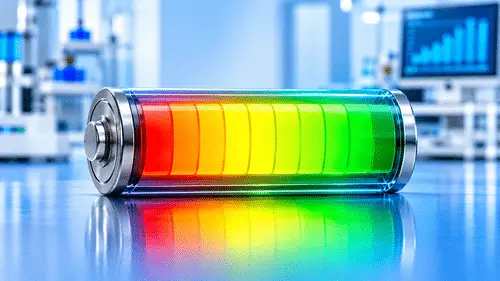
QuantumScape also reports that its cells operated at temperatures down to -20°C. The company hasn’t provided enough detail here to establish how charging speed, capacity retention or energy density change across that temperature range. The low-temperature result is therefore a reported operating point, not a complete performance map.

What the cycle test measured
In the company’s white paper, the 1,000-cycle result comes from two-layer unit cells tested at room temperature under one atmosphere of applied pressure. The cells were charged and discharged at a 1C rate, with 100% depth of discharge and cathode loading above 5mAh/cm². QuantumScape says the cells retained about 80% of their capacity at the end of the test.
Those conditions matter when comparing battery results. A 1C rate describes charging or discharging relative to the cell’s capacity, while 100% depth of discharge means the full tested capacity was used during each cycle. The stated pressure and cathode loading also help define the test configuration. Results from cells with different formats, loads, temperatures or cycling protocols may not be directly comparable.

The test supports a specific conclusion: these two-layer laboratory cells retained about four-fifths of their initial capacity after 1,000 complete cycles under the stated conditions. It doesn’t show that a larger cell, a production line or a complete vehicle pack will deliver the same retention. QuantumScape cautions that early test results may not carry over to commercial cell formats or manufacturing scale.
Cell architecture and the scale-up task
Osprey combines QuantumScape’s ceramic separator and anode-free lithium-metal approach with a solid cathode made from sulfides. The cell architecture is intended to support the company’s all-solid-state battery development. Its reported fast charging and cycle retention are encouraging laboratory outcomes, but translating them into production requires larger cell formats and manufacturing processes that can produce cells at higher throughput.
Scale-up can change how a cell performs. A small test cell and a larger-format design differ in dimensions and manufacturing demands, and the performance demonstrated in one configuration doesn’t by itself establish uniformity or repeatability in another. The next meaningful evidence will come from results that show how the architecture behaves as cell size and production volume increase.
QuantumScape describes Osprey as a licensing and co-development platform for battery manufacturers and carmakers, rather than a commercial battery product. The company says it is developing the technology with automotive partners. Cells based on its QSE platform are shipping to customers; Osprey is presented as a longer-term platform for all-solid-state battery development.
What remains to be demonstrated
The reported results haven’t been independently confirmed on commercial-scale cells or vehicle battery packs. QuantumScape hasn’t announced an Osprey production timeline or pricing details, and the company says significant engineering work remains before mass production. That leaves the headline figures as early test and projection data, rather than a basis for estimating a finished vehicle’s range, charging performance or service life.
For engineers assessing the platform, the key distinction is between what has been measured and what is still projected. The five-minute charge and 1,000-cycle retention are reported laboratory results under stated conditions; around 1,100 Wh/l is an expectation for a different, energy-focused design. Larger cells, repeatable higher-throughput manufacturing and validation at pack scale will determine how much of that performance carries into commercial applications. QuantumScape’s Osprey platform information provides further company detail.
 Addivate Adds ROBOZE ARGO 1000 HYPERMELT for Larger Polymer Parts
 AXT and Stärke-AMG Plan Adelaide SAF 3D Printing Capacity
 Fluke ii1050 and ii1030 Acoustic Imagers Add 202 Microphones for Industrial Inspections