Defender Downdraft Tables: Airflow, Filtration and Configuration Options
Clean Air Industries’ Defender tables draw welding fume and grinding dust down through the work surface, with airflow up to 9,000 CFM.
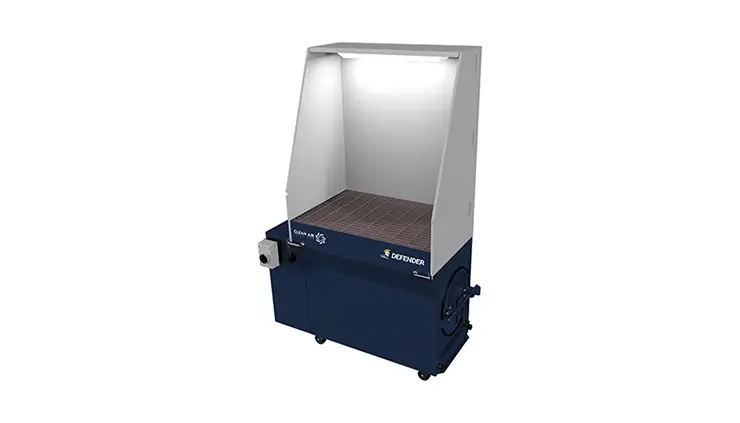
For welding and grinding work, a downdraft table captures airborne contaminants at the work surface and pulls them away from the operator’s breathing zone. Clean Air Industries’ Defender industrial series combines that source capture with cartridge filtration, pulsed filter cleaning and configurable work areas. The industrial models are offered in three sizes, with airflow ranging from 4,200 to 9,000 cubic feet per minute (CFM).
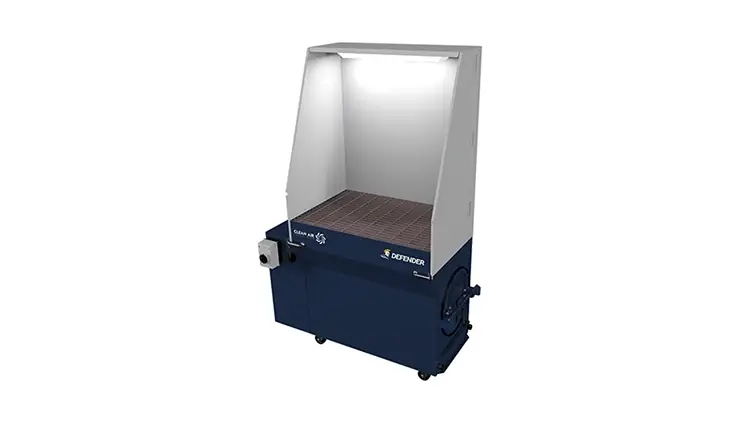
Capture at the work surface
The table draws fume and dust downward through its work surface. After filtration, the air is returned directly to the workshop, according to the manufacturer. Returning filtered air indoors can also help retain energy used for heating or air conditioning, though the practical effect will depend on the facility and its operating conditions.
Clean Air Industries describes the tables as providing consistent high airflow and uniform face velocity. Those characteristics matter because the capture pattern needs to cover the working area: airflow that varies across the surface may leave some contaminants less effectively drawn into the table. The available product information gives the industrial series’ overall airflow range but does not specify face velocity, filter efficiency or performance under particular welding and grinding conditions.
Three industrial sizes and system arrangements
The self-contained industrial tables come in 4×3, 4×6 and 4×9 configurations. The 4×9 model is listed with airflow up to 9,000 CFM; the company describes the range as suited to high-volume production. The choice between sizes is tied to the work area and the amount of airflow required, so the stated maximum alone does not establish which model fits a particular process.
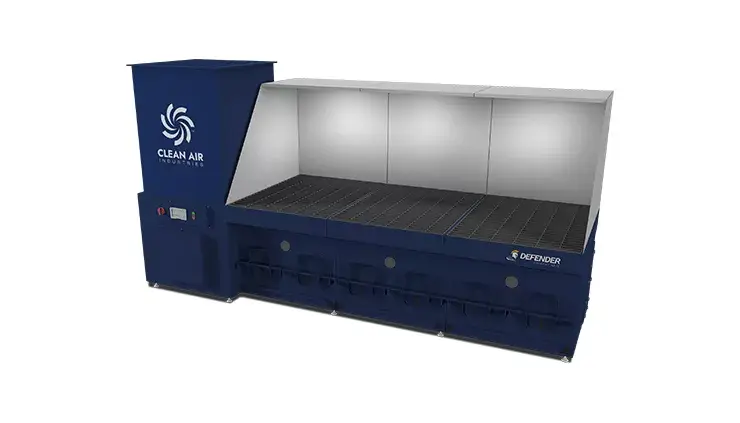
Clean Air Industries also offers a ducted version designed to connect with a dust collector system. The company presents it as a cost-effective option where several downdraft tables are needed. In that setup, the table becomes part of a larger collection arrangement, making system compatibility and the collector configuration relevant to selection.
A separate portable Defender product is listed in a standard 2×3 configuration with 1,200 CFM. That is a distinct product from the industrial series, whose stated airflow begins at 4,200 CFM. Keeping those ranges separate helps avoid treating the portable unit as one of the three industrial table sizes.
Filter access and pulse cleaning
Quick-release filter doors provide access for inspecting, rotating or replacing the cartridge filters. Inside the unit, a pulsed-air cleaning system dislodges dust from the filters and directs it into a dust drawer for removal. The drawer is positioned for access and cleaning, according to the manufacturer.
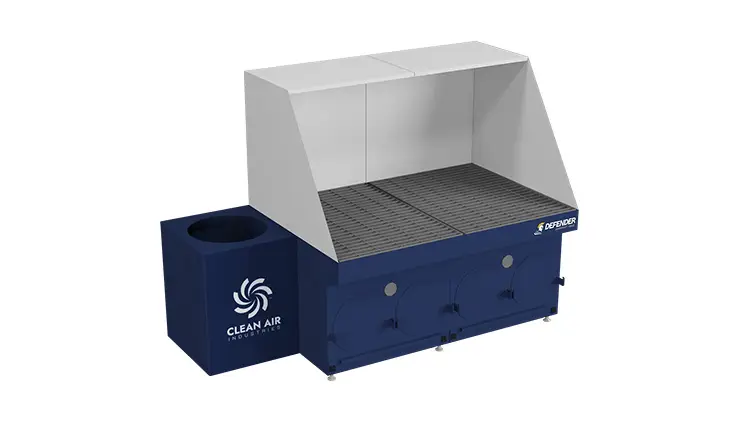
Pulse cleaning can reduce the need to remove filters for routine dust clearing, while accessible doors and a removable collection drawer support maintenance. The available details do not state cleaning intervals, filter service life or how performance changes as filters load. Those values would need to be established for the actual dust and operating schedule.
Spark control, sound and work-area options
The industrial tables include a multi-stage spark arrest system and an exhaust silencer. These features address two practical concerns in welding and grinding environments: sparks entering the filtration path and noise from the exhaust. The product description does not provide sound levels or specify the spark arrest system’s operating limits, so those details should be checked against the intended application.
Optional sidewalls, dividers and LED lighting let users configure the work area. Sidewalls help contain sparks and dust and guide airflow toward the table, as described by Clean Air Industries. Dividers can separate work positions, while lighting adds visibility at the surface.
For educational settings, the company describes sidewalls with dividers and viewing windows that allow several students to work at once while instructors retain a clear line of sight. That arrangement makes visibility and separation part of the table layout, alongside the basic capture function.
Matching a table to the work
Selection starts with the process, workpiece size and number of work positions, then moves to the table dimensions and airflow needed for the application. Facilities weighing a self-contained model against a ducted arrangement also need to consider how the table will fit into their dust collection system. The manufacturer offers application recommendations based on the facility’s needs; its published overview does not provide detailed sizing calculations or test conditions.
The Defender range puts source capture, filter access and work-area configuration into one equipment choice. For a specific installation, the useful next step is to confirm the required airflow, filtration arrangement and available options against the actual welding or grinding operation.
 AMD Venice Uses 2.5D Packaging to Feed More Bandwidth Into EPYC Zen 6
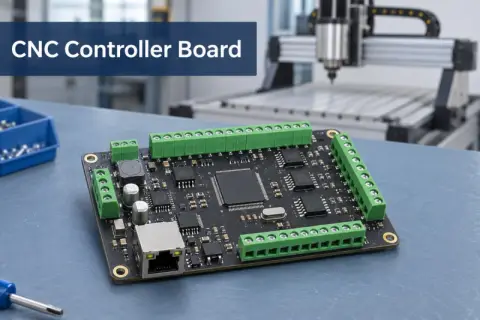 CNC Controller Board Design: Interfaces, PCB Specs and Assembly Testing
 Stratasys and Nano Dimension End $42.5 Million Markforged Sale Agreement