Nvidia Vera Server CPU Combines High Memory Bandwidth With Strong Per-Core Performance
Vera pairs a 1024-bit LPDDR5X interface with large shared cache, but cross-socket latency and total throughput remain workload dependent.
Nvidia Vera’s clearest strength is how it feeds each core: a wide memory interface delivers high bandwidth, while large private L2 caches and a shared L3 help keep more accesses on chip. The trade-off shows up elsewhere. Vera’s cross-socket latency is high, and a design with more than twice as many cores can still lead on workloads that use every thread.
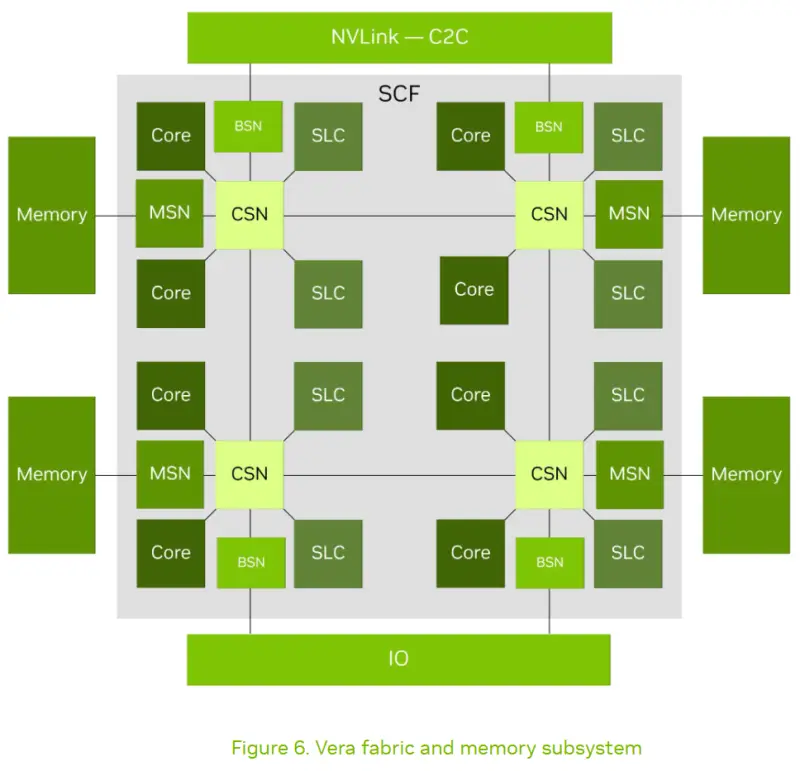
That balance starts with the Scalable Coherency Fabric (SCF), Nvidia’s second generation chip-wide interconnect. Like the mesh networks used in other server CPUs, SCF links the cores and caches to memory and peripheral I/O. Its Coherency Switch Nodes (CSNs) each host two cores and cache, a layout that limits the number of network nodes. Ampere’s Altra Max uses a comparable arrangement: each Arm CMN-600 request node connects to a DynamIQ Shared Unit containing two Neoverse N1 cores.
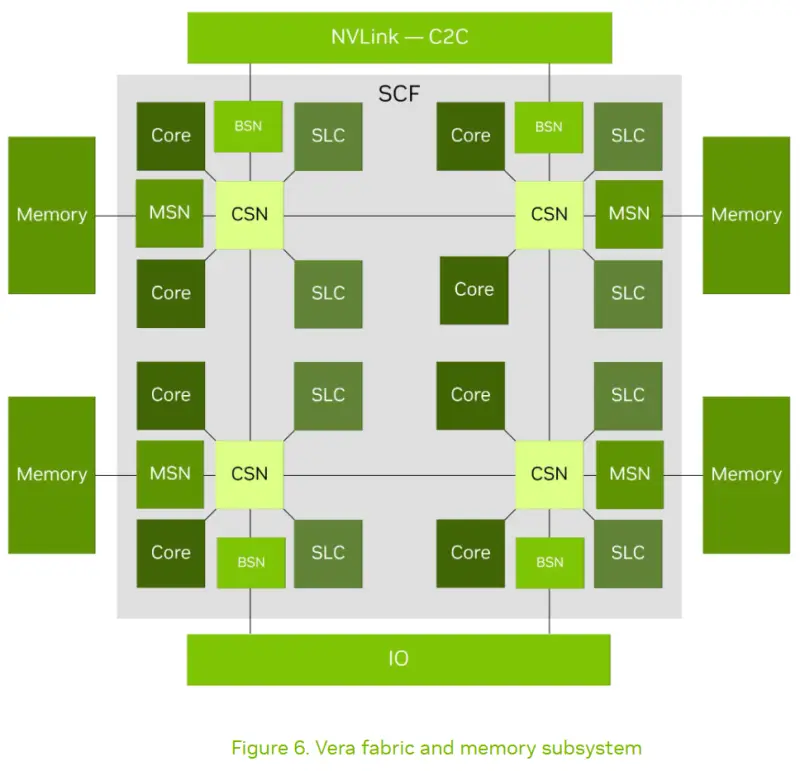
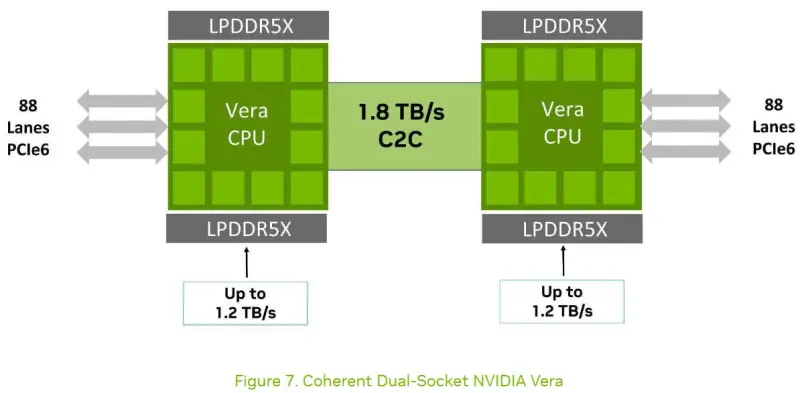
Memory Switch Nodes connect SCF to Vera’s LPDDR5X controllers. The 1024-bit LPDDR5X-9600 interface provides up to 1.228 TB/s of bandwidth. Bridge Switch Nodes connect PCIe and the socket link: Vera has 88 PCIe lanes, with a combined stated bandwidth of 665.5 GB/s, while NVLink C2C provides a theoretical 1.8 TB/s between sockets.

Memory bandwidth without a sharp latency penalty
Vera’s memory system marks a change from Grace. Grace used LPDDR5X, but its measured memory latency exceeded 200 ns, and its bandwidth trailed contemporary server designs using DDR5. Vera pairs its much wider interface with latency described as comparable to DDR5 systems. It also uses SOCAMM2 modules, making memory replaceable in the field and potentially upgradeable; Grace’s memory was soldered to the system.
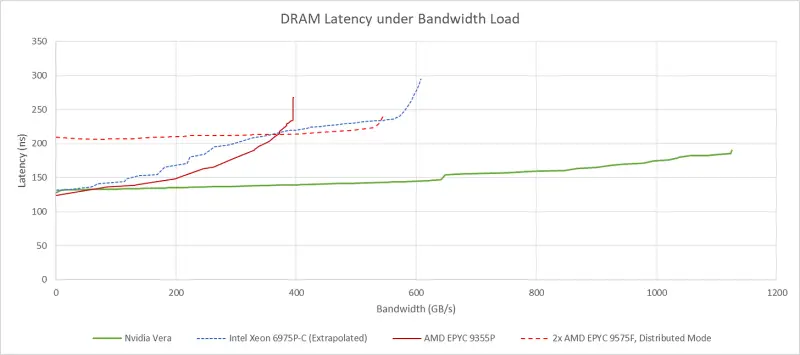
The more telling result is latency under load. In measurements using a pointer-chasing thread alongside other threads that push memory bandwidth toward its limit, Vera stays below 200 ns. Other server platforms in the comparison show latency climbing sharply as demand nears the memory controllers’ capacity. That steadier response could help limit interference between workloads sharing a server, and it gives Vera room to scale on memory-bound tasks even with fewer cores.
Shared cache trades per-core bandwidth for reach
Vera has a 164 MB L3 shared across its cores and private 2 MB L2 caches. The L3 is non-inclusive: it need not retain a copy of data that already resides in an L2. Where data isn’t duplicated among the private caches, the combined L2 and L3 capacity can reach 340 MB. Shared data can therefore occupy one L3 copy rather than taking space in multiple cache instances.
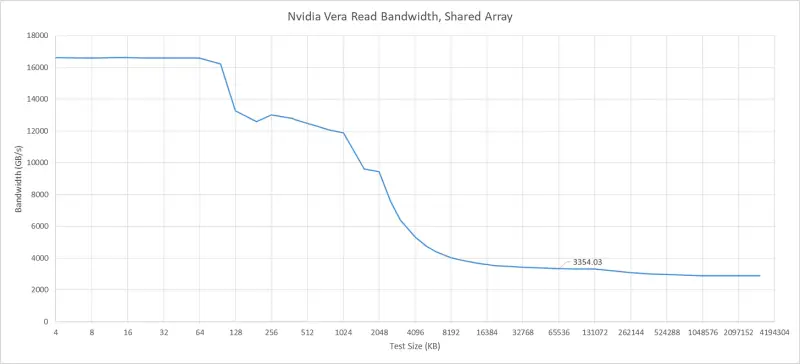
Measured L3 read bandwidth is about 3.35 TB/s across the chip, or 33.1 GB/s per core when averaged over the core count. A single core can reach 88.5 GB/s when it has no competition from other cores, so the shared rate is a substantial reduction. Still, each core’s 2 MB L2 can absorb accesses and reduce demand on L3.
AMD’s Genoa-X makes a different cache trade. Its L3 can supply a single core with 90 GB/s, declining to 85 GB/s when all cores in a die are active. Eight-core clusters keep each L3 instance’s workload bounded. Genoa-X also offers 1248 MB of combined L2 and L3, which can suit thread-private data or many separate jobs. When threads share data, though, copies across L3 instances can use capacity inefficiently. A thread on Genoa-X is limited to its 96 MB L3 instance; Vera can, in principle, use its entire 164 MB shared L3.
Fast socket link, costly remote access
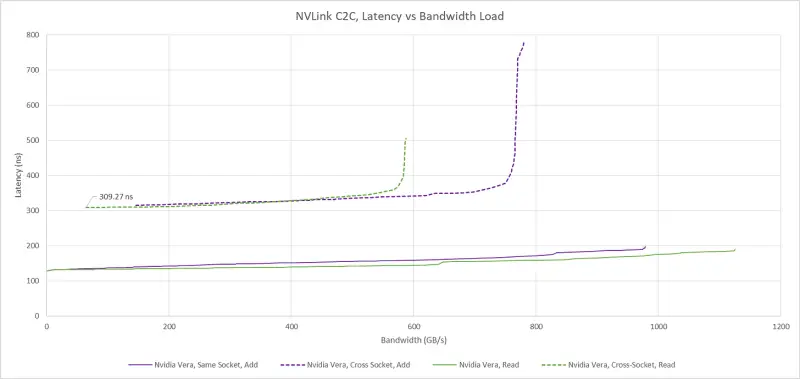
NVLink C2C connects Vera sockets in a two-socket system, where each socket and its attached memory form a separate NUMA node. A remote memory load takes 309.27 ns, 177.41 ns longer than a local load. That result comes with several dozen GB/s of link traffic. A pointer-chasing test run alone measures more than 370 ns, suggesting the link reaches a faster operating state when traffic builds up.
Once active, the link offers substantial throughput: reads exceed 587 GB/s, and a read-modify-write workload that transfers data in both directions reaches 780 GB/s. That is more bandwidth than most systems provide to directly attached memory. The cost is latency: remote access is slower than the 222.7 ns measured for AMD Genoa-X, and Vera’s link latency rises under heavy traffic. During the read-modify-write test, it reaches 780 ns at the same time the link delivers 780 GB/s.
Coherency is the bigger two-socket concern
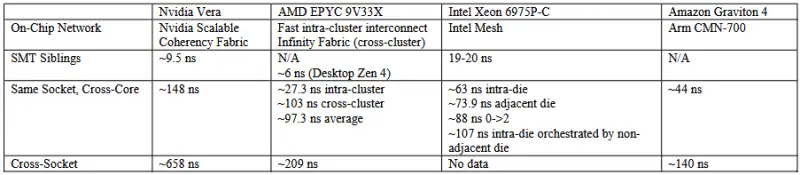
Coherent systems must make one core’s writes visible to other cores, including when the data remains in a private cache. A test that passes a value between threads with atomic operations measures an average of 148.5 ns between core pairs on the same socket. Results vary from 87.5 to 199.3 ns depending on the pair and which agent owns the cache line. Threads sharing a physical core through SMT communicate in under 10 ns.
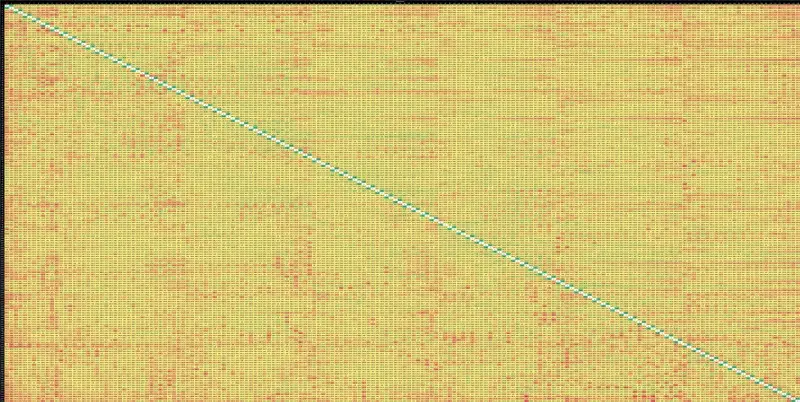
Across sockets, core-to-core latency is about 660 ns. That’s much higher than the roughly 209 ns measured on AMD’s Genoa-X (EPYC 9V33X); Amazon Graviton 4 also performs better, with latency comparable to older, lower-core-count designs. Vera’s within-socket results are consistent, as Nvidia describes, but average latency is still higher than on Grace, Graviton 4 and Genoa-X. Applications that frequently share data across cores or sockets may feel this cost more than tasks that stay close to their local memory.

Throughput depends on the workload
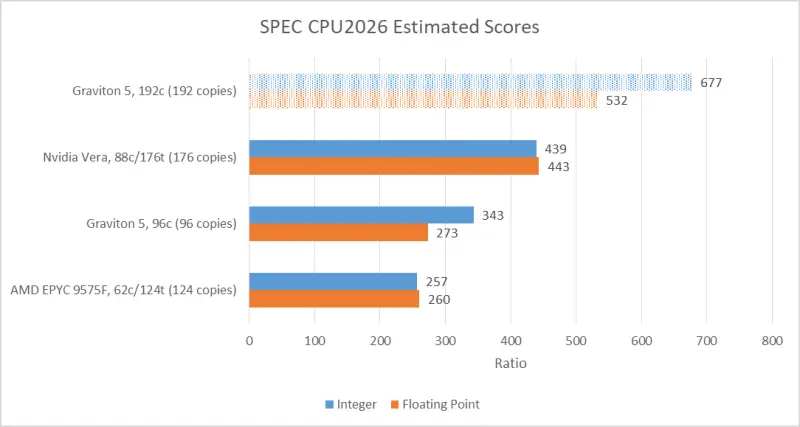
SPEC CPU2026 rate tests run multiple copies of each workload to measure throughput. With one copy per hardware thread, Vera beats Graviton 5 in a node-to-node comparison and also outperforms a lower-core-count Zen 5 system. In a socket-level comparison, however, Vera trails Graviton 5. The comparison has a limitation: Graviton 5 can’t expose the whole socket as one NUMA node. Even so, it highlights the familiar choice between stronger cores and a larger pool of less powerful cores. SMT narrows the gap, but it’s difficult for Vera to match a design with more than twice its core count when enough work exists to keep those cores busy.
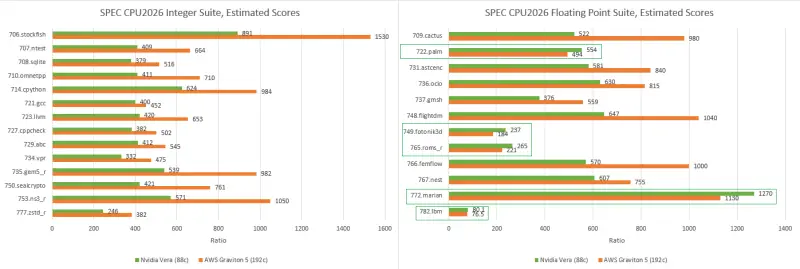
Memory-intensive tests shift the result. In 749.fotonik3d, a DRAM-heavy SPEC CPU2026 workload, Vera leads Graviton 5 by nearly 20% at the socket level despite its lower core count. The advantage also appears in several other floating-point tests. Graviton 5, by contrast, has a large lead in workloads that benefit more from cache capacity.
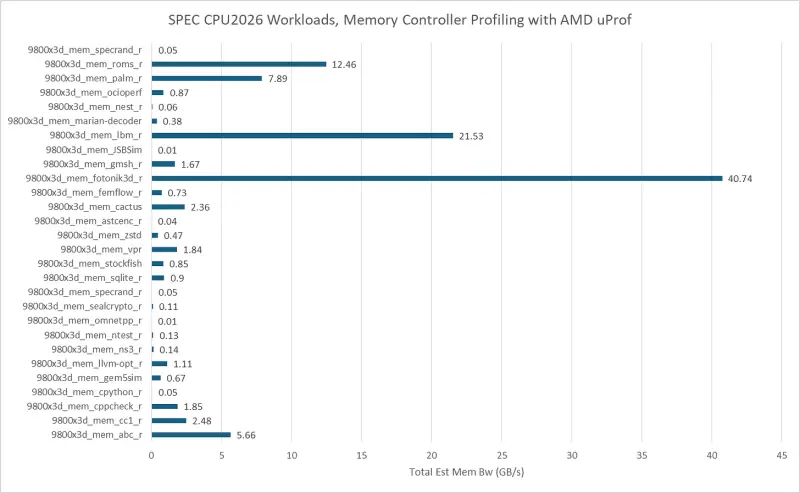
Vera looks strongest when individual threads need high performance and their workload can use its memory bandwidth. Its architecture gives a single thread access to a large shared cache and avoids the sharp rise in local memory latency seen on other platforms under load. For jobs that benefit chiefly from many cores or large cache capacity, its socket-level throughput may fall short. In dual-socket systems, the roughly 660 ns core-to-core figure also makes workload placement and cross-socket data sharing material design considerations.
 AMD Venice Uses 2.5D Packaging to Feed More Bandwidth Into EPYC Zen 6
 CNC Controller Board Design: Interfaces, PCB Specs and Assembly Testing
 Stratasys and Nano Dimension End $42.5 Million Markforged Sale Agreement