AMD Zen 6: Denser Cores, Wider Vector Throughput and Faster Recovery
AMD’s Mike Clark explains how Zen 6 balances higher throughput, core density and cache bandwidth, with Zen 6c tuned for performance at lower frequencies.
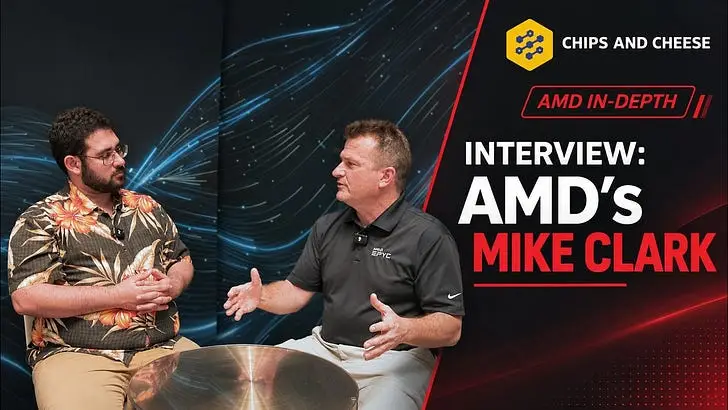
Zen 6 changes the role of AMD’s compact core. In earlier generations, the denser design mainly helped fit more cores into a given area. For Zen 6, AMD has also used that design to raise per-core performance: Zen 6c supports the full L3 allocation of 4MB per core, and the 32-core configuration totals 128MB. Mike Clark, AMD’s original Zen architect, described the dense core as the family’s highest-performance option by IPC, while the other design is now aimed at higher clock frequencies.
That distinction reflects a broader design goal: Zen 6 and Zen 6c should behave similarly enough that software teams don’t need separate optimizations for each. Their internal capacities differ where the lower frequency target gives Zen 6c room to grow. Clark said several queues are larger in the compact core, including the floating-point scheduler. The added capacity is intended to draw out more instructions per cycle and support performance in simultaneous multithreading workloads, while keeping the software-facing behavior aligned across the two designs.
Front-end delivery and scheduling
Zen 6 builds on Zen 5’s front end, which can fetch two basic blocks. That setup creates coordination work when a single thread draws instructions from both the instruction cache and the operation cache. AMD spent time refining that delivery path, Clark said, with the aim of reducing wasted power and keeping instructions moving more efficiently through the front end. The design work addresses how the sources are synchronized as well as how much the front end can deliver.
The integer execution layout also changed. Zen 5 had three integer multiply units, supported by a more unified scheduler. Clark said adding the third multiplier was straightforward in that arrangement, but AMD saw little performance gain from it. For Zen 6, the company returned to more distributed schedulers that dispatch work to the arithmetic logic units. With that structure, two multipliers offered a better area and scheduler trade-off.
The scheduler changes show why counting execution units alone doesn’t explain a core’s performance. A unit has to be fed efficiently, and its scheduler must route work without adding unnecessary complexity. AMD’s move back to two multipliers followed both the measured results from Zen 5 and the requirements of the new scheduling layout.
More vector work and wider loads
Zen 6 adds two vector neural network instruction (VNNI) units. Clark said AMD had long seen a role for CPU cores in AI tasks such as orchestration, data type manipulation and smaller models, even though a CPU core isn’t intended to outperform a graphics processor at that work. As inference use grew, the team decided to add more VNNI capacity. The change came late enough that the floor plan was already set, but AMD managed to fit in the extra units.
The load path also gets a wider operating mode. Zen 5 could move two vector loads at a time, despite having the wiring needed for more. Zen 6 can issue four loads when they are 128 or 256 bits wide, and Clark confirmed it can handle 256-bit loads. AMD already had 1,024 wires in place to support two 512-bit loads; splitting those connections into smaller transfers required additional design work. The Zen 6 team used that opportunity to enable the broader load arrangement.
Cache bandwidth has received attention too. Clark said Zen 5’s L2 could fall short of 64 bytes per cycle on reads when prefetches that hit in L2 competed with demand requests for bandwidth. Zen 6 is designed to sustain prefetch traffic alongside those requests, reducing conflicts and allowing the cache to deliver the full 64 bytes per cycle. The change matters because prefetching only helps when it doesn’t crowd out the data a core has already requested.
Branch recovery and larger cache layouts
AMD also worked to reduce the time needed to recover from a branch misprediction without sacrificing prediction accuracy. Clark described branch prediction as a search through design choices, including the number and organization of TAGE tables and the amount of information each stores. The team sought a more efficient arrangement rather than simply expanding the predictor. AMD also focused on shortening the pipeline’s restart path: unpredictable branches remain, so faster redirection to the front end can limit the resulting delay.
That recovery work has to fit within the core’s area and timing constraints. Clark said AMD’s branch prediction team explores many possible configurations, with AI tools also helping with optimization. The reported outcome is a predictor that recovers faster and is slightly more accurate than Zen 5’s. Those characteristics address different parts of the same problem: making better predictions reduces the number of wrong turns, while faster recovery reduces their cost when they happen.
Moving beyond the core, the 12-core and 32-core chiplet designs have different L3 topologies. Larger structures can increase physical distance, even when newer manufacturing technology helps them occupy less area. Clark said AMD uses design techniques within the L3 mesh to preserve bandwidth, though he did not disclose their details. Inside the cores, larger queues help tolerate the increased latency associated with those longer paths. The approach balances cache capacity and core count against the time needed to deliver data.
Memory bandwidth and what the measurements show
Clark said support for LPDDR5X in the Verano EPYC ecosystem did not substantially change the core design. At the core complex level, AMD focuses on bandwidth per core and on the connection between the chiplet and the I/O die. He cited 32-byte reads per SDP port and said the system was already provisioned for bandwidth with MRDIMMs. That left the choice of memory technology and related packaging elements with little effect on the core itself.
One early performance observation came from Zen 6c: George Cozma said it matched AMD’s fastest Zen 5 server CPU in SPECint 2026 despite running at a lower clock frequency. That result is a useful indication of the compact core’s throughput, although it doesn’t by itself establish performance across other workloads. In combination with the larger queues, full L3 allocation and additional vector capacity, it points to a Zen 6 family designed to make density serve performance as well as core count.
The practical question as Zen 6 systems arrive is how those design choices hold up across workloads with different instruction mixes, cache demands and memory access patterns. AMD’s description sets out the intended balance: Zen 6c uses its frequency headroom for more internal capacity, while both cores share a software-oriented design and improvements to instruction delivery, cache access and branch recovery.
 AMD Venice Uses 2.5D Packaging to Feed More Bandwidth Into EPYC Zen 6
 CNC Controller Board Design: Interfaces, PCB Specs and Assembly Testing
 Stratasys and Nano Dimension End $42.5 Million Markforged Sale Agreement